 Bellingham Roofing
 Two Shingles, Two Different Roofs
When homeowners in Bellingham ask us about re-roofing, the first fork in the road is almost always the same question: architectural shingles or 3-tab? Both are asphalt shingles, both come in a wide range of colors, and both will keep water out of your attic on day one. The difference shows up over years, not days — and in a climate like ours, with salt air rolling in off Bellingham Bay, driving rain for months at a stretch, and a moss season that never really ends, those differences matter more than they would in a drier part of the country.
This page breaks down how the two products are actually built, how each one tends to age here in Whatcom County, and what that means for your budget and your roof's real service life — not just the number printed on the shingle wrapper.
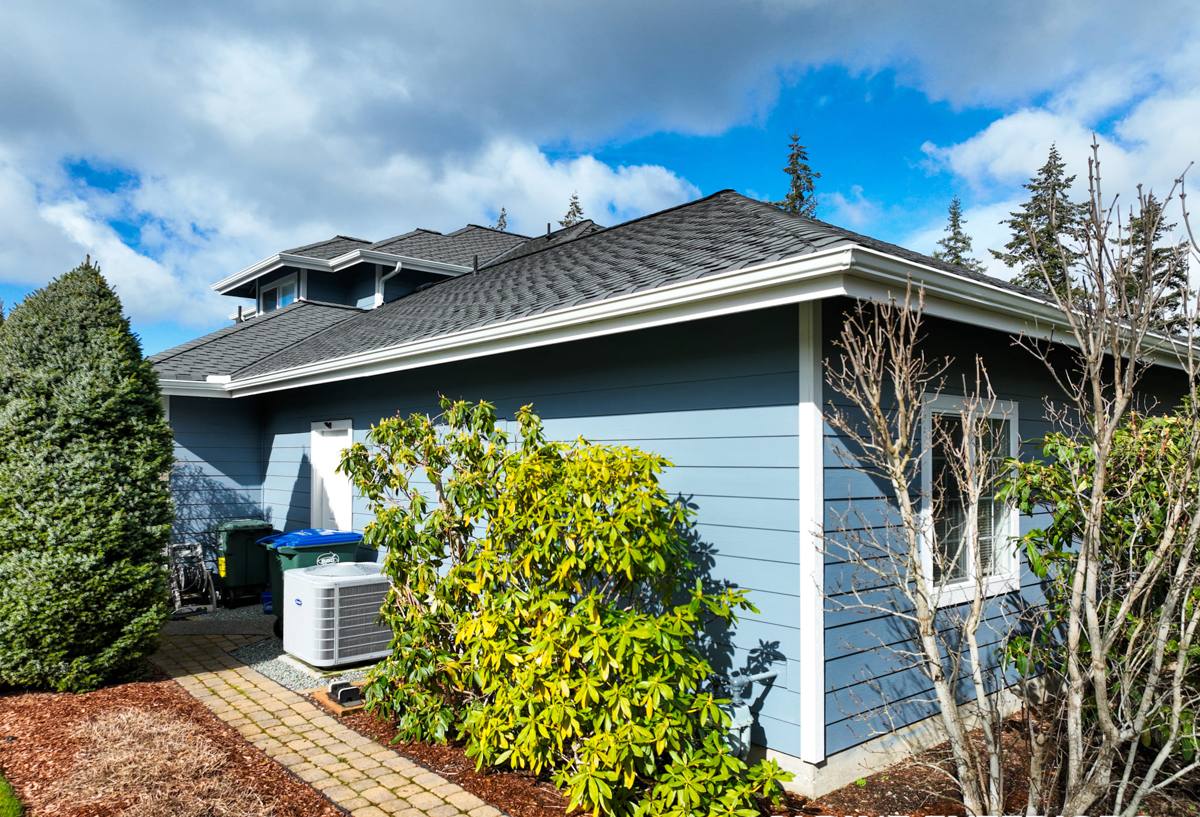
How They're Built
3-Tab Shingles
3-tab shingles are a single layer of asphalt-coated fiberglass, cut into three even tabs so the finished roof reads as a flat, uniform pattern. They're lightweight — typically somewhere around 220 to 240 pounds per square (100 square feet) — and every tab is the same thickness and the same shape. That uniformity is part of why they've historically been the lower-cost option: less material, faster installation, simpler manufacturing.
Architectural (Laminate) Shingles
Architectural shingles, sometimes called laminate or dimensional shingles, are built from two layers of material fused together, with a randomized tab pattern that creates shadow lines and a more dimensional, textured look. That second layer isn't just cosmetic — it roughly doubles the shingle's weight, typically in the 300 to 450 pound per square range depending on the manufacturer, and adds real thickness at the butt edge. More mass and more layers mean more material standing between the weather and your roof deck.
What Actually Wears Out a Shingle in Bellingham
Shingles here don't fail the way they do in a hot, dry climate. We don't see much UV-driven cracking or heat blistering. What we see instead is moisture-driven wear: granule loss from near-constant rain exposure, moss and algae taking hold in shaded or north-facing sections of roof, and the slow lifting of tab edges where wind-driven rain gets underneath a thinner shingle over repeated freeze-thaw cycles in the winter months. Salt-laden air off the water can also accelerate the breakdown of metal fasteners and flashing faster than it would further inland, which puts extra importance on how well a shingle system is fastened and sealed in the first place.
Why Thickness and Mass Matter Here
A thicker, heavier shingle simply has more material to lose before it's compromised. The extra layer in an architectural shingle also creates a stiffer, less flexible tab, which resists wind uplift better and holds its seal along the self-adhering strip more consistently through repeated wet-dry cycles. A 3-tab shingle's thinner profile isn't defective — it's just working with a smaller margin, and in a climate that stays wet as long as ours does, that margin gets tested constantly.
Moss and the Long Wet Season
Moss is the single biggest complaint we hear from homeowners across Whatcom County, and it doesn't discriminate much between shingle types — moss will grow on any organic roofing surface that stays damp and shaded long enough. But the way moss causes damage does differ. On a 3-tab roof, moss that takes hold at a tab edge can wedge itself under the thinner shingle and lift it, creating a path for water. On an architectural roof, the thicker profile and tighter nailing pattern give moss less of a foothold to work under, though it will still colonize the surface over time if the roof isn't maintained.
Neither shingle type is "moss-proof." Regular soft-washing, keeping overhanging branches trimmed back, and making sure valleys and gutters aren't holding standing water will do more for moss prevention than shingle choice alone — but the added thickness of an architectural shingle does buy you a bit more resistance to the physical lifting moss can cause.
Real-World Lifespan Comparison
| Factor | 3-Tab Shingles | Architectural Shingles |
|---|---|---|
| Typical manufacturer warranty | 20–25 years | 30 years to lifetime (limited) |
| Realistic service life in Bellingham's climate | 15–20 years | 25–30+ years |
| Wind rating (varies by manufacturer) | 60–70 mph | 110–130 mph |
| Resistance to moss lift/edge curling | Lower | Higher |
| Relative material cost per square | Lower | Moderate to higher |
| Curb appeal / dimensional look | Flat, uniform | Textured, shadow-line |
The warranty numbers are worth reading carefully — they describe the material's rated performance under lab conditions, not a guaranteed number of years on your specific roof. Steep pitches, heavy tree cover, and coastal exposure will always shorten real-world lifespan compared to the wrapper. That said, the gap between 3-tab and architectural warranties is a reasonably honest signal of how each product is engineered to hold up.
Wind and Storm Performance
Bellingham doesn't get hurricanes, but we do get sustained winter storms off the Sound with gusts that can pull at loose or aging shingle edges, especially on exposed or elevated lots. Because architectural shingles are heavier and use a wider, more aggressive sealant strip, they generally hold their wind rating better over time as the sealant ages. A 3-tab roof that's a decade old and has seen a few hard winters is more likely to have individual tabs lifting or missing after a windstorm than a comparably aged architectural roof.
What to Watch For After a Storm
- Tabs that are creased, lifted, or missing entirely, especially on the roof's windward side
- Granules collecting in gutters or at the base of downspouts
- Soft or discolored ceiling spots that show up a few days after heavy rain, not immediately
- Flashing around chimneys, skylights, or vent pipes that looks bent or pulled away
- Moss buildup concentrated at the north-facing slopes or valleys
Cost Considerations
3-tab shingles cost less per square, and installation labor is generally a bit faster since the product is lighter and simpler to lay. That upfront savings is real and, for a homeowner on a tight budget or working on a lower-slope secondary structure like a shed or detached garage, it can be a reasonable call. But when we walk clients through the math over a 25-to-30-year window, architectural shingles usually come out ahead on cost per year of service, simply because they tend to need replacing less often and hold up better to the wind and moisture conditions we get here.
The other factor worth mentioning: 3-tab shingles have become harder to find from major manufacturers in recent years, as most of the industry has shifted production toward architectural and premium lines. That's not a knock on the product — it's just changed the pricing and availability picture, and it's part of why we don't push 3-tab as a primary roofing material anymore except in specific budget-driven situations.
Appearance and Resale
Beyond performance, there's a straightforward curb-appeal difference. The flat, uniform look of 3-tab shingles reads as more basic or dated to a lot of buyers, while the shadow-line texture of architectural shingles gives a roof more depth and a higher-end appearance from the street. In a housing market where buyers and appraisers increasingly expect architectural shingles as the standard, re-roofing with 3-tab can occasionally raise questions during a home sale, even when the roof itself is sound.
Our Standard Recommendation
For most homes in Bellingham and around Whatcom County, we recommend architectural shingles as the default choice. The combination of driving rain, coastal air, and moss pressure means the extra thickness and wind resistance pay for themselves over the life of the roof. We'll still install 3-tab shingles when a homeowner has a specific budget constraint or the structure doesn't warrant a premium product — that's a legitimate call in some cases, and we're not going to talk anyone out of a decision that fits their situation. What we won't do is recommend 3-tab as a long-term primary roofing solution without being upfront about the tradeoffs above.
Questions Worth Asking Before You Decide
- What's the pitch and exposure of your roof — is it shaded, coastal-facing, or unusually steep?
- How long do you plan to stay in the home, and does resale value factor into the decision?
- What's your budget for this project versus your budget for maintenance over the next 15–20 years?
- Does your homeowners insurance offer any rate difference for a higher wind-rated shingle?
- Are you comparing manufacturer warranties side by side, not just sticker price?
If you're weighing architectural versus 3-tab shingles for a home in Bellingham or elsewhere in Whatcom County, we're happy to take a look at your specific roof and talk through what actually makes sense for your situation. Reach out for a free, no-pressure estimate — there's no obligation, and we'll give you a straight answer even if that answer is simpler than you expected.