 Bellingham Roofing
 The Part of the Roof Nobody Sees
When people think about a roof, they picture shingles. Shingles are what you see from the street, and they're what most homeowners judge a roofing job by. But shingles are only the outer skin. The real work of keeping water out of your home happens underneath, in layers most people never think about until something goes wrong: the underlayment, the flashing, and the details where the roof meets walls, chimneys, vents, and valleys.
In Bellingham and the rest of Whatcom County, this hidden layer matters more than in drier climates. We get long stretches of steady, driving rain off the Sound, salt-laden air near the water, and a moss season that can run most of the year on shaded, north-facing slopes. A roof here doesn't just need to shed water in a downpour — it needs to handle months of dampness sitting on the surface, wind-driven rain that pushes sideways under shingle edges, and moss that holds moisture against the roof deck long after a storm has passed. That's a different job than roofing in Arizona or even Seattle proper, and it's why what's underneath the shingles deserves as much attention as the shingles themselves.
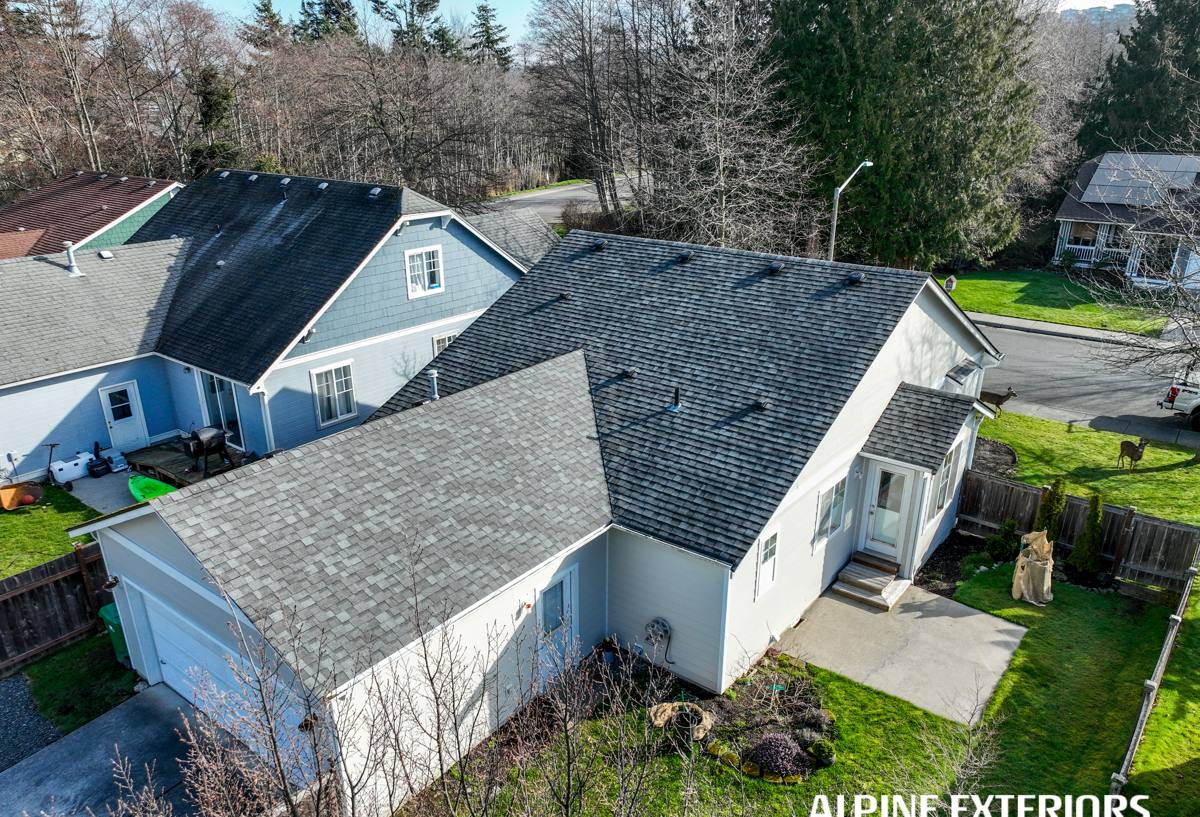
What Underlayment Actually Does
Underlayment is the water-resistant layer installed directly on the roof deck, before shingles go down. Think of it as the roof's backup system. Shingles are designed to shed the vast majority of water, but no shingle roof is 100% watertight in every condition — wind can lift edges, ice can back up at eaves, and over time granules wear and small gaps open. Underlayment is what catches water that gets past the shingles and directs it back out instead of into your attic or walls.
Types of Underlayment
- Asphalt-saturated felt (felt paper): The traditional option. Inexpensive and functional, but it can tear more easily during installation and absorbs some moisture over time.
- Synthetic underlayment: A woven or non-woven polymer sheet. More tear-resistant, lighter to handle, and generally more consistent in wet weather — a practical advantage on a job site in a place where you can't always count on a dry week.
- Self-adhering (peel-and-stick) membrane: Used in vulnerable spots — eaves, valleys, around penetrations — where it bonds directly to the deck and seals around fastener holes. This is the product doing the heaviest lifting against wind-driven rain and ice damming.
Our standard approach is synthetic underlayment across the field of the roof with self-adhering membrane at eaves, valleys, and other high-exposure areas. It costs more than felt alone, but given how much of the year Whatcom County roofs spend wet rather than dry, it's the combination that holds up best over the life of the roof.
Flashing: The Roof's Weak Points, Reinforced
If underlayment is the roof's backup layer, flashing is the patch job at every place the roof surface isn't continuous — chimneys, skylights, vent pipes, walls, dormers, and valleys where two roof planes meet. These transitions are where the vast majority of roof leaks actually start. A roof can go twenty years without a single shingle failing and still leak at a poorly flashed chimney within five.
Common Flashing Types
- Step flashing: Individual L-shaped metal pieces woven into the shingle courses where a roof meets a sidewall. Done right, each piece overlaps the one below it so water is always directed downhill and out, never into the wall.
- Valley flashing: Metal or membrane running down the seam where two roof slopes converge — one of the highest-volume water paths on the whole roof.
- Chimney flashing: A combination of base flashing, step flashing, and counter-flashing (which is set into the mortar joint) working together. This is one of the most failure-prone details on any roof if it's not built in layers.
- Pipe boot flashing: The rubber or metal collar around plumbing vent pipes. The rubber gaskets on these are usually the first thing to crack and dry out, often years before the surrounding shingles need attention.
- Drip edge: Metal flashing along the eaves and rakes that directs water off the roof edge into the gutter instead of behind it and into the fascia.
Flashing is metal (usually aluminum or galvanized steel) and it's meant to outlast at least one shingle cycle. Reusing old, dented, or corroded flashing to save money on a reroof is a false economy — it's a small material cost against the much larger cost of a leak repair two years later.
Why This Matters More in Bellingham
Three things about our climate put extra stress on flashing and underlayment specifically:
Driving Rain
Storms coming off the Strait and the Sound often bring rain sideways, not straight down. Wind-driven rain finds its way under shingle tabs and around flashing edges that would stay dry in a calmer climate. This is exactly the scenario self-adhering membrane and properly lapped step flashing are built for.
Salt Air
Homes closer to the water deal with airborne salt that accelerates corrosion on unprotected or lower-grade metal flashing and fasteners. It's worth using flashing and fastener materials rated for coastal exposure rather than the cheapest available metal, especially within a mile or two of the water.
Moss Season
Whatcom County's mild, damp climate is close to ideal for moss growth on shaded or north-facing roof slopes, and moss season here can stretch across most of the year. Moss doesn't just look bad — it holds moisture directly against the shingle surface and roof deck far longer than open air would. Over years, that constant dampness works against shingle granules, fasteners, and any weak point in the flashing or underlayment beneath it. Roofs with heavy, long-term moss buildup are disproportionately likely to develop leaks at their flashing details, simply because that's where sustained moisture finds the smallest gap.
Signs Your Flashing or Underlayment Needs Attention
Because these layers are hidden, problems often show up somewhere other than where the actual failure is. A stain on a ceiling below a chimney might trace back to a flashing gap several feet away, not a hole directly above the stain.
- Water stains on ceilings or walls, especially near chimneys, skylights, or where a roofline meets a wall
- Visible rust, gaps, or lifted edges on metal flashing around penetrations
- Cracked or shrunken rubber boots around plumbing vents
- Daylight visible through the roof deck from inside the attic
- Consistent moss buildup in valleys or along shaded slopes
- Granules collecting in gutters near flashing transitions, suggesting water is channeling improperly
Any one of these is worth a look before it becomes a deck repair. Flashing and underlayment problems are usually far cheaper to fix while they're isolated than after they've caused rot in the roof deck or framing underneath.
Comparing Underlayment Options
| Underlayment Type | Moisture Resistance | Durability | Best Use |
|---|---|---|---|
| Asphalt felt (15# or 30#) | Moderate | Lower — tears more easily, degrades faster when repeatedly wetted | Budget reroofs, low-slope exposure areas |
| Synthetic underlayment | Good | High — tear-resistant, handles wet job-site conditions well | Full roof field on most reroofs |
| Self-adhering membrane | Excellent — seals around fasteners | High | Eaves, valleys, low-slope sections, around penetrations |
What to Ask a Roofer About These Details
Because flashing and underlayment are invisible once the job is finished, this is an area where the difference between a careful contractor and a rushed one shows up years later, not on install day. A few honest questions can tell you a lot before work begins.
- Will old flashing be reused or replaced with new metal?
- What underlayment product is being used, and where does self-adhering membrane get installed specifically?
- How will chimney and sidewall flashing be built — step flashing woven into courses, or a shortcut method?
- What's the plan for existing moss or debris on the roof deck before underlayment goes down?
- Is drip edge included at both eaves and rakes?
A contractor who can answer these clearly, without hesitation, is one who treats these details as standard practice rather than an afterthought.
The Long-Term View
Shingles get replaced on a cycle — typically every 20 to 30 years depending on the material. Good flashing, if installed correctly with quality metal, can often outlast more than one shingle cycle. Underlayment is usually replaced alongside the shingles since it's built into the same job. Getting these layers right the first time isn't just about avoiding a leak next winter — it's about not having to open the roof back up for repairs between now and the next full reroof. In a climate that gives a roof this many wet months per year to find its weak points, that first installation quality carries a lot of weight.
If you're noticing a stain, some moss buildup, or you're just planning ahead for a reroof and want to understand what's actually happening under your shingles, we're happy to take a look. We offer free, no-pressure estimates and can walk you through exactly what condition your flashing and underlayment are in — use the form below to get started.