 Bellingham Roofing
 Why the Material Choice Matters More Here Than Elsewhere
Roofing material comparisons you find online are often written for a generic climate that doesn't exist in Whatcom County. Bellingham roofs deal with a specific combination of conditions: months of steady drizzle, driving rain that comes in sideways off the Strait, a shaded and humid environment that grows moss aggressively, and for homes closer to the water, a steady dose of salt air. Those four factors interact with roofing materials differently than they would in a dry inland climate, and that changes which product makes sense for a given house.
This page walks through how asphalt shingles and metal roofing actually perform under those conditions, where each one makes sense, and what to weigh beyond the sticker price. It's meant as a starting point for a conversation, not a sales pitch for one product over the other — both materials have a legitimate place on Bellingham roofs.
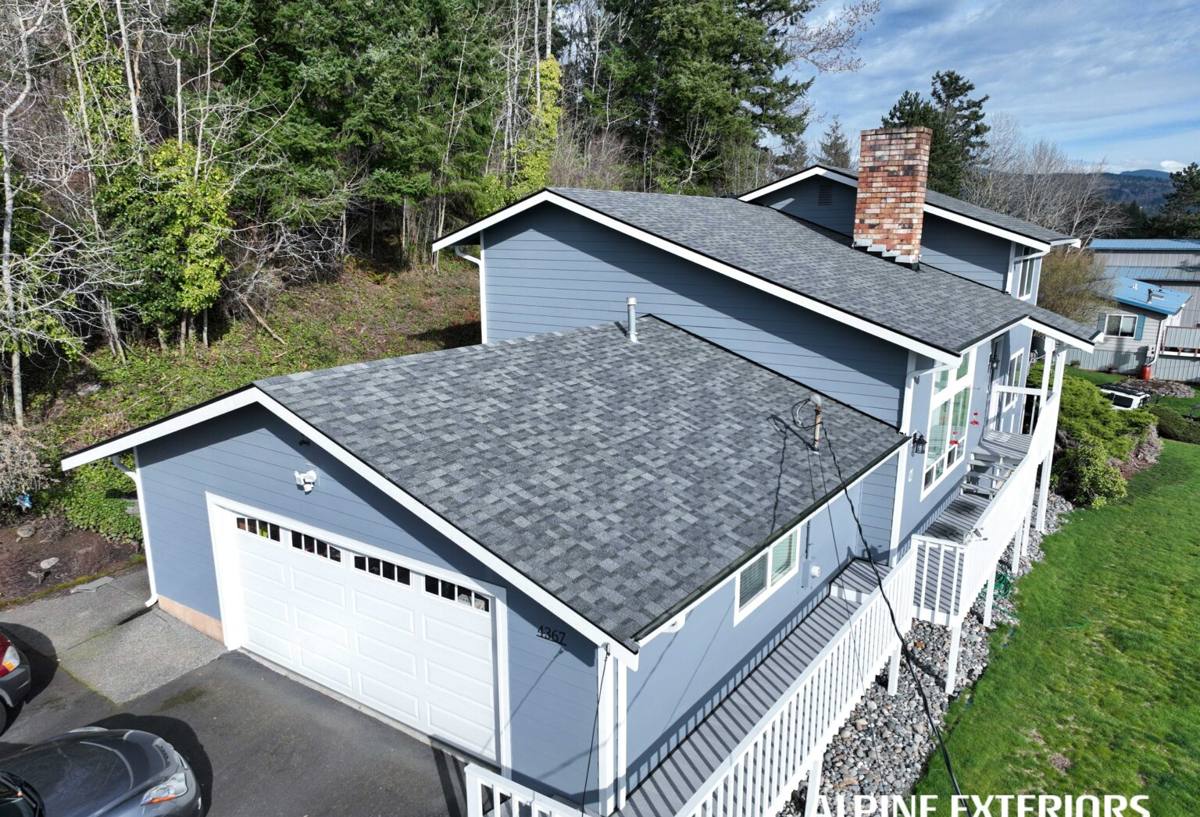
Asphalt Shingles: What They Offer
Asphalt shingles remain the most common roofing material in this region, and for good reason. They're straightforward to install, widely available, easy to repair in sections, and less expensive up front than most alternatives. Modern architectural (dimensional) shingles hold up reasonably well in the Pacific Northwest when installed correctly, with attention paid to underlayment, ventilation, and flashing details.
Where Asphalt Struggles Locally
The trade-off shows up over time. Asphalt is a porous, granulated material, and in a climate where roofs stay damp for weeks at a stretch, that surface texture gives moss spores something to grab onto. Once moss establishes itself, its root structure works into the shingle mat and can lift edges, trap moisture underneath, and shorten the roof's usable life if left unmanaged. Asphalt shingles also degrade faster under constant moisture cycling than they do in drier climates — the freeze-thaw swings we get in Whatcom County aren't extreme, but the sheer number of wet days per year adds up.
Metal Roofing: What It Offers
Metal roofing — whether standing seam panels or metal shingles — sheds water fast and gives moss and moisture far less to hold onto than a granulated asphalt surface. That's a real advantage in a climate where roofs rarely get a chance to fully dry out between storms. Metal also handles driving, wind-blown rain well because of how the panels interlock, and a properly installed system has a long service life with comparatively little maintenance.
Where Metal Requires More Care
Metal isn't maintenance-free everywhere. Coastal salt air is corrosive to lower-quality or poorly coated metal, so panel selection and finish matter more the closer a home sits to the water. Installation is also less forgiving than asphalt — panel spacing, fastener choice, and flashing at penetrations all need to be right the first time, because mistakes are harder to correct after the fact than swapping a shingle. And metal costs more upfront, which is the main reason it isn't the default choice for every home.
Head-to-Head Comparison
| Factor | Asphalt Shingles | Metal Roofing |
|---|---|---|
| Upfront cost | Lower | Higher |
| Typical lifespan (well-maintained) | 20-30 years | 40-60+ years |
| Moss resistance | Lower — porous surface, needs regular cleaning | Higher — smooth surface sheds debris and moisture |
| Performance in driving rain | Good with proper underlayment | Very good — interlocking panels shed water fast |
| Coastal/salt air durability | Not significantly affected by salt | Depends heavily on coating and panel quality |
| Installation sensitivity | Lower — more forgiving, easier repairs | Higher — precision matters, repairs are specialized |
| Noise in heavy rain | Minimal, especially over solid decking | Noticeable unless insulated/decked properly |
Moss and the Long Wet Season
Moss is probably the single biggest maintenance issue for roofs in this part of Washington, and it doesn't discriminate much by material — it's a bigger problem for asphalt, but it can still accumulate in valleys, around vents, and on north-facing metal sections that stay shaded and damp. What changes is how much moss actually damages the roof underneath it. On asphalt, moss growth left unaddressed for a season or two can start lifting granules and shingle edges. On metal, moss tends to sit on the surface without working into the material itself, so the main risk is trapped moisture at seams or fasteners rather than material breakdown.
Either way, moss control isn't optional here — it's a routine part of roof ownership. Homes under tree cover or on the shadier, north-facing slopes common around Bellingham neighborhoods will see moss return faster regardless of material, and should plan on more frequent inspection.
Salt Air and Coastal Exposure
For homes closer to Bellingham Bay or other shoreline areas of Whatcom County, salt air is a factor that a lot of general roofing advice ignores entirely. Salt-laden moisture accelerates corrosion on unprotected or poorly coated metal, particularly at cut edges, fasteners, and dissimilar-metal contact points where galvanic corrosion can start. This doesn't mean metal is a bad choice near the water — it means the coating system and panel quality matter more, and cutting corners on either is where problems start. Asphalt shingles aren't immune to coastal conditions either; wind-driven salt spray combined with constant dampness can accelerate wear at exposed edges and around flashing.
The practical takeaway is that proximity to the water should be part of the material conversation, not an afterthought. A roof three miles inland and a roof facing the bay directly are dealing with meaningfully different exposure.
Cost Factors Worth Weighing Beyond the Estimate
The upfront number on a quote only tells part of the story. A few things worth factoring in before deciding purely on initial price:
- Maintenance frequency: asphalt generally needs moss treatment and gutter/valley cleaning more often, which adds up in labor cost over the life of the roof.
- Underlayment and decking condition: both materials depend on what's underneath — if the decking or underlayment needs replacing, that cost applies regardless of which surface material you choose.
- Insurance and resale considerations: some homeowners find metal roofing affects insurance premiums or resale positioning differently than asphalt; that's worth a direct conversation with your insurer, not an assumption.
- Warranty structure: manufacturer warranties differ significantly between products and even between product lines from the same manufacturer — read what's actually covered, including labor and material separately.
- Repairability: asphalt is generally cheaper and faster to repair in isolated spots; metal repairs typically require matching panel profiles and finish, which can take more lead time.
Installation Quality Matters More Than the Product Choice
A well-installed asphalt roof will consistently outperform a poorly installed metal roof, and vice versa. The details that matter most — correct underlayment for our rainfall volumes, proper ventilation to prevent trapped moisture in the attic, ice-and-water shield at eaves and valleys, and flashing that's actually sealed rather than just caulked — apply to both materials and are where roofs most commonly fail early. Any material comparison that skips installation quality is incomplete. Our standard on any roof we install, metal or asphalt, is that flashing, ventilation, and underlayment get the same level of attention regardless of which surface product sits on top.
A Practical Pre-Decision Checklist
- How close is the home to shoreline or open water exposure?
- How much tree cover or shade does the roof get, and how bad has moss been historically?
- What's the current condition of the decking and underlayment?
- What's the realistic timeline you plan to stay in the home — 10 years or 30?
- How much ongoing maintenance are you willing to commit to?
- Does your homeowners insurance treat metal and asphalt differently?
Which Homes Tend to Fit Which Material
There's no universal right answer, but some patterns hold up. Homes under heavy tree cover with a long track record of moss problems often benefit from metal's smoother, harder-to-colonize surface, provided the budget supports it. Homes closer to the water benefit from metal only when paired with the right coating and fastener specification — otherwise the salt exposure works against the material's main advantage. Homes on a tighter renovation budget, or where the roof is one piece of a larger project, often do well with a properly installed architectural asphalt shingle system paired with a realistic moss-maintenance routine. Neither material is the "correct" choice in the abstract — it depends on the specific house, its exposure, and how the owner wants to spend their maintenance time versus their upfront budget.
If you're weighing metal against asphalt for a home in Bellingham or elsewhere in Whatcom County, we're happy to take a look at the roof in person and walk through what actually makes sense for your exposure, tree cover, and budget. There's no pressure and no obligation — just a straight assessment, and a free estimate below.