 Bellingham Roofing
 Composite Decking Built for Birch Bay's Coastal Conditions
Birch Bay sits close enough to the water that homes here deal with a different set of stresses than decks just a few miles inland in Bellingham. Salt-laden air, near-constant winter rain, and a moss season that can run from October well into spring all work against a deck's surface, fasteners, and substructure. Composite decking has become the go-to material for homeowners in this stretch of Whatcom County precisely because it holds up to that combination better than wood, but only when it's specified and installed correctly for the environment it's actually sitting in.
We treat a Birch Bay composite deck as a coastal build, not a generic backyard project. That distinction shows up in the fasteners we choose, how we frame the substructure, how we handle drainage, and how we set board gaps. None of that is visible once the job is finished, which is exactly why it matters — it's the part of the deck that determines whether you're calling us back in three years or enjoying a low-maintenance deck for two decades.
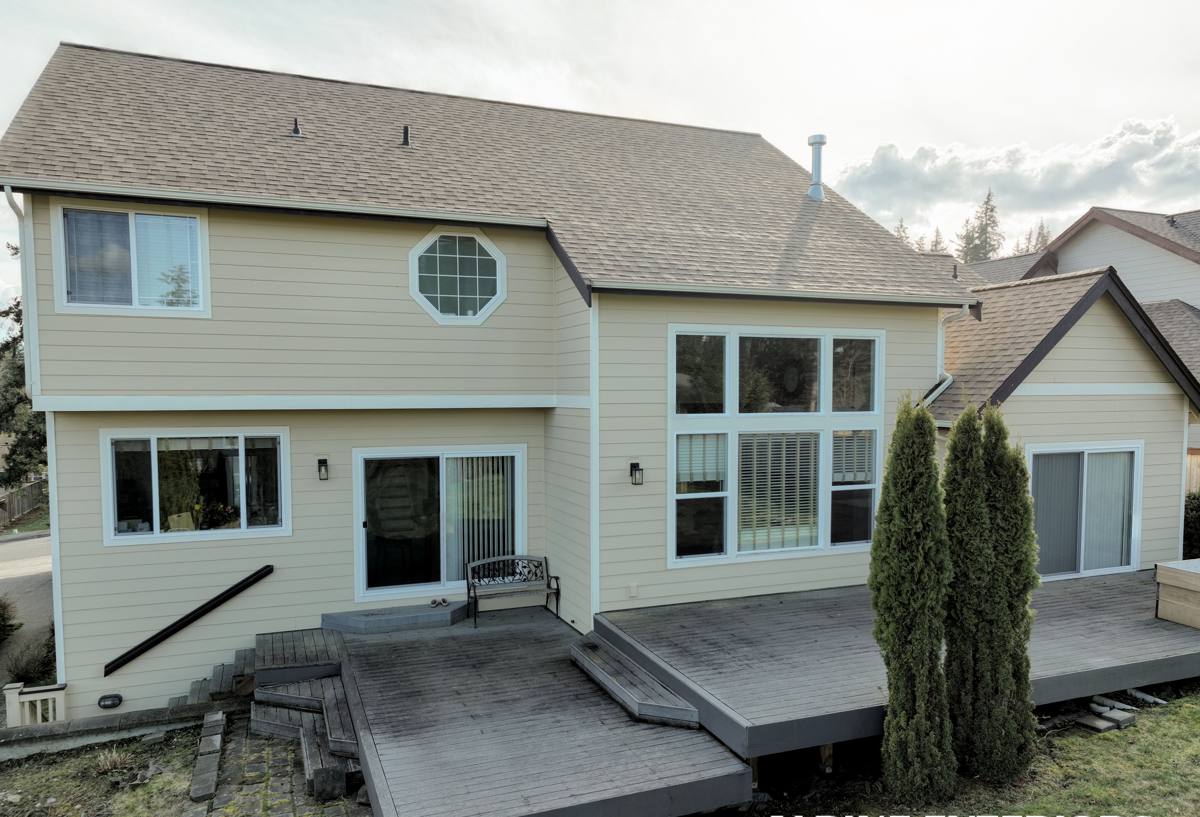
What Birch Bay's Climate Actually Does to a Deck
Three things define decking conditions in this part of the county, and each one attacks a deck differently.
Salt Air
Proximity to Birch Bay and the broader Salish Sea means airborne salt settles on every exterior surface, including deck hardware. Standard steel fasteners and connectors corrode faster here than they would in a landlocked Whatcom County neighborhood. Once a fastener starts rusting, it can streak the decking surface and eventually lose holding strength.
Driving Rain
Wind off the water frequently pushes rain sideways rather than straight down, which means water gets driven into gaps, against ledger boards, and up under rail posts in ways a calm-weather deck design doesn't anticipate. A deck that isn't detailed for driving rain will trap moisture in places you can't see until rot or corrosion is already established.
Moss and Sustained Dampness
Long stretches of overcast, damp weather let moss and algae establish themselves on any surface that stays wet and shaded. On wood decking this leads to slick, degrading surfaces. On composite, the risk is smaller but not zero — moss can still grow in board grooves, fastener heads, and anywhere debris collects, particularly on the shadier north side of a house.
Why Composite Makes Sense Here
Composite decking is a blend of wood fibers and recycled plastics, capped in most modern products with a protective outer layer. For Birch Bay specifically, that construction offers real advantages over wood:
- It doesn't absorb moisture the way wood does, which matters when a deck is exposed to driving rain most of the year
- It doesn't need annual staining or sealing, which is a maintenance task that's easy to fall behind on during a wet Whatcom County winter
- It resists splintering and surface checking that wood develops as it repeatedly wets and dries
- Its color and texture are baked in, so it doesn't gray or fade the way an unmaintained wood deck does within a couple of seasons near salt air
Composite isn't maintenance-free, and we won't tell a homeowner otherwise. It still needs periodic washing to keep moss and salt film from building up, and the substructure underneath it — whatever the surface material — is still wood or metal that needs to be protected. The value of composite in this location is that it removes the surface-level upkeep that wood demands, while shifting the real work to getting the build underneath it right.
What a Correct Installation Involves
Substructure and Fasteners
The frame underneath the decking takes the brunt of moisture exposure over time. We use fasteners and structural connectors rated for coastal or high-corrosion environments rather than standard-grade hardware, because the cost difference is small relative to what it costs to fix a corroded ledger connection or joist hanger a few years down the road. Joists that will sit under composite boards get protected from trapped moisture rather than left as bare, exposed wood.
Ledger Attachment and Flashing
Where the deck attaches to the house is the single most common point of moisture failure on any deck, and it's even less forgiving in a driving-rain environment like Birch Bay. Proper flashing at the ledger board keeps wind-driven water from working its way behind the siding and into the house framing — a problem that can go unnoticed for years because it's hidden behind the deck itself.
Drainage and Airflow
Composite decking needs consistent airflow underneath it to dry out after rain and to keep moss and mildew from establishing in shaded, damp pockets. We grade and detail the substructure so water moves away from the house and off the site instead of pooling under the deck, and we keep the underside ventilated rather than closed in.
Board Spacing and Fastening
Composite boards expand and contract with temperature and moisture more than most homeowners expect. Gaps that are too tight can buckle in a wet winter; gaps that are too wide collect debris and moss. We follow manufacturer spacing specifications and use hidden fastening systems designed for the specific composite product, rather than face-screwing boards the way older wood decks were built.
Composite vs. Other Decking Materials for This Location
| Factor | Composite Decking | Pressure-Treated Wood | Cedar |
|---|---|---|---|
| Moisture resistance near salt air | Strong — capped boards resist absorption | Moderate — needs regular sealing to keep pace | Moderate — naturally rot-resistant but still absorbs water |
| Maintenance in a wet climate | Periodic washing only | Annual sealing/staining recommended | Annual staining recommended |
| Moss/algae resistance | Good, especially on shaded sides with cleaning | Poor without regular treatment | Fair |
| Upfront cost | Higher material cost | Lowest material cost | Mid-range |
| Long-term cost over 15-20 years | Lower once maintenance is factored in | Higher due to repeated sealing/replacement | Higher due to repeated sealing/replacement |
Wood decks can absolutely work in Birch Bay when the homeowner is committed to a real maintenance schedule. Where we see wood decks struggle here is when that schedule slips for even a year or two — the coastal exposure doesn't leave much margin for deferred maintenance the way an inland deck might.
Our Process for a Birch Bay Composite Deck
- On-site evaluation — we look at sun and wind exposure, existing drainage patterns, ledger attachment points, and how close the deck sits to salt air and prevailing weather
- Substructure design — framing layout, joist spacing, and fastener selection are specified for the site's actual exposure, not a generic default
- Flashing and moisture detailing — ledger flashing, drainage paths, and ventilation are built in before a single composite board goes down
- Composite installation — boards are laid with manufacturer-specified spacing and hidden fastening, with attention to how each board will handle wind-driven rain and shaded, damp areas
- Rail and edge detailing — post bases, stair stringers, and rail connections get the same corrosion-resistant hardware as the deck frame
- Final walkthrough — we go over the maintenance a composite deck actually needs in this climate, so there are no surprises
Maintaining a Composite Deck in Birch Bay
Composite decking's low-maintenance reputation is earned, but "low" isn't "none," especially this close to the water. A simple seasonal routine keeps a composite deck performing the way it's supposed to:
- Rinse or wash the surface periodically to remove salt film, pollen, and organic debris before it builds up
- Sweep leaves and debris out of board grooves and corners, especially in shaded areas prone to moss
- Check that gaps between boards and around the perimeter haven't become clogged, which restricts drainage and airflow
- Inspect visible fasteners, post bases, and stair connections once a year for early signs of corrosion
- Trim back vegetation that shades the deck and keeps it damp longer than necessary
Why Hire a Crew That Already Works Birch Bay
A lot of decking problems we get called to fix aren't failures of the composite product itself — they're the result of a build that didn't account for where it was actually located. A crew that hasn't worked this specific stretch of coastline may not think to upgrade fasteners for salt exposure, detail flashing for driving rain, or plan drainage for a shaded, damp lot. Those aren't exotic requirements, but they only get addressed when the builder is used to thinking about them by default.
We work throughout Bellingham and Whatcom County, and Birch Bay's coastal conditions are a regular part of that work, not an exception. That familiarity shows up in the small decisions made before the first board is installed — decisions that don't show up on a spec sheet but do show up in how the deck holds up ten years from now.
If you're planning a new composite deck or replacing an aging wood deck in Birch Bay, we're happy to walk the site with you and talk through what your specific lot and exposure call for. There's no pressure and no cost to get an estimate — the form below will get you started.