 Bellingham Roofing
 Roofing and Exterior Work for the York Area of Bellingham
Homes in and around York deal with the same weather every property in Whatcom County deals with — but the details matter. Proximity to Bellingham Bay means salt-laden air works on metal fasteners, flashing, and exposed hardware year-round. Long stretches of driving rain off the Sound push water sideways into places roofs and siding were never designed to shed it fast. And our extended damp season, especially under mature tree cover common in older Bellingham neighborhoods, means moss and algae get a running start every fall and don't let go until late spring. None of that is unique to any one street, but it adds up differently depending on a home's age, orientation, and how well its last roof or siding job accounted for it.
We're a Bellingham-based crew that works this area regularly, which means we're not guessing at what a York-area roof or wall assembly is up against. We handle roofing, siding, windows, and decks, and we look at all four as connected systems — because on a coastal Pacific Northwest home, they usually are. A roof leak often shows up first as a stained soffit or a soft spot in siding. A failing deck ledger connection can trace back to the same flashing mistakes that cause roof leaks. Treating these as one envelope, rather than four separate trades, is how problems actually get found and fixed instead of just patched.
What the Local Climate Actually Does to a House
Salt Air and Corrosion
Homes closer to the water see faster corrosion on exposed metal — roofing nails, flashing edges, gutter hangers, and deck hardware all age quicker here than they would fifty miles inland. This doesn't mean every material fails; it means fastener choice and flashing detail matter more here than in a lot of the country. We favor corrosion-resistant fasteners and flashing metals suited to coastal exposure, and we'll tell you plainly when a cheaper option is likely to cost more in five years than it saves today.
Driving Rain and Wind-Driven Moisture
Rain that falls straight down is easy to shed. Rain that comes in sideways during a Sound storm finds every gap in siding laps, window flashing, and roof-to-wall transitions. Most of the water damage we find in older homes isn't from a single dramatic leak — it's from years of wind-driven moisture working into small gaps that were never properly flashed in the first place.
Moss, Algae, and Shade
Whatcom County's tree cover is part of what makes these neighborhoods pleasant to live in, and part of what makes moss such a persistent problem on north-facing roof slopes and shaded siding. Moss holds moisture against roofing material long after the rest of the roof has dried out, which shortens shingle life and can lift edges enough for water to get underneath. It's manageable, but it needs to be managed on purpose — not just power-washed once and forgotten.
Roofing: What We Actually Look At
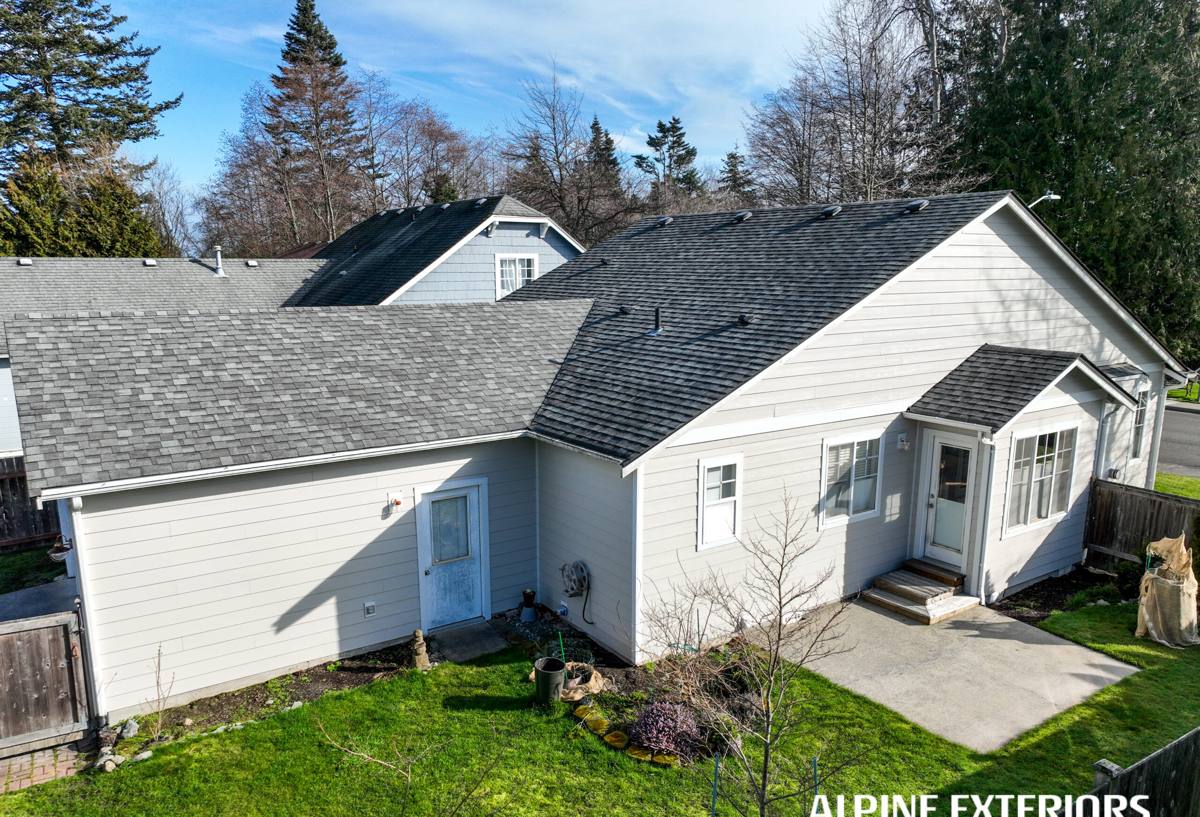
A roof inspection here isn't just "how do the shingles look." We check flashing at every roof-to-wall intersection, valley condition, ventilation (a poorly ventilated attic traps moisture and accelerates moss and rot from underneath), gutter and downspout function, and how water moves off the roof and away from the foundation and siding below. On a lot of Bellingham-area homes, especially those with additions or multiple roof lines, the intersections are where problems start — not the open field of the roof itself.
Roofing Materials We Work With
- Asphalt composition shingles — the most common choice locally, good value, wide range of quality tiers
- Standing seam and other metal roofing — strong performance against wind-driven rain, longer lifespan, higher upfront cost
- Cedar shake/shingle — traditional look for older PNW homes, requires more maintenance attention in our moss-prone climate
- Flat or low-slope roofing (membrane systems) — common on additions, garages, and some modern builds
We'll walk you through the honest trade-offs for your specific roof rather than pushing one system as the answer for everyone. A steep, shaded, north-facing roof has different priorities than a sunny, open one, even on the same street.
Siding: Matching the Product to the Exposure
Siding takes a beating from the same wind-driven rain that affects roofs, plus UV exposure on sun-facing walls and moisture retention on shaded ones. We work with fiber cement, engineered wood, vinyl, and traditional wood siding, and the right choice depends on your home's exposure, your maintenance appetite, and your budget.
Where we're cautious is around products that look good on day one but have a track record of moisture problems in wet climates when installation details aren't followed exactly — certain engineered wood products, for instance, are only as good as their caulking, flashing, and ongoing paint maintenance. That's not a knock on the material; it's a statement about installation sensitivity and long-term upkeep, and it's why we walk clients through what a given product will actually ask of them over 10-15 years, not just how it looks going in.
| Siding Type | Upfront Cost | Maintenance | Best Fit |
|---|---|---|---|
| Fiber cement | Mid-high | Low-moderate, repaint every 10-15 yrs | Most exposures, good moisture resistance |
| Vinyl | Low-mid | Low, occasional washing | Budget-conscious, low-maintenance priority |
| Engineered wood | Mid | Moderate, installation-sensitive | Homes wanting a wood look with lower cost than cedar |
| Cedar/wood | Mid-high | High, regular staining/sealing | Traditional look, owners who will maintain it |
Windows: Sealing Out Wind-Driven Rain
Old, single-pane, or poorly flashed windows are one of the most common sources of both moisture intrusion and energy loss in older Bellingham-area homes. Window replacement isn't just about comfort and heating bills — it's about getting proper flashing integration with the surrounding siding so wind-driven rain doesn't track behind the window frame and into the wall cavity. We pay close attention to this integration because a window installed without correct flashing can cause hidden rot that isn't visible until siding comes off years later.
Decks: Built for Wet Ground and Wet Weather
Decks here face two challenges: constant moisture exposure and, depending on the lot, damp or poorly draining ground beneath. Ledger board attachment (where the deck connects to the house) is one of the most safety-critical details in deck construction, and it's also one of the most common places we find flashing done incorrectly on older decks — which lets water into the house framing, not just the deck itself. We build and repair decks with attention to proper ledger flashing, joist protection, and drainage, whether you're working with pressure-treated lumber or composite decking.
Deck Material Basics
- Pressure-treated wood — lower upfront cost, needs regular sealing/staining to hold up in our wet climate
- Composite decking — higher upfront cost, minimal maintenance, consistent performance in damp conditions
- Cedar — attractive natural option, requires consistent maintenance to resist moisture and graying
Why a Local Crew Matters Here
Anyone can install a roof or hang siding. What's harder to fake is knowing, without being told, that a north-facing slope under fir trees needs a different moss strategy than a south-facing one, or that a house three blocks from the water needs different fastener hardware than one further inland. A local crew that works Whatcom County day in and day out has usually already seen the specific way water finds its way into homes like yours — because we've fixed it before on a similar house nearby. That's not something you get from a crew passing through on a regional contract.
Local also means accountability. If something needs a warranty call or a follow-up in year three, we're still here, still working in this same area, not a phone number in another state.
What to Ask Before Hiring Anyone
- Are they licensed and insured to work in Washington State, and can they show proof without hesitation?
- Do they inspect flashing and transitions, or just the field of the roof/siding?
- Will they put the scope of work, materials, and warranty terms in writing before starting?
- Do they explain trade-offs honestly, or only push the highest-margin product?
- Can they explain how your specific home's exposure (shade, wind, proximity to water) affects their recommendation?
Getting Started
If you're noticing moss buildup, a stain on a ceiling or soffit, siding that feels soft in a spot, drafty windows, or a deck that's seen better days, it's worth having a local crew take a look before a small issue becomes a bigger repair. We're happy to walk your property, explain what we see in plain terms, and give you a free, no-pressure estimate — use the form below to get started.