 Bellingham Roofing
 Why Barkley Homes Need Siding Built for This Exact Climate
Barkley sits inside one of the more demanding exterior environments in Whatcom County. Homes here deal with salt-laden air drifting in off the water, rain that arrives sideways as often as it falls straight down, and a moss season that runs far longer than what most siding products were ever designed to handle. None of that shows up as a single dramatic event. It shows up ten and fifteen years later, as caulk failure, soft trim, streaked paint, and panels that have quietly been absorbing moisture the whole time.
This page is specifically about James Hardie fiber cement siding for Barkley properties — not a general overview of exterior services, and not a product we're trying to talk you into because it's the only thing we sell. It's the material we've standardized on because, of everything available, it holds up the best against exactly the conditions Barkley throws at a house year after year.
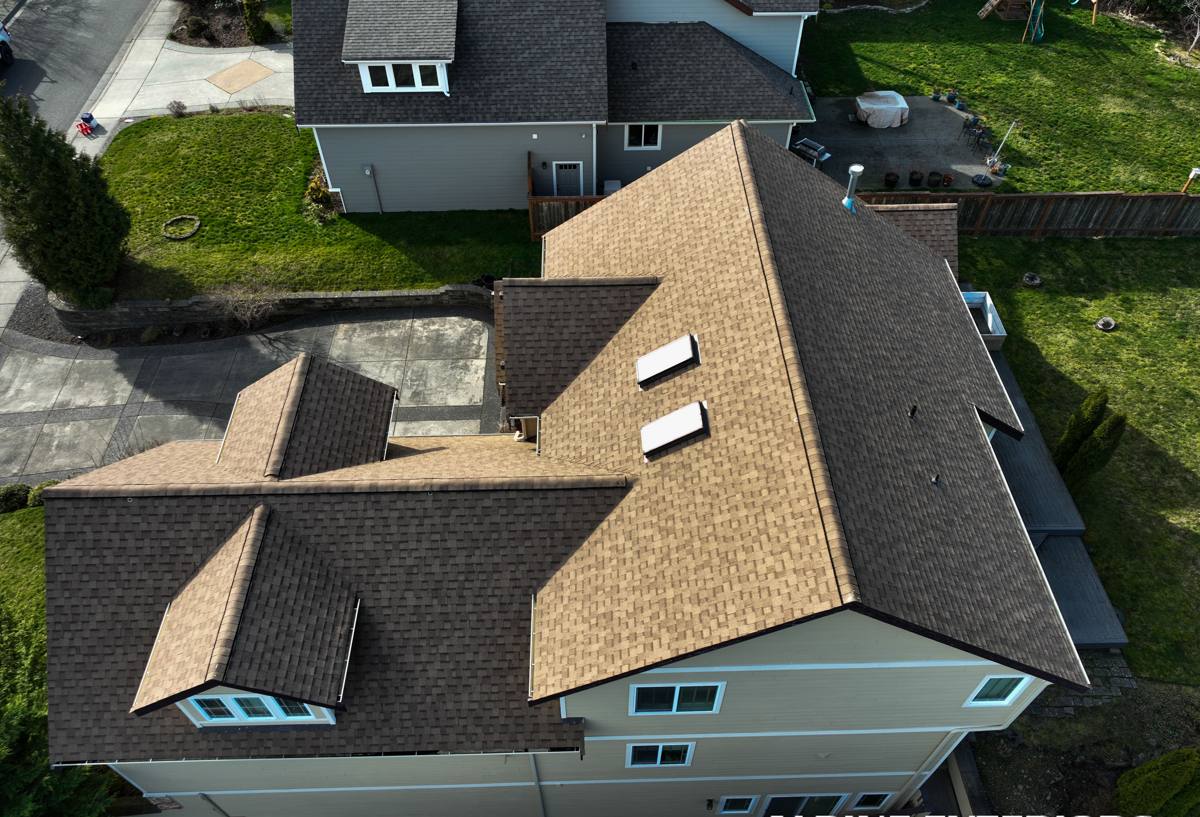
What Salt Air, Driving Rain, and Moss Actually Do to Siding
Salt air doesn't just make a house feel damp near the water — it keeps surfaces wet longer than they'd stay in a drier climate, and it accelerates corrosion on any exposed fastener, hinge, or piece of hardware that isn't rated for it. Over years, that steady exposure works against any finish that depends on a field-applied coating rather than a factory-cured one.
Driving rain is the second factor, and it's the one that separates a correct installation from a merely adequate one. Wind-driven rain doesn't run straight down a wall — it gets pushed sideways into laps, seams, and fastener penetrations that a calmer climate wouldn't test nearly as hard. Flashing and clearance details that would pass fine somewhere drier become the actual difference-maker here.
Moss and mildew round it out. Shaded walls, north-facing exposures, and anything under tree cover stay damp for extended stretches through fall, winter, and much of spring — exactly the condition moss needs to take hold. On any wood-based or moisture-absorbent siding, that's not just a green stain on the surface. It's ongoing dampness working against the material itself, which eventually leads to swelling, softening, and rot at edges and seams.
Why James Hardie Fiber Cement Is the Product We Install
We install James Hardie fiber cement siding on Barkley homes and nothing else — no vinyl, no LP SmartSide, no Cemplank or Allura, no primed spruce or cedar. That's a professional standard we hold ourselves to, not a claim that every other product is worthless. Vinyl, engineered wood, and natural wood siding all have legitimate uses in the right climate and budget. In a climate that combines salt air, sustained wind-driven rain, and a long moss season, though, the products that tend to struggle share a common weakness: they either absorb moisture directly, rely on a coating to keep water out indefinitely, or expand and contract enough with temperature and humidity swings that seams gradually work loose.
What Hardie Does Differently
James Hardie's fiber cement is non-combustible and doesn't swell, rot, or feed moss the way wood-based products can. Its ColorPlus finish is baked on in a factory under controlled conditions rather than applied on-site, and it carries a manufacturer warranty against fading and chalking that a field-applied paint job typically can't match. Hardie also engineers climate-specific HZ formulations rather than shipping one board for every region — the HZ5 line, built for wetter, harsher climates, is what we specify for most Barkley installations rather than a version engineered for a drier part of the country.
Paired with a strong transferable warranty and installation carried out to Hardie's actual published specifications, it's the system we trust to perform through a full Whatcom County year of weather — not just look good the week it goes up.
What a Correct James Hardie Installation Actually Involves
Fiber cement only performs the way it's engineered to when it goes on correctly. That's true of any premium siding product, but it matters more here because the climate leaves less room for shortcuts. A correct job on a Barkley home includes:
- Fastener type, length, and spacing set to Hardie's specification for the substrate and exposure, not a generic fastening schedule
- Properly lapped and sealed weather-resistive barrier installed underneath, with no gaps at seams or penetrations
- Flashing detailed at every window, door, and wall penetration so wind-driven rain is directed out and away rather than trapped behind the cladding
- Correct clearance above grade, decks, and hardscape so lower courses aren't sitting in standing moisture
- Field-cut edges primed and sealed per Hardie's instructions, since an unsealed cut edge is the one place factory protection doesn't reach
- Caulk and sealant used only where Hardie's details call for it — not as a substitute for flashing that should be there instead
Skipping or shortcutting any one of these steps can undercut the material's real-world performance, regardless of how good the product itself is. It's also how a siding job that looks identical on install day ends up performing very differently five or ten years in.
How We Approach a Barkley Siding Project
The process starts with an actual look at the house — not a generic estimate built off square footage alone. We check existing siding and trim condition, look for signs of moisture that are already established behind the surface, and note which walls take the heaviest wind-driven rain based on orientation and exposure. That assessment drives decisions on tear-off scope, flashing repair or replacement, and where extra attention is needed before a single new board goes up.
Product and Color Selection
From there, we walk through Hardie's board profiles and ColorPlus color options with the homeowner, factoring in how a given color and sheen will actually read against Barkley's grey-sky stretches and how it holds up under sustained damp exposure on shaded elevations versus sun-exposed ones.
Installation and Close-Out
Installation follows the sequence above — barrier, flashing, fastening, and finish work — with the same crew handling a project start to finish rather than rotating labor through it. Once the job is done, we walk the property with the homeowner, register the manufacturer warranty, and leave clear documentation of what was installed in case it's ever needed for a future repair or a home sale.
James Hardie Compared to Other Siding Options
Most homeowners looking into a siding project have already run across several material options. It's worth comparing them honestly rather than pretending the decision is already settled.
| Material | Behavior in Barkley's Climate | Long-Term Maintenance |
|---|---|---|
| James Hardie fiber cement | Non-combustible, doesn't absorb moisture or feed rot the way wood-based products can | Low — factory finish resists fading and chalking under sustained damp exposure |
| Vinyl | Won't rot, but can warp, crack, or pop loose under wind-driven rain and temperature swings over time | Low upfront cost, but panels typically get replaced rather than repaired when they fail |
| LP SmartSide / engineered wood | Wood-based core is more moisture-sensitive at cut edges and seams than fiber cement | Moderate — edge sealing and coating touch-ups matter more in sustained damp conditions |
| Primed spruce or cedar | Natural wood absorbs moisture readily and is a preferred surface for moss establishment | Highest — regular repainting, caulking, and moss treatment needed to hold up |
This isn't a claim that every alternative fails outright — it's why our own standard, for a climate this consistently wet, is fiber cement installed to spec rather than a material that trades a lower sticker price for a heavier maintenance load ten or fifteen years out.
What Drives Cost on a Barkley Siding Project
Every project is different, but the same handful of factors tend to move the price up or down the most. Knowing them ahead of time makes for a more useful first conversation.
| Cost Factor | Why It Matters |
|---|---|
| Condition of existing siding and sheathing | Hidden rot or moisture damage found during tear-off adds repair scope before new siding can go on |
| Home size, stories, and roofline complexity | More wall area, more corners, and more roof-to-wall intersections all add labor and flashing detail |
| Trim and architectural detail | Corner boards, window trim, and decorative elements take more time to fit and finish correctly |
| Board profile and ColorPlus selection | Lap width, texture, and factory color options carry different material costs |
| Access and site conditions | Slopes, mature landscaping, and tight lot lines can affect staging and labor time |
Signs a Barkley Home's Siding Needs Attention
Some warning signs are easy to spot from the ground; others take a closer look. Worth checking for before problems get more expensive to fix:
- Soft or spongy spots when you press on siding or trim, especially near the bottom courses
- Visible green or black staining that keeps coming back after cleaning, particularly on shaded or north-facing walls
- Cracked, bubbled, or peeling paint that returns quickly after a fresh coat
- Gaps at caulk lines around windows, doors, or corner trim that keep reopening
- Warping, bowing, or panels that no longer sit flush against the wall
- Interior signs like peeling paint, musty smell, or discoloration on walls that back up to exterior siding
Any one of these on its own isn't necessarily an emergency, but ignoring several at once in a climate this wet tends to let a manageable repair turn into a full replacement.
Why a Crew That Already Works Barkley Matters
A lot of what determines whether siding holds up here comes down to judgment calls a generic, out-of-area crew tends to miss: which wall orientations take the heaviest wind-driven rain, where moss is likely to establish first based on shade and drainage patterns, how much clearance a given foundation or hardscape condition actually requires, and how flashing needs to be layered so it sheds water through an entire wet season rather than just passing a dry-day walkthrough.
A crew that installs James Hardie siding in Barkley and the surrounding Whatcom County area regularly starts recognizing these patterns house to house. That familiarity shows up in small decisions on site — where a J-channel actually belongs, where caulk is appropriate versus where flashing is required instead, how tight fastener spacing needs to be given local wind exposure — that a homeowner rarely notices directly but absolutely feels in how the siding performs over the following decade.
If you're weighing a siding project for a Barkley home, we're happy to take a look and talk through what your specific property needs — no pressure, no obligation. Reach out through the form below for a free estimate.