 Bellingham Roofing
 Decking in Columbia Takes a Different Kind of Beating
The Columbia neighborhood sits close enough to Bellingham Bay that salt-laden air is a daily fact of life, not an occasional nuisance. Add in Whatcom County's long wet season, driving rain off the water, and the low-angle winter sun that never quite dries out shaded yards, and you've got conditions that are genuinely tough on outdoor structures. A deck built for a drier inland climate, or built without much thought for this specific mix of moisture and salt, will show it within a few seasons.
Composite decking exists partly to solve this problem, but only when it's specified and installed correctly. A lot of the composite deck problems we get called out to look at in this area aren't material failures — they're installation shortcuts that didn't account for how much water this neighborhood actually sees, or how long that moisture sits before it evaporates.
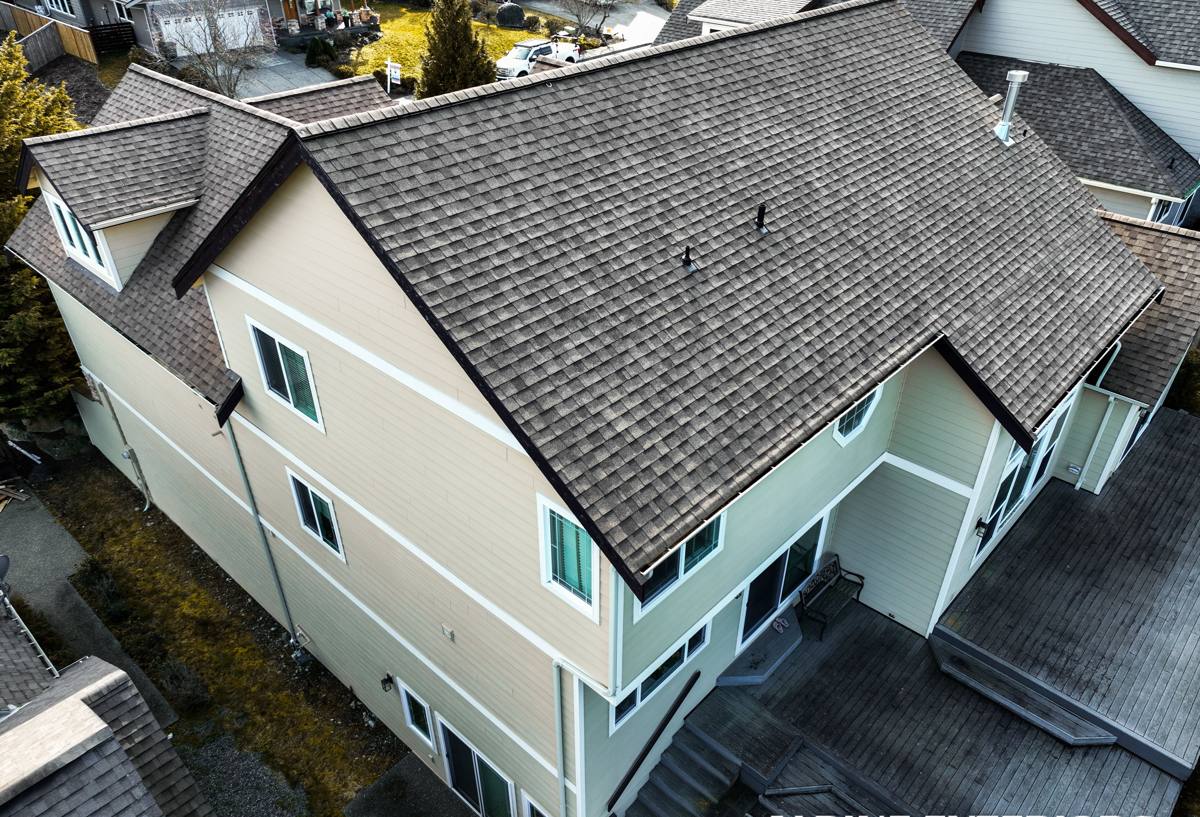
What Salt Air, Rain, and Moss Actually Do to a Deck
Salt Air
Salt-laden air accelerates corrosion on any exposed metal — screws, joist hangers, flashing, railing hardware. On an older deck, this shows up as rust streaks bleeding down the boards or fasteners that back out because the metal underneath is degrading. Composite boards themselves don't corrode, but the fasteners and structural hardware holding them up absolutely can if they're not rated for it.
Driving Rain
Wind off the bay doesn't just drop rain straight down — it pushes it sideways, under railings, into ledger connections, and into any gap that isn't properly flashed or sealed. Over time, water finds its way to the framing underneath the decking, and that's where rot starts even when the surface boards look fine.
Moss Season
Bellingham's moss season runs long — realistically much of the fall through spring stretch — and it's worst on decks that don't get much direct sun, which describes a lot of yards in this area with mature trees and close-set homes. Moss and algae hold moisture against the deck surface and turn boards slick and slippery, which is a real fall hazard on stairs and ramps, not just a cosmetic issue.
What a Correct Composite Decking Job Involves Here
Composite boards themselves are only part of the system. The parts underneath and around them are what determine whether a deck actually holds up to this climate. On every composite deck we build in this area, we pay close attention to:
- Ledger board flashing where the deck attaches to the house — this is the single most common source of hidden water damage on older decks
- Joist tape or a moisture barrier on top of the framing, so the composite boards aren't the only thing keeping water off the wood underneath
- Stainless or coated fasteners and hardware rated for coastal/marine exposure, not standard interior-grade hardware
- Proper gapping between boards for drainage and seasonal expansion
- Adequate ventilation underneath the deck so trapped moisture can actually dry out between rain events
- Sloped or graded ground beneath low decks so water doesn't pool and sit against the structure
Skip any one of these and the composite boards can look perfect on the surface while the structure underneath quietly deteriorates — which is exactly the kind of problem that's expensive to fix later and cheap to prevent up front.
Composite vs. Other Decking Materials for This Climate
Every decking material involves trade-offs. Here's how the common options stack up specifically against Columbia's salt air, rain, and moss conditions:
| Material | Moisture Behavior | Maintenance | Typical Lifespan Here |
|---|---|---|---|
| Pressure-treated wood | Absorbs water, prone to cupping and splintering in wet cycles | Annual cleaning, periodic staining/sealing | 10-15 years before major repair or replacement |
| Cedar | Naturally rot-resistant but still absorbs moisture over time | Regular sealing to maintain resistance | 15-20 years with upkeep |
| Uncapped composite | Resists rot but the exposed shell can absorb some surface moisture, feeding mold/algae growth | Periodic cleaning to keep moss and mildew from taking hold | 20-25 years |
| Capped composite / PVC | Fully sealed shell sheds water and resists staining and mold growth | Occasional washing, no sealing or staining | 25-30+ years |
We generally steer homeowners in this neighborhood toward capped composite for anything exposed to weather, specifically because of the moss and algae issue. An uncapped or lower-grade board can still perform reasonably well, but it asks more of the homeowner in ongoing cleaning to keep it looking and performing the way it should. That's a maintenance trade-off worth knowing before you buy, not a defect in the product — it's just how the material is built.
Our Installation Process
The process doesn't change much from job to job, but the details we pay attention to are shaped by this specific location:
- On-site assessment — we look at sun exposure, drainage, existing framing condition, and how close the deck sits to grade, since low decks with poor airflow are where we see the worst moss buildup.
- Framing and structure check — if we're replacing an old deck, we inspect the ledger and joists for hidden water damage before anything new goes down. This is non-negotiable; new boards on a compromised frame just hide the problem.
- Flashing and moisture barrier installation — ledger flashing and joist protection go in before decking, not as an afterthought.
- Fastening with corridor-appropriate hardware — coastal-rated fasteners and hidden fastener systems where the board manufacturer supports them.
- Board installation with proper spacing — accounting for drainage and the thermal expansion composite boards go through across our temperature swings.
- Railing, stairs, and edge detailing — the places driving rain tends to find its way in.
- Final walkthrough — we go over care and cleaning specific to this climate before we consider the job done.
Maintaining a Composite Deck Through a Long Moss Season
One of the real advantages of composite is how little maintenance it needs compared to wood — but "low maintenance" isn't "no maintenance," especially here. A simple seasonal routine keeps a composite deck performing the way it's supposed to:
- Sweep debris off the deck regularly, especially in fall when leaves and needles trap moisture against the boards
- Wash the deck surface a couple of times a year with a soft-bristle brush and a composite-safe cleaner to keep moss and algae from establishing
- Check railing posts and stair connections annually for any looseness, since fastener issues show up here before board issues do
- Keep gutters and downspouts near the deck clear so runoff isn't dumping directly onto or under the deck surface
- Trim back vegetation that's shading the deck and keeping it damp longer than it needs to be
- Avoid pressure washing at high pressure directly into board seams — it can drive water into places it shouldn't be
Cost Factors for a Columbia Composite Deck Project
Every project is different, but the same handful of factors drive cost on most composite decking jobs in this area:
| Factor | Why It Matters Here |
|---|---|
| Board tier (uncapped vs. capped/PVC) | Capped boards cost more upfront but hold up better against moss, algae, and salt exposure with less maintenance |
| Substructure condition | Older decks near the water often need more framing repair due to hidden moisture damage |
| Deck height and ventilation needs | Low decks may need additional grading or venting work to manage moisture underneath |
| Railing and hardware grade | Coastal-rated hardware and railing systems cost more but hold up significantly longer |
| Size and complexity | Multi-level decks, built-in benches, and stairs add labor and material beyond a simple rectangular deck |
Rather than quote a broad price range that doesn't mean much without seeing the site, we'd rather walk the property, look at what's actually there, and give a straight number based on real conditions.
Why Hiring a Crew That Already Works in Columbia Matters
A lot of decking problems in this neighborhood aren't unique — they're the same handful of issues repeated on different lots: ledger flashing that wasn't done right the first time, hardware that wasn't rated for salt exposure, and low decks with no airflow underneath that stay damp for months at a stretch. A crew that's worked this specific area already knows which of these issues to check for before they become expensive, and knows how the local permitting and inspection process runs so there are no surprises partway through the job.
That local familiarity also means we're not guessing at how a deck will perform here — we've seen how different board tiers and installation details hold up through an actual Whatcom County winter, not just in a manufacturer's spec sheet.
Mistakes We Commonly Find on Older or DIY Decks Here
When we're called out to inspect an existing deck in this area — whether for a repair, a resurfacing, or a full replacement — the same few issues turn up again and again:
- Missing or improperly installed ledger flashing, leading to hidden rot at the house connection
- Standard interior-grade fasteners used outdoors, now rusted and weakened
- Boards installed tight against each other with no drainage gap
- No ventilation or grading under low decks, trapping moisture year-round
- Composite boards installed over a compromised or undersized frame that was never addressed
None of these are unusual mistakes — they're just the kind of shortcuts that don't show up as a problem for a year or two, which is exactly why they're so common on decks that weren't built with this climate specifically in mind.
Get a Straight Answer for Your Property
If you're considering composite decking for a home in Columbia, we're happy to come take a look, walk you through what your specific site needs given its sun exposure, drainage, and age of any existing structure, and give you an honest, no-pressure estimate. Use the form below to get started.