 Bellingham Roofing
 Custom Decks Built for Columbia's Conditions, Not Just Its Curb Appeal
The Columbia neighborhood sits close enough to Bellingham Bay that salt-laden air is a daily fact of life, and close enough to the trees and hillsides that shade and moisture linger on outdoor surfaces for months at a time. A deck built here has to do more than look good on a sunny afternoon in July. It has to shed driving rain off the water, resist corrosion from salt air, and survive a moss season that can stretch from October well into spring. We build custom decks with those specifics in mind, not a generic set of blueprints pulled off a shelf.
This page focuses on one job, done right, in one part of town: custom deck construction and replacement for homeowners in Columbia. If you're comparing quotes or just trying to understand what a correct deck build actually involves in this climate, this is written for you.
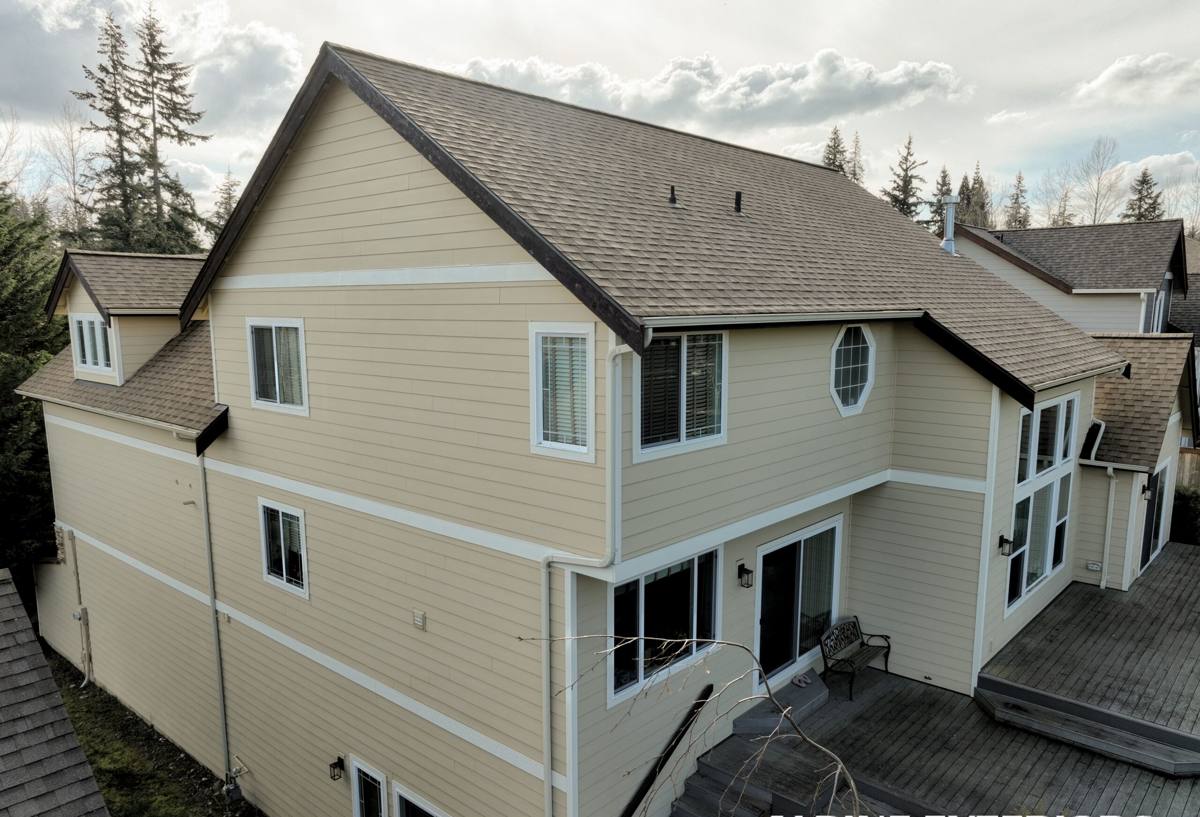
What Bellingham's Climate Actually Does to a Deck
Whatcom County doesn't get brutal winters, but it gets something arguably harder on wood and hardware: sustained dampness. A deck here rarely dries out completely for weeks at a stretch during the wet season, and that changes what "durable" means.
Moss and Standing Moisture
Shaded lots, overhanging trees, and north-facing exposures common in Columbia all encourage moss growth on decking boards. Moss holds moisture against the wood surface long after the rain stops, which accelerates rot in untreated or poorly finished lumber and turns board surfaces slick and unsafe underfoot. Board spacing, airflow underneath the deck, and the finish applied to the wood all affect how much moss takes hold and how fast.
Salt Air and Metal Fasteners
Proximity to the bay means airborne salt reaches yards and decks that aren't even in view of the water. Salt air corrodes standard fasteners, joist hangers, and hidden hardware faster than it would inland. A deck that looks fine on the surface can have compromised structural connections underneath if the wrong-grade hardware was used.
Driving Rain and Ledger Connections
Wind-driven rain off the Sound doesn't just fall straight down — it pushes sideways into ledger boards, stair stringers, and any point where the deck meets the house. Flashing details that would be adequate in a drier climate aren't always enough here.
Decking Material Options for This Climate
There's no single "best" decking material — there's a best material for your budget, your lot's sun and shade pattern, and how much upkeep you actually want to do. Here's how the common options compare for a Columbia-area yard:
| Material | Moss / Moisture Behavior | Maintenance | Typical Lifespan Here |
|---|---|---|---|
| Cedar | Naturally moisture-resistant but still needs sealing; moss will grow on shaded boards without upkeep | Annual cleaning and re-sealing recommended | 15-20 years with upkeep |
| Pressure-treated fir/pine | Prone to moss and surface checking if not finished; budget option | Regular sealing, more frequent board replacement | 10-15 years |
| Composite decking | Won't rot, but can still grow surface moss/algae in deep shade | Periodic cleaning, no sealing needed | 25-30+ years |
| PVC decking | Fully moisture-proof, easiest to keep moss-free with occasional washing | Lowest maintenance of the group | 25-30+ years |
We install all of the above depending on what the homeowner wants. Our default recommendation for heavily shaded Columbia lots leans toward composite or PVC simply because moss cleanup and re-sealing become a recurring chore on natural wood in deep shade — that's a maintenance conversation, not a knock on wood decking, which still performs well on sunnier, more exposed lots.
Structural Details That Matter More Here Than People Realize
The parts of a deck nobody sees are the parts most likely to fail early in this climate if they're built to a minimum standard instead of a correct one.
Fasteners and Hardware
We use fasteners and structural connectors rated for the corrosion exposure this area actually sees, not just whatever meets the bare code minimum. That matters more within a mile or two of the bay, but salt air travels further than people expect, and Columbia is close enough that we treat it as coastal exposure by default.
Ledger Flashing
Where the deck attaches to the house, proper flashing — installed in the correct order relative to the house's siding and building wrap — is what keeps driving rain from working its way into the rim joist and wall framing behind it. This is one of the most commonly shortcut details in low-bid deck work, and it's usually invisible until there's a rot problem years later.
Joist Protection
Covering the tops of joists and beams with a protective tape or membrane before decking goes down keeps rainwater from sitting in fastener holes and screw penetrations, which is exactly where rot starts on an otherwise sound frame.
Footings on Local Soil
Whatcom County's clay-heavy soils in many residential areas hold water differently than sandy or well-drained soil, which affects footing depth and drainage around post bases. We size and place footings based on what the actual soil at your property is doing, not a one-size template.
Design Choices That Fit a Columbia Lot
Columbia is a mix of established homes, mature tree cover, and lots with real variation in sun exposure and slope. A few design decisions consistently make a difference here:
- Wider board gapping or grooved-edge boards on shaded sections to let moisture and debris drain rather than collect
- Under-deck airflow — skirting with vents rather than solid enclosure, so the underside can dry out between storms
- Railing material chosen with salt-air corrosion in mind if the lot has any bay exposure or is on a windward slope
- Stair and landing placement that accounts for runoff patterns off the roofline, so water isn't funneled straight onto high-traffic steps
- Gutter and downspout coordination so roof runoff isn't discharging directly onto or under the new deck
None of this is exotic. It's the difference between a deck designed for a brochure photo and one designed for this specific yard, this specific tree canopy, and this specific weather pattern.
Our Custom Deck Process
Every custom deck we build in the Columbia area follows the same sequence, adjusted for the specific lot and design:
- On-site walkthrough to assess sun/shade exposure, drainage patterns, soil condition, and how the deck ties into the existing house
- Design and material conversation — size, layout, decking material, railing style, and a realistic maintenance expectation for whatever we choose
- Permitting through the appropriate local jurisdiction, including structural details like footing size and guardrail height where required
- Demolition of any existing structure, if applicable, with an honest look at what condition the ledger and house framing are in underneath
- Framing with corrosion-appropriate hardware, proper ledger flashing, and joist protection before any decking goes down
- Decking, railing, and stair installation
- Final walkthrough covering how to care for the specific material you chose through the wet season
Living With a Deck Through Moss Season
Whatever material you choose, a little seasonal attention goes a long way in this climate. This is the basic upkeep routine we recommend to Columbia homeowners:
- Sweep leaves and debris off the deck surface regularly in fall — trapped organic matter is what feeds moss growth
- Clean surface moss or algae with an appropriate deck cleaner before it builds up, rather than waiting until boards are visibly slick
- Check and clear under-deck ventilation gaps or skirting vents once a year
- Re-seal or re-stain wood decking on the schedule appropriate to the product — don't wait for visible graying or checking
- Inspect ledger flashing and fastener heads periodically for any sign of rust bleed or loosening
- Confirm downspouts and gutters near the deck are clear before the fall rains start
Permits and Local Code
Most custom deck construction and many deck replacements in Bellingham and Whatcom County require a building permit, particularly when structural work, guardrails, or attachment to the house is involved. Requirements around guardrail height, stair geometry, and footing depth are set by the adopted building code and enforced by the local jurisdiction. We handle the permitting process as part of the job so you're not left navigating it alone, and so the finished deck is something that holds up to inspection now and to resale scrutiny later.
Why a Crew That Already Works Columbia Makes a Difference
A contractor who works this neighborhood regularly already has a working sense of which lots get heavy shade, where drainage tends to be a problem, and how the local jurisdiction handles deck permitting — none of which has to be re-learned or guessed at on your project. That familiarity shows up in fewer surprises during the build and a deck that's designed for the yard you actually have, in the county you actually live in, rather than a generic template. It also means someone local is easy to reach if a question comes up on your deck five or ten years down the road.
If you're planning a new deck or replacing one that's showing its age, we're happy to take a look and put together a straightforward, no-pressure estimate. Use the form below to get started.