 Bellingham Roofing
 Why Cordata Decks Wear Out Faster Than Homeowners Expect
Cordata sits in the same marine climate that defines all of Whatcom County: mild temperatures, a long wet season, and moisture that lingers instead of drying off quickly. For a deck, that combination is tougher than it sounds. Wood and even composite decking need real drying time between rain events to stay healthy, and in this part of Bellingham that drying window can shrink to a few days a week for months at a stretch. The result is decks that look fine from a distance but are quietly losing ground underneath — softening boards, corroding fasteners, and framing that stays damp long after the sun comes back out.
Driving Rain and Standing Moisture
Driving rain doesn't just fall straight down — wind pushes it sideways into ledger boards, under railings, and into any gap where flashing or caulking has started to fail. Once water gets behind a board or into a joint, it doesn't evaporate the way surface rain does. It sits, and that's where rot starts. Decks with poor drainage, tight board spacing, or shade from mature trees hold onto that moisture the longest.
Salt Air's Slow Effect on Fasteners
Whatcom County's proximity to Bellingham Bay and the Salish Sea means the air here carries a mild salt content that travels further inland than most homeowners assume. It's not dramatic, but over years it accelerates corrosion in screws, joist hangers, and structural hardware — especially anything that wasn't rated for exterior or coastal-adjacent use to begin with. A deck built with the wrong fasteners a decade ago may look sound on the surface while the metal holding it together is quietly failing.
A Long Moss Season
Moss doesn't need much to get established here — shade, moisture, and time, and Cordata's tree cover and long gray stretches supply all three. On a deck, moss is more than a slip hazard. It holds water against the wood surface, feeds on the same organic material the deck is made of, and works its way into seams and fastener holes, prying them open a little more with every freeze-thaw cycle in the colder months.
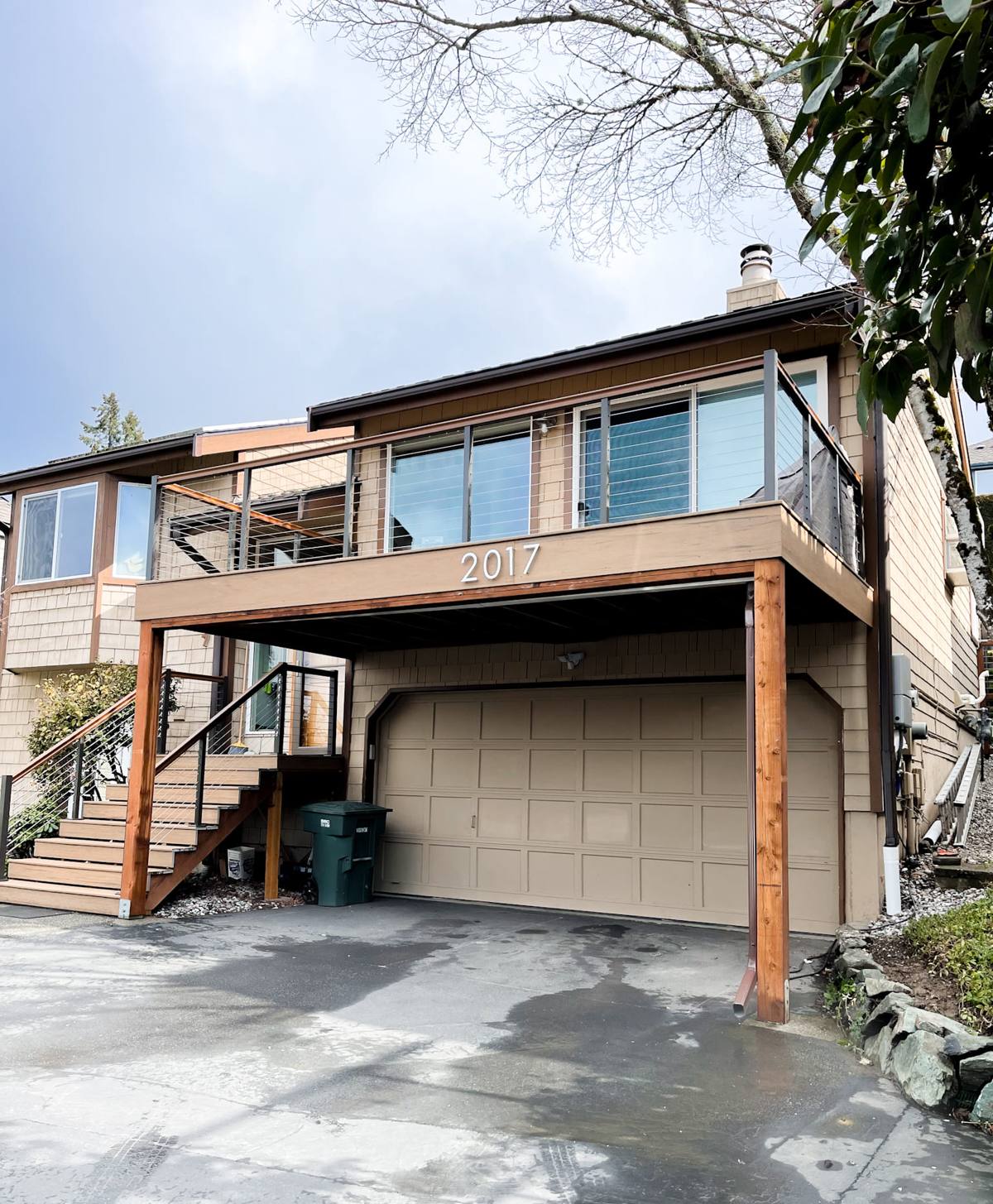
Signs Your Deck Needs Repair Now, Not Later
Deck problems in this climate rarely show up all at once. They start small and get more expensive the longer they're ignored, because moisture damage spreads underneath the surface before it's visible on top. These are the signs worth acting on:
- Boards that feel spongy, springy, or noticeably softer underfoot than the rest of the deck
- Green or black staining, especially in shaded corners or where boards meet the house
- Railings or stair posts that wiggle when pushed, even slightly
- Rust streaks below screw heads or around metal connectors
- Gaps opening up where the deck meets the house, or a ledger board that looks pulled away from the siding
- A musty smell coming from underneath the deck
- Nails backing out or fasteners that spin freely without biting into wood
- Standing water that takes more than a day to drain after rain
Any one of these on its own might be minor. Two or three together, especially near the ledger board or main support posts, usually means the damage has moved past the surface.
What a Correct Deck Repair Actually Involves
A repair that only replaces what's visible from the top often misses the reason the deck failed in the first place. A repair done right starts underneath and works outward.
Framing and Structural Checks First
Before touching decking boards, we check the joists, beams, and posts for soft spots, cracking, or movement. This is where the real risk lives — a deck can have brand-new boards on top and still be structurally unsound underneath if the framing was never inspected. We probe suspect areas rather than guessing from appearance, since rot often hollows wood out while leaving the surface looking intact.
Ledger Board and Flashing
The ledger board — where the deck attaches to the house — is the single most common source of hidden water damage on decks in this climate. Flashing that's missing, cracked, or installed incorrectly lets water track behind the board and into the house rim joist. We check this connection closely on every repair, because a deck can be perfectly solid everywhere else and still be failing at this one seam.
Decking Boards and Fasteners
Individual boards get replaced where they're soft, cracked, or cupped, matched as closely as possible to the surrounding material. We also address fastener choice at this stage — swapping out corroded or undersized screws for hardware rated for exterior and coastal-adjacent use, since reusing failing fasteners just resets the same problem on a shorter timeline.
Railings, Stairs, and Guardrails
Railings and stair stringers take a lot of direct weather exposure and a lot of physical load, which makes them a common failure point. We check post connections, baluster spacing against current code, and stringer condition, since a railing that looks fine but isn't solidly anchored is a safety issue, not just a cosmetic one.
Repair or Replace? What Actually Drives That Decision
Homeowners often assume any deck with visible damage needs full replacement. In our experience, most decks in Cordata can be repaired if the framing is still sound — replacement usually only makes sense once the structural members themselves are compromised. Here's how we weigh it:
| Factor | Usually Points to Repair | Usually Points to Replacement |
|---|---|---|
| Framing condition | Joists and posts are solid; damage is limited to boards or railings | Multiple joists or the ledger board are soft or rotted through |
| Age of the deck | Built or resurfaced within the last 10-15 years | Original structure is 20+ years old with no prior upgrades |
| Extent of damage | Damage is localized to one area or side | Damage is spread across most of the deck surface |
| Fastener condition | Isolated corrosion, easily replaced | Widespread rust or failing connectors throughout |
| Code compliance | Railing height and spacing already meet current code | Structure predates current guardrail and footing requirements |
| Budget goals | Want to extend the deck's life at a lower cost | Want a long-term reset and are open to a larger investment |
We'll always tell you honestly which category your deck falls into after a hands-on inspection — not just a walk-around, but actually checking under the deck and probing the framing.
Our Deck Repair Process in Cordata
We keep the process straightforward because homeowners deserve to know what's happening to their home and why.
- Full inspection — we check the deck from underneath as well as on top, probing framing, the ledger connection, and fasteners rather than relying on a visual pass alone.
- Honest scope and estimate — you get a clear explanation of what's failing, why, and what it will take to fix it, with repair and replacement options laid out side by side when both are reasonable.
- Repair work — damaged framing, boards, flashing, and hardware get replaced with materials suited to this climate, not just whatever matches on the shelf.
- Final check — we walk the deck with you, testing railings and problem areas that prompted the repair in the first place, before calling the job done.
Materials We Use and Why
Material choice matters more here than in drier climates, because the margin for error with moisture is smaller. For structural repairs, we use pressure-treated lumber rated for ground contact where it's load-bearing, since standard lumber grades aren't built to handle sustained dampness. For decking surfaces, both quality wood and composite boards have a place — the right choice depends on the deck's exposure, how much shade and moss pressure it gets, and how much upkeep the homeowner wants to take on long-term. We'll walk through the honest trade-offs for your specific deck rather than pushing one product across every job.
Wood Decking
Real wood has a natural look many homeowners prefer and it's often the more budget-friendly repair option, but it needs regular sealing or staining to keep moisture out — especially in a climate with this much rain and moss pressure. Skipping that maintenance is the single biggest reason wood decks fail early here.
Composite Decking
Composite boards resist rot and don't need sealing, which appeals to homeowners who want to spend less time on upkeep. The trade-off is a higher upfront cost and the fact that composite still needs regular cleaning — moss and algae will grow on composite just as readily as on wood if it stays shaded and damp, since the growth is feeding on surface debris, not the board material itself.
Keeping Moss and Rot From Coming Back
A repair only holds up as long as the deck is maintained afterward, and in Whatcom County's climate that means staying ahead of moss rather than reacting to it. A few habits go a long way between now and your next inspection:
- Sweep leaves and debris off the deck regularly through fall, since trapped organic matter is what feeds moss growth
- Rinse or lightly clean the surface a couple of times a year, focusing on shaded corners and under furniture
- Check that gaps between boards stay clear so water can drain instead of pooling
- Trim back vegetation that's shading the deck and keeping it damp longer than the rest of the yard
- Re-seal or re-stain wood decking on the schedule the product calls for, not just when it starts looking faded
- Have railings and stair connections checked periodically, since loosening often happens gradually and quietly
Why Hire a Crew That Already Works in Cordata
Deck repair done right depends on recognizing how a specific climate attacks a specific structure, and that comes from doing this work repeatedly in the same conditions. A crew that regularly repairs decks around Bellingham and Whatcom County knows which framing details tend to fail first in this weather, which fasteners hold up and which don't, and how much moss and moisture pressure a shaded deck in this area actually sees over a year. That local pattern recognition is what separates a repair that lasts from one that needs to be redone in two or three years.
It also means a faster, more accurate estimate. Because we're not guessing at how this climate behaves, we can walk a Cordata deck and tell you fairly quickly whether you're looking at a straightforward repair or something more involved, and why.
Get an Honest Look at Your Deck
If your deck in Cordata is showing soft spots, moss buildup, rust at the fasteners, or railings that don't feel as solid as they used to, it's worth having it looked at before another wet season adds to the damage. We offer free, no-pressure estimates — we'll inspect the deck, tell you honestly what's going on, and lay out your repair options with no obligation. Use the form below to get started.