 Bellingham Roofing
 Composite Decking Built for Edgemoor's Coastal Conditions
Edgemoor sits close to the water, and that proximity shapes everything about how an outdoor deck ages here. Salt-laden air drifts in off the bay, rain comes in sideways more often than people expect, and the shoulder seasons bring long stretches of damp, shaded weather where moss and algae get a real foothold. A deck built without those specifics in mind will show it within a few seasons — soft spots, slick green film on the boards, corroded hardware, or a substructure that never quite dries out between storms.
Composite decking, installed correctly, holds up to this environment far better than untreated wood without turning into a maintenance project of its own. But "composite decking" covers a wide range of products and installation quality, and the difference between a deck that looks good for two years and one that performs for two decades comes down to choices most homeowners never see: what's under the boards, how the framing breathes, what the fasteners are made of, and whether the whole system was designed to shed water instead of trap it.
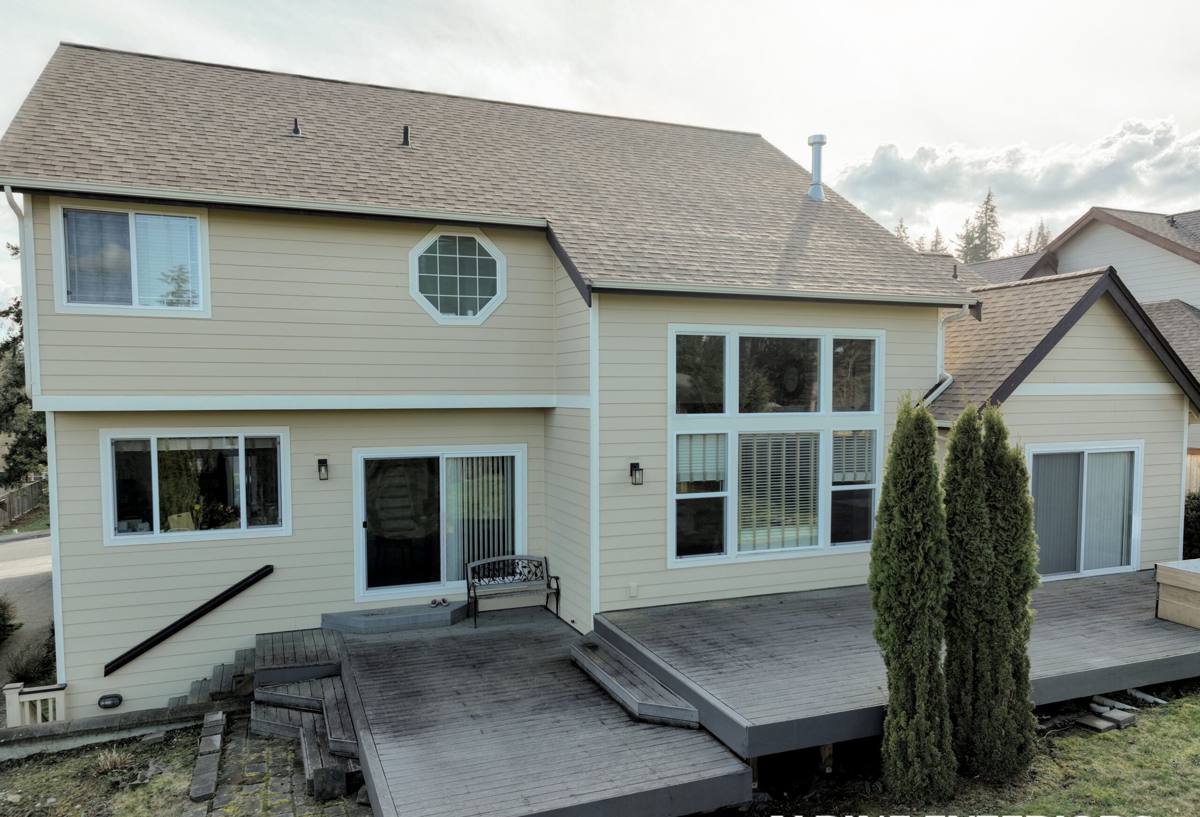
What Bellingham's Marine Climate Does to a Deck
Salt Air and Metal Fatigue
Homes near the water deal with airborne salt even without a direct ocean view. Salt accelerates corrosion on anything ferrous — screws, brackets, joist hangers, ledger bolts. A deck that looks fine on the surface can have hardware quietly failing underneath if it wasn't spec'd for a marine-influenced environment from the start.
Driving Rain and Water Intrusion
Storms here don't always fall straight down. Wind-driven rain gets pushed sideways and up under fascia boards, behind ledger flashing, and into any gap where a builder assumed water would only ever come from above. Decking attached to a house needs flashing detail that accounts for that, not just a standard ledger board bolted to the rim joist.
Moss, Algae, and Shade
Whatcom County's long wet season and the tree cover common in Edgemoor's neighborhoods mean a lot of decks sit in partial shade for months at a time. That's exactly the condition moss and algae need. On wood, that growth breaks down fibers over time. On composite boards, it's mostly cosmetic, but only if the board's surface texture and cap layer were chosen with that in mind — some composite profiles hold onto grime in deep grain patterns more than others.
Why Composite Makes Sense for This Neighborhood
We're not against wood decking as a category — it has its place, and some homeowners prefer the look and are willing to keep up with the sanding, staining, and sealing it requires. But for a waterfront-adjacent neighborhood with heavy seasonal rain, composite decking removes several recurring failure points:
- No annual sanding, staining, or sealing to keep ahead of moisture damage
- Capped boards resist the surface graying and splintering that wet wood develops
- Consistent density means no soft spots forming where water pools
- Color and grain hold up under years of damp, low-sun conditions
- Better resistance to the slow rot that starts at fastener holes in wood decking
The trade-off is upfront cost and the fact that composite can't be refinished the way wood can — the color you install is the color you live with. For most Edgemoor homeowners weighing decades of low maintenance against a higher material cost, that trade works out in composite's favor, especially on decks that get regular use.
What a Correct Composite Deck Installation Actually Involves
The boards themselves get most of the attention, but they're the easiest part to get right. The parts that determine whether a deck lasts are underneath and around the edges.
Substructure and Ventilation
Composite decking is heavier than wood and doesn't flex the same way, so joist spacing and beam sizing need to match the manufacturer's engineering specs — not just whatever spacing was used on the last wood deck. Airflow underneath matters too; a deck built low to grade with poor ventilation stays damp longer after every rain, which shortens the life of the framing even if the boards on top never rot.
Fasteners and Hardware
In a salt-air environment, we spec stainless steel or coated fasteners rated for coastal exposure, along with joist hangers and structural hardware built to the same standard. Standard zinc-coated hardware can start showing rust within a few seasons this close to the water — a detail that's invisible until it isn't.
Ledger Attachment and Flashing
Where the deck meets the house is the single most common source of long-term water damage. Proper ledger flashing, correctly lapped with the house's water-resistive barrier and sealed against wind-driven rain, keeps water from working its way behind the siding and into the wall framing. This is not an area to shortcut.
Hidden Fastener Systems and Board Layout
Most composite decking today uses a hidden fastener system that clips boards from the side, avoiding surface screw holes that can trap water and show wear. Board layout — direction, seams, and picture-framing at the edges — affects both appearance and how well the deck sheds water toward the drainage points.
Composite Decking Options: A Practical Comparison
| Material | Moisture Resistance | Maintenance | Typical Lifespan |
|---|---|---|---|
| Pressure-treated wood | Fair — needs sealing to hold up | Annual staining/sealing | 10-15 years |
| Uncapped composite | Good | Occasional cleaning | 15-20 years |
| Capped composite | Very good | Rinse/wash as needed | 25-30+ years |
| PVC decking | Excellent | Minimal | 25-30+ years |
Capped composite is what we recommend for most Edgemoor projects — it delivers most of PVC's moisture and stain resistance at a somewhat lower cost, while looking and feeling closer to natural wood grain. Uncapped composite is a reasonable budget option but needs more attention to cleaning in a moss-prone environment, since its exposed surface has less resistance to organic growth than a capped board.
What Drives the Cost of a Deck Project
| Factor | Why It Matters |
|---|---|
| Deck size and height | Larger decks and elevated structures need more framing, footings, and railing |
| Substructure condition | Rebuilding a failed frame costs more than decking over a sound one |
| Board tier | Uncapped, capped, and premium composite lines vary significantly in material cost |
| Railing and stairs | Composite or aluminum railing systems add cost over basic wood rail |
| Site access | Tight lots or steep grades near the water can add labor time |
| Flashing and waterproofing detail | Doing the ledger and drainage correctly takes more time than a quick attach |
Our Process for Edgemoor Deck Projects
Every project starts with an on-site look at the existing structure, if there is one, and the specific exposure of the deck — sun, shade, wind direction, and how close it sits to grade or to salt-air drift off the water. From there:
- Structural assessment of framing, footings, and ledger connection
- Recommendation on board tier and railing system based on budget and exposure
- Written estimate with a clear scope — no vague allowances
- Framing repair or rebuild where needed, using coastal-rated hardware
- Ledger flashing and drainage detail done before a single deck board goes down
- Composite board installation with hidden fastener systems
- Final walkthrough covering care and what to expect over the first year
Keeping a Composite Deck Looking Right in This Climate
- Rinse or sweep off fallen leaves and debris regularly — trapped organic matter is what feeds moss and algae
- Wash the surface a couple times a year with a mild soap and soft-bristle brush, especially in shaded sections
- Keep gutters and downspouts near the deck clear so runoff isn't dumping directly onto or under it
- Check railing posts and stair connections once a year for movement
- Avoid pressure washing at close range or high pressure — it can damage the cap layer on some boards
- Trim back overhanging branches to reduce shade and leaf litter where practical
Why Local Experience Matters for This Job
A deck built to a generic spec sheet can still fail in a marine environment if it wasn't built for one. Crews that work Edgemoor and the surrounding Bellingham waterfront regularly know which hardware actually holds up here, how far wind-driven rain can travel under a poorly flashed ledger, and which composite lines perform best against the area's moss season rather than just looking good in a showroom. That local pattern recognition is the difference between a deck that needs attention every year and one that doesn't.
It also matters for the practical side of the job — knowing typical lot layouts and grade conditions in this part of Whatcom County, working efficiently around the access constraints that come with waterfront-adjacent properties, and building decks that hold up to the specific combination of salt, rain, and shade this neighborhood sees every year.
Get a Straight Answer on Your Deck
If you're dealing with a tired wood deck, a composite deck that's underperforming, or you're planning a new one from scratch, we're happy to take a look and give you an honest read on what it needs. There's no pressure and no upsell — just a clear estimate based on what your specific property and exposure require. Use the form below to request a free estimate for your Edgemoor deck project.