 Bellingham Roofing
 Why Happy Valley Decks Take a Beating
Happy Valley sits close enough to Bellingham Bay that salt-laden air reaches yards and decks year-round, and it sits in a corner of Whatcom County that gets its share of driving, wind-blown rain off and on for months at a stretch. Add in the long moss season that starts in fall and doesn't really let go until late spring, and you've got a climate that is genuinely hard on outdoor wood structures. None of this is unusual for the neighborhood — it's just the trade-off of living where the terrain slopes toward the water and the air stays damp most of the year. The problem is that most deck damage in this climate happens slowly, underneath boards and around fasteners, long before it's visible from the top.
We work on decks throughout this part of Bellingham regularly enough to know the failure patterns aren't random. They follow the weather. A deck built the same way in a drier inland climate would age very differently than one built here, which is why generic repair advice often misses the actual cause of the problem.
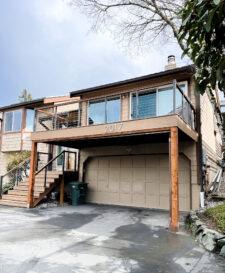
The Most Common Deck Problems We Find in Happy Valley
Ledger Board Rot and Flashing Failures
The ledger board — the piece that bolts the deck to the house — is the single most important structural connection on most decks, and it's also the one most likely to fail quietly. When flashing behind the ledger is missing, undersized, or has simply worn out, driving rain gets pushed behind the board by wind and sits there. Wood stays wet longer than it looks like it should, and rot sets in from the inside. This is a structural safety issue, not a cosmetic one, and it's one of the first things we check on any repair call.
Moss, Algae, and Trapped Moisture
A long moss season means moss and algae get a real head start on shaded or low-airflow deck areas — under railings, in board gaps, and anywhere the sun doesn't reach much of the year. Beyond making boards slick and dangerous underfoot, moss holds moisture against the wood surface far longer than open air would, which accelerates rot in exactly the spots you'd never think to check.
Corroded Fasteners and Hardware
Salt air corrodes metal faster than inland air does, and a lot of older decks in this area were built with standard galvanized nails, screws, or joist hangers that weren't rated for that kind of exposure. Once fasteners start rusting, they lose holding strength well before it's visible, and a board that looks fine can still be barely attached underneath.
Failing Footings and Support Posts
Happy Valley's terrain includes plenty of sloped lots, and decks built on a grade depend on footings and posts staying solid where drainage is often working against them. Water that doesn't shed away from post bases keeps wood posts damp at ground level — the single most common spot for rot to start on a support post — and can also lead to settling or shifting over time.
Guardrails, Stairs, and Code Compliance
Railings and stair stringers take direct weather exposure and a lot of physical stress, and they're also the components most tied to current building code requirements around height, baluster spacing, and load. Repairs here need to hold up structurally and meet code, not just look fixed.
Repair or Replace? What Actually Determines the Answer
Homeowners usually want a straight answer to "can this be repaired," and most of the time it depends less on the deck's age and more on where the damage is and how far it's spread. Surface-level wear is almost always repairable. Structural rot at connection points needs a closer look before we can say the same.
| Factor | Usually Repairable | Usually Needs Replacement |
|---|---|---|
| Ledger board condition | Solid wood, minor surface weathering | Soft, spongy, or rot has spread along its length |
| Support posts/footings | Isolated soft spot near ground line | Rot has reached the post's core or footing has shifted |
| Decking boards | A handful of boards cupped, cracked, or moss-stained | Widespread rot across most of the deck surface |
| Fasteners/hardware | Rust visible but hardware still holds tight | Fasteners loose, corroded through, or missing entirely |
| Framing (joists/beams) | One or two isolated soft spots | Multiple joists compromised or beam sagging |
In a lot of cases a deck ends up being a mix of both — some sections get sistered or replaced, structural connections get properly rebuilt, and the rest of the deck stays as-is. We'll always tell you honestly when full replacement is the more cost-effective long-term move rather than sinking money into a structure that's fighting rot on multiple fronts.
What a Correct Deck Repair Involves
A repair that just swaps out the obviously bad boards without checking what's underneath tends to fail again within a season or two in this climate. Our process is built around finding the actual cause, not just the visible symptom.
- Full structural inspection — checking the ledger connection, flashing, framing, posts, and footings, not just the decking surface.
- Moisture and rot probing — testing suspect areas rather than guessing from appearance alone, since surface paint or stain can hide soft wood underneath.
- Addressing the water source first — flashing, drainage, and grading issues get corrected before new material goes in, otherwise the repair is temporary.
- Structural repair or reframing — replacing compromised joists, beams, or posts with lumber and hardware rated for the exposure.
- Fastener and hardware upgrade — using corrosion-resistant fasteners and connectors appropriate for coastal air, even if that wasn't standard when the deck was originally built.
- Surface and railing work — decking, railings, and stairs repaired or replaced to match structural work and current code requirements.
- Final walkthrough — confirming everything is solid, level, and safe before we consider the job done.
Choosing Materials That Hold Up to Whatcom County Weather
Material choice matters more here than in a drier climate, and it's a decision worth making deliberately rather than defaulting to whatever was used originally.
Pressure-treated lumber is a solid, cost-effective choice for framing and is what most local decks are built on. It resists rot well when properly maintained, but it does require periodic sealing or staining to perform as intended over the long run — skipping that maintenance is one of the most common reasons framing fails early in wet climates.
Cedar has natural rot resistance and a look a lot of homeowners prefer, but it's a softer wood and benefits from the same maintenance discipline as treated lumber, plus a bit more care around fastener selection to avoid staining.
Composite decking largely eliminates the surface rot and staining issues, which is appealing given the moss season, but it isn't maintenance-free — it still needs regular cleaning to keep moss and algae from building up on the surface, and the framing underneath it still needs to be real, properly protected wood or approved alternatives. We're straightforward with clients about this trade-off: composite reduces one category of problems while shifting the maintenance burden to routine cleaning instead of periodic sealing.
Whatever material you choose, hardware is where we don't compromise — stainless or coated, corrosion-rated fasteners and connectors on every repair, because salt air exposure doesn't care what the decking looks like on top.
A Homeowner's Seasonal Deck Checklist
Between professional inspections, a few minutes of your own checking each season catches problems while they're still small and inexpensive to fix.
- Look underneath the deck at the ledger board connection for staining, softness, or gaps in flashing
- Check for moss or algae buildup in shaded areas and board gaps, and clear it before it spreads
- Press on deck boards near the edges and around posts — any give or sponginess means it's time for a closer look
- Inspect visible fasteners and hardware for rust streaks or loosening
- Confirm water drains away from post bases rather than pooling against them
- Test railings and guardrails for wobble or movement, especially after winter storms
- Check stair stringers and treads for cracking or soft spots
Permits, Codes, and Working Within Local Rules
Deck repair work in and around Bellingham can fall under local permitting requirements depending on the scope — structural repairs, railing replacement, and anything affecting the deck's footprint or height are more likely to need a permit than simple board or surface repairs. Requirements are set by the City of Bellingham or Whatcom County depending on exactly where a property sits, and they can change, so we check what applies to your specific job rather than assuming. Working within the correct permit process also matters for insurance and resale down the line — an unpermitted structural repair can become a real headache when the home eventually sells.
Why Hire a Crew That Already Works in Happy Valley
A crew that's worked on decks throughout this part of Bellingham already knows what to check first — ledger flashing, post bases on sloped lots, the shaded corners where moss takes hold. That's not a substitute for a thorough inspection of your specific deck, but it does mean less time spent chasing the wrong problem and more time fixing the actual cause. We also understand what the local permitting process looks like and how to build a repair that's meant to hold up to another decade of Whatcom County weather, not just pass inspection today.
If you've got a deck in Happy Valley that's showing soft spots, moss buildup, rust streaks on the hardware, or just doesn't feel as solid as it used to, we're happy to come take an honest look. There's no pressure and no cost to get our assessment and a straightforward estimate — just a clear picture of what's actually going on and what it would take to fix it right.