 Bellingham Roofing
 Birch Bay's Climate and What It Means for Siding
Birch Bay sits right on the water in northwest Whatcom County, and that location puts more stress on a home's exterior than most inland Bellingham neighborhoods ever see. Salt-laden air blows in off the water almost year-round, rain gets driven sideways into wall assemblies during fall and winter storms instead of falling straight down, and the mix of shade, moisture, and mild temperatures keeps moss and mildew active on north-facing walls for most of the year. Any siding product installed here is being tested constantly, not just during the occasional bad storm.
We install James Hardie fiber cement siding exclusively, and Birch Bay is a big part of why. This page is specifically about what a Hardie siding project looks like on a Birch Bay home — what the climate demands, what correct installation actually involves, and how our process works from first walk-through to final inspection.
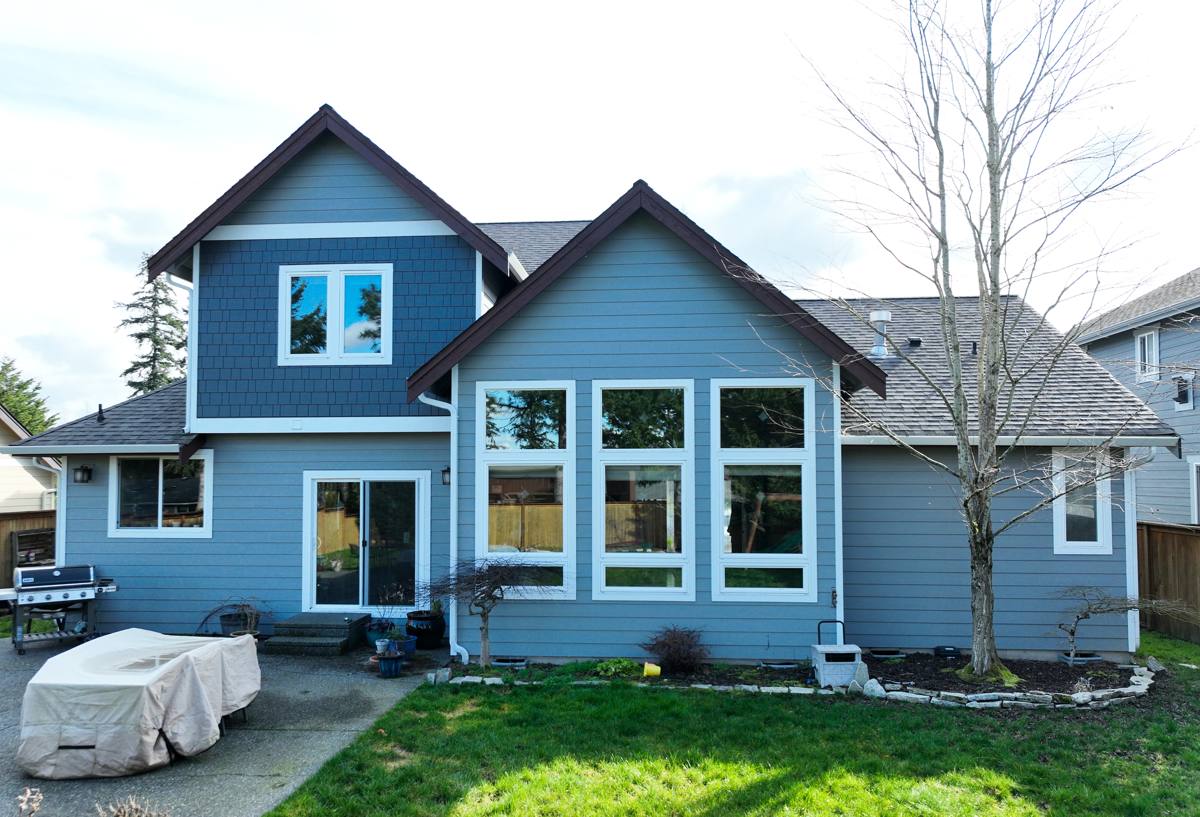
What This Environment Demands From a Siding System
Salt Air and Corrosion
Homes closer to the water take a steadier dose of salt-laden air than properties even a mile or two inland. Salt accelerates corrosion in fasteners, flashing, and trim, and it can break down a weak factory finish faster than a drier climate would. Every piece of hardware that goes into a Birch Bay siding job — nails, screws, flashing, trim fasteners — needs to be chosen with that corrosion exposure in mind, not just picked because it's what's on the truck.
Wind-Driven, Sideways Rain
Open water exposure also means more wind, and wind-driven rain doesn't behave like a calm, straight-down rainstorm. It gets pushed sideways into seams, laps, and anywhere two building materials meet — window trim, corner boards, the transition where siding meets the roofline. A siding system that would perform fine in a sheltered inland yard can still take on moisture here specifically because water is arriving from an angle the installation wasn't detailed to handle.
A Long Moss and Mildew Season
Mild temperatures, shade from tree cover, and near-constant dampness add up to a moss and mildew season that runs longer here than in drier parts of Whatcom County. It shows up first on shaded and north-facing walls, and any siding material that's even slightly porous becomes a surface for organic growth to take hold over time. A material's resistance to moisture absorption matters as much as its resistance to physical damage.
Why We Only Install James Hardie Siding
We used to offer a broader range of siding products. We don't anymore, and that change came directly from what we kept finding on service calls and tear-offs in coastal, high-moisture conditions like Birch Bay's — not from a supplier deal or a sales script.
- Non-combustible core: Fiber cement doesn't feed a fire the way wood-based siding products can, which matters for both safety and, in many cases, insurance considerations.
- Factory-applied ColorPlus finish: The color is baked on under controlled factory conditions rather than brushed on in the field, which holds up longer against fading, chalking, and moisture intrusion than site-applied paint.
- Climate-engineered HZ product lines: Hardie builds specific formulations for regions with heavy moisture exposure, which describes waterfront Whatcom County well.
- Dimensional stability: Fiber cement doesn't swell, cup, or warp the way engineered wood products can after repeated wet-dry cycles through a Pacific Northwest winter.
- Strong transferable warranty: Hardie backs its product with one of the more substantial warranty structures in the industry, provided the installation follows their published specifications.
We won't install LP SmartSide, vinyl siding, Cemplank, Allura, primed spruce, or cedar. Each of those products has a legitimate place in the market and homeowners elsewhere who are satisfied with them — this isn't a claim that they're defective. It's a professional call we've made: on an exposure like Birch Bay's, engineered wood products carry more long-term moisture and maintenance risk than we're willing to put our name behind, vinyl can't match fiber cement's rigidity and fire performance, and site-finished or unfinished wood products (primed spruce, cedar) put ongoing maintenance and repainting squarely on the homeowner in a climate that's especially hard on field-applied coatings. We'd rather install one system we fully stand behind than offer a cheaper alternative that shifts risk onto the people living in the house.
Matching the Right Hardie System to a Waterfront-Adjacent Home
James Hardie makes several siding profiles — lap siding, shingle-style panels, and board-and-batten among them — and most Birch Bay homes can wear any of these well depending on the architectural style. The more important decision for this location is the underlying HZ formulation. Washington's marine climate zone generally calls for Hardie's moisture- and freeze-thaw-oriented HZ5 product line rather than the drier-climate formulation sold in other parts of the country. Getting the right HZ designation matters more here than picking a particular profile — it's the part of the product that's engineered specifically for conditions like a wet, mild Pacific Northwest winter with sustained humidity, which is exactly what Birch Bay gets.
Color is worth planning alongside the profile choice rather than as an afterthought. ColorPlus finishes come in dozens of options, and on a shoreline-adjacent property it's worth viewing physical samples outdoors, in both bright and overcast light, before committing — colors read differently under the flatter, grayer light this area gets for a good part of the year than they do on a sunny showroom sample board.
What Correct Installation Looks Like in This Climate
Fiber cement only performs the way it's engineered to when it's installed to Hardie's published specifications, and in a climate like Birch Bay's, the installation details matter as much as the material itself. A Hardie product installed loosely will still develop moisture problems here — the material is only as good as the work behind it.
- Correct fastener type and spacing: corrosion-resistant fasteners set at the manufacturer's specified spacing and depth, not just "close enough."
- Proper clearance from grade and roof lines: siding held up off the ground and away from roof surfaces by the minimum required gap so it isn't sitting in standing moisture.
- Rain-screen or drainage-plane detailing: a drainage gap and weather-resistive barrier behind the panels so any moisture that does get past the siding has somewhere to go instead of sitting against the sheathing.
- Properly lapped and sealed flashing: at every window, door, and wall penetration, since sideways-driven rain finds gaps that straight-down rain never would.
- Factory-mitered or correctly caulked joints: tight, consistent seams at corners and butt joints rather than gaps filled with excess caulk as a shortcut.
| Siding Material | Moisture Behavior | Maintenance | Fire Resistance | Typical Warranty |
|---|---|---|---|---|
| James Hardie fiber cement (HZ5) | Dimensionally stable, doesn't swell or rot when installed to spec | Occasional gentle washing | Non-combustible | Long, transferable, product-backed |
| LP SmartSide (engineered wood) | Can swell or delaminate at cut edges and joints if moisture gets in | Regular inspection of seams and finish | Combustible (wood-based) | Manufacturer warranty, more installation-sensitive |
| Vinyl siding | Doesn't absorb water but can warp, crack, or blow off in high wind | Low, but color can fade and isn't repairable in place | Melts/deforms under heat | Varies widely by manufacturer and grade |
| Cedar / primed spruce | Absorbs moisture; prone to rot and moss growth without diligent upkeep | Regular repainting/staining and moss treatment | Combustible | Typically none beyond the finish coating |
Our Process for a Birch Bay Siding Project
- On-site assessment: we walk the whole exterior, note wind and shade exposure on each elevation, and check for existing moisture damage before quoting anything.
- Tear-off and sheathing inspection: once old siding comes off, we inspect the sheathing and framing underneath for rot or hidden damage — a step that matters more here than in drier climates, since problems can be developing behind siding that still looks fine from the outside.
- Repair and moisture barrier installation: any damaged sheathing gets replaced, and a weather-resistive barrier with proper drainage detailing goes on before any Hardie panel does.
- Hardie installation to manufacturer spec: correct fasteners, clearances, flashing, and joint treatment, following the details above rather than shortcuts.
- Trim, caulking, and finish work: corner boards, trim, and any ColorPlus touch-up caulking completed to a consistent, weather-tight standard.
- Final walkthrough: we go over the completed exterior with the homeowner before calling the job done.
What a Solid Birch Bay Estimate Should Include
- A physical walk of every exterior wall, not just a drive-by or a photo estimate
- A clear answer on which Hardie HZ formulation and profile is being quoted, and why
- A specific plan for moisture barrier and drainage detailing, not a vague "we'll handle it"
- Confirmation of Washington contractor licensing and bonding, and who pulls the Whatcom County or applicable permit
- A written scope that separates tear-off, sheathing repair (if needed), and new siding installation as distinct line items
- A realistic timeline that accounts for weather windows, since siding work pauses during heavy wind-driven rain
Cost Factors on a Birch Bay Siding Project
| Factor | Why It Affects Cost |
|---|---|
| Home size and elevation complexity | More square footage and more corners, gables, and trim details mean more material and labor |
| Tear-off vs. install over existing | Removing old siding costs more up front but is usually the right call once moisture is suspected underneath |
| Hidden sheathing or framing repair | Rot found during tear-off has to be fixed before new siding goes on, and the extent isn't always known until the old material is off |
| Trim, window, and detail count | More openings and architectural detail mean more flashing, cutting, and finish work |
| Profile and color selection | Shingle-style panels and premium ColorPlus colors typically cost more than standard lap siding in common colors |
| Site access | Waterfront lots with limited staging space or steep grades can add labor time |
We don't publish a flat per-square-foot number because these factors genuinely change the total, and quoting a fake average would tell a homeowner less than an actual walk-through does.
Why a Crew That Already Works Birch Bay Matters
Siding work here isn't the same job as siding work ten miles inland. A crew that already works Birch Bay knows to plan flashing and drainage detailing for sideways rain as a default, not an upgrade; knows which elevations on this stretch of coastline take the worst of the wind and salt; and has already been through the Whatcom County permitting process enough times that it doesn't slow the job down. That experience shows up less in what gets said during the estimate and more in what doesn't fail five years later — the joint that was caulked correctly the first time, the fastener that wasn't left to corrode, the drainage plane that was actually installed instead of skipped to save an hour.
If your siding is showing moss buildup that keeps coming back, panels that feel soft or look swollen, or paint that's failing faster than it should, it's worth having it looked at before small problems turn into sheathing repair. If you're planning a full re-side or want an honest look at what a James Hardie system would cost for your specific home, we're happy to walk the property with you and put together a free, no-pressure estimate.