 Bellingham Roofing
 Why Puget-Area Siding Wears Differently
Homes near the water in the Puget Sound region deal with a combination of stresses that inland houses in Whatcom County simply don't see as much of. Salt-laden air corrodes fasteners and finishes faster. Wind-driven rain doesn't just wet the surface of your siding — it gets pushed sideways and upward under laps, trim, and butt joints that were never designed to shed water from that angle. And the long, wet moss season here means anything shaded or north-facing stays damp for weeks at a stretch, which is exactly the condition organic growth and rot both need to take hold.
None of this means a Puget-area home is doomed to constant siding problems. It means the siding, the flashing details, and the repair work all have to be matched to those specific conditions — not treated the same as a repair job on a dry, sheltered lot across town. A patch that would hold up fine somewhere else can fail here within a couple of seasons if it doesn't account for how water actually moves across this coastline.
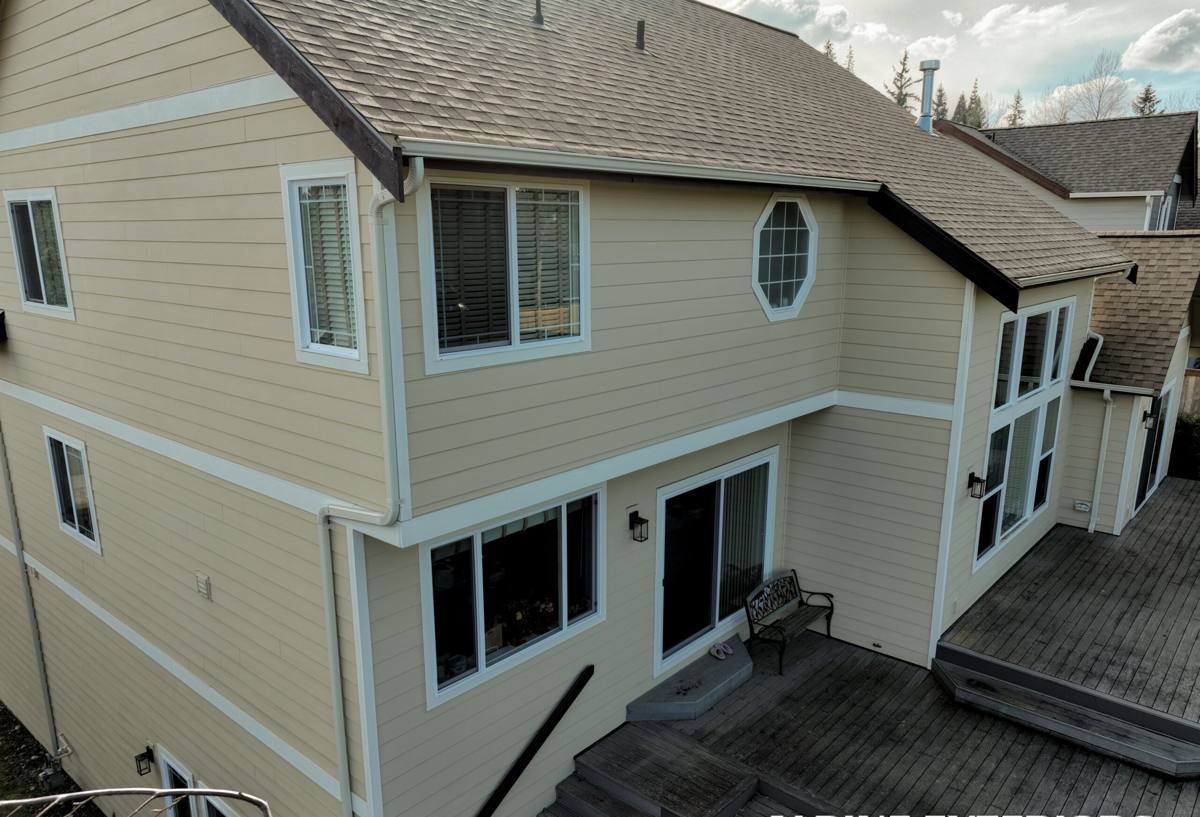
Signs Your Siding Needs Repair, Not Just Paint
A lot of homeowners reach for a paint job when the real problem is underneath the surface. Repainting over damaged siding buys a little time and hides the issue, but it doesn't stop water intrusion or rot — it just makes it harder to see until the damage is worse. Here's what actually signals a repair need:
- Soft or spongy spots when you press on the siding, especially near the bottom courses or around windows and doors
- Visible cracking or splitting at butt joints, corners, or panel edges
- Persistent dark streaking or moss growth that comes back within a season of cleaning
- Paint that's bubbling, peeling, or failing in patches rather than evenly across the wall
- Gaps opening up at trim boards, corner posts, or where siding meets window and door casings
- A musty smell or visible staining on interior walls that back up to exterior siding
Any one of these can be a small, contained fix if it's caught early. Left alone through another wet Whatcom County winter, most of them turn into a much bigger job — often one that involves sheathing repair, not just siding replacement.
What a Correct Siding Repair Actually Involves
A siding repair that's done right isn't just cutting out a bad section and nailing in a new piece. It starts with figuring out why that section failed in the first place — because if the underlying cause (bad flashing, a missing kick-out, poor caulk joints, trapped moisture) isn't addressed, the replacement piece will fail the same way on the same timeline.
The steps that matter
A proper repair sequence looks like this: remove the damaged siding and any surrounding material that shows signs of moisture intrusion, inspect the water-resistive barrier and sheathing underneath for rot or staining, correct whatever let water in to begin with (flashing, sealant, drainage plane gaps), then install new material with the same fastening pattern, clearances, and finish as the surrounding siding. Skipping the inspection step is the single most common shortcut that leads to repeat failures — and it's the one that's easiest to skip because it doesn't show up in a quick estimate.
Matching existing siding
If your home already has fiber cement siding, a proper repair uses the same material system so the patched area expands, contracts, and weathers the same way as the rest of the wall. Mixing material types on the same wall — even if the color looks close on day one — almost always shows as a visible seam once the finishes age at different rates.
Repair vs. Replacement: How to Tell Which You Need
Not every siding problem calls for a full re-side, and not every repair is worth doing if the rest of the siding is close behind it. Here's how we walk homeowners through that decision:
| Factor | Repair usually makes sense | Replacement usually makes sense |
|---|---|---|
| Extent of damage | Isolated to one or two wall sections | Spread across multiple elevations |
| Age of existing siding | Under 15 years, otherwise sound | Original siding is decades old or already failing broadly |
| Cause of failure | One-off event (impact, isolated flashing gap) | Systemic issue (product-wide moisture behavior, original install defects) |
| Material on the house now | Fiber cement, in good condition elsewhere | Vinyl, LP SmartSide, or wood showing widespread wear |
| Underlying sheathing | Dry and sound at the damaged area | Rot found in multiple locations during inspection |
We'll tell you honestly which side of that table your house falls on. A repair that's going to need a matching repair three walls over in two years isn't a good use of your money — we'd rather say so upfront than sell you a patch job twice.
Why We Repair — and Replace — With James Hardie Fiber Cement Only
Bellingham Roofing Co installs and repairs with James Hardie fiber cement siding exclusively. We don't install vinyl, LP SmartSide, cedar, primed spruce, Cemplank, or Allura, and when a repair calls for new material, we use Hardie product even if the rest of your home is something else — which is a conversation we'll have with you directly rather than quietly mixing materials.
The reason comes down to how these products handle the exact conditions Puget-area homes deal with. Fiber cement is non-combustible and dimensionally stable — it doesn't swell, cup, or delaminate the way wood-based siding can when it stays damp through a long moss season. James Hardie's ColorPlus factory finish is baked on under controlled conditions, which holds up better against salt air and UV than field-applied paint, and it's backed by a real transferable warranty on both the substrate and the finish. Hardie's HZ5 product line is specifically engineered for the wetter, harsher climate zones — which is exactly the environment a Puget Sound-adjacent property sits in.
That's not a knock on every alternative product across the board — vinyl and engineered wood both have their place and their fans. It's why we standardized on one system we trust to perform, warranty, and match consistently, rather than repairing with whatever's cheapest or most convenient for a given job.
Our Process for Puget Siding Repair
When we come out for a repair estimate in the Puget area, we're not just looking at the damaged section — we're looking at the whole elevation and asking what caused it. Our process:
- Full-wall inspection — not just the visibly damaged spot, since water intrusion often travels sideways under the siding before it shows on the surface
- Moisture check at the damaged area and at common failure points nearby (window heads, deck ledgers, dryer vents, hose bibs)
- Honest scope recommendation — repair, partial re-side, or full replacement, with our reasoning explained, not just a number
- Root-cause correction — flashing, sealant, or drainage fixes done before any new siding goes up
- Material match using James Hardie product and fastening to manufacturer spec so the repair performs and ages like the surrounding wall
- Final walk-through so you can see exactly what was done and why
What to Ask Before Hiring a Siding Repair Crew
Siding repair is one of those jobs where a fast, cheap fix can look identical to a correct one for the first six months. Before you hire anyone in the Bellingham area, it's worth asking:
- Will you inspect the sheathing and water-resistive barrier, or just replace the visible boards?
- What caused this damage, and will the repair actually prevent it from happening again?
- What siding material will you use for the patch, and will it match the performance of what's already on my house?
- Is the flashing and sealant work included, or billed separately if problems are found?
- Do you carry manufacturer certification for the material you're installing?
- What's covered under warranty — labor, material, or both — and for how long?
A contractor who's comfortable answering all of these in plain language, before you sign anything, is a good sign. One who wants to talk price before talking scope usually isn't.
Why Local Experience in Puget Matters
Every coastal neighborhood in Whatcom County has its own version of "the wall that always has a problem" — the north side that never dries out, the corner that catches wind-driven rain off the water, the low section that sits closer to grade than it should. A crew that's worked repair calls across the Puget area already has a mental list of where those problem spots tend to show up on a given lot orientation, which means less guesswork and fewer surprises once the old siding comes off. That's not something you can shortcut with a general contractor who mostly works inland — the climate exposure here is genuinely different, and the repair details need to reflect it.
If you're seeing soft spots, staining, or siding that just won't stay clean through moss season, we're happy to take a look and give you a straight answer on what it actually needs. Request a free, no-pressure estimate using the form below.