 Bellingham Roofing
 South Hill Siding Takes a Beating — Here's Why
Homes on South Hill sit in a stretch of Whatcom County that gets the full Pacific Northwest treatment: salt-tinged air drifting in off the water, months of driving rain that comes in sideways more often than straight down, and a moss season that seems to run longer every year. None of that is unusual for Bellingham. But it does mean siding here has a harder job than siding in a dry inland climate, and it fails in different, more specific ways when it's installed wrong.
Salt air accelerates corrosion on exposed fasteners and metal flashing. Driving rain finds every gap in a weather-resistive barrier and pushes moisture sideways into wall cavities, not just down. And moss doesn't just grow on roofs — it colonizes shaded, north-facing siding and butt joints that stay damp for weeks at a stretch, holding water against the substrate long after a storm has passed. A siding job that would hold up fine in a milder, drier region can start showing problems within a few years on South Hill if it wasn't detailed for this specific climate.
That's the lens we use for every siding installation in this neighborhood: not "will this look good going up," but "will this still be doing its job in twenty years of Whatcom County weather."
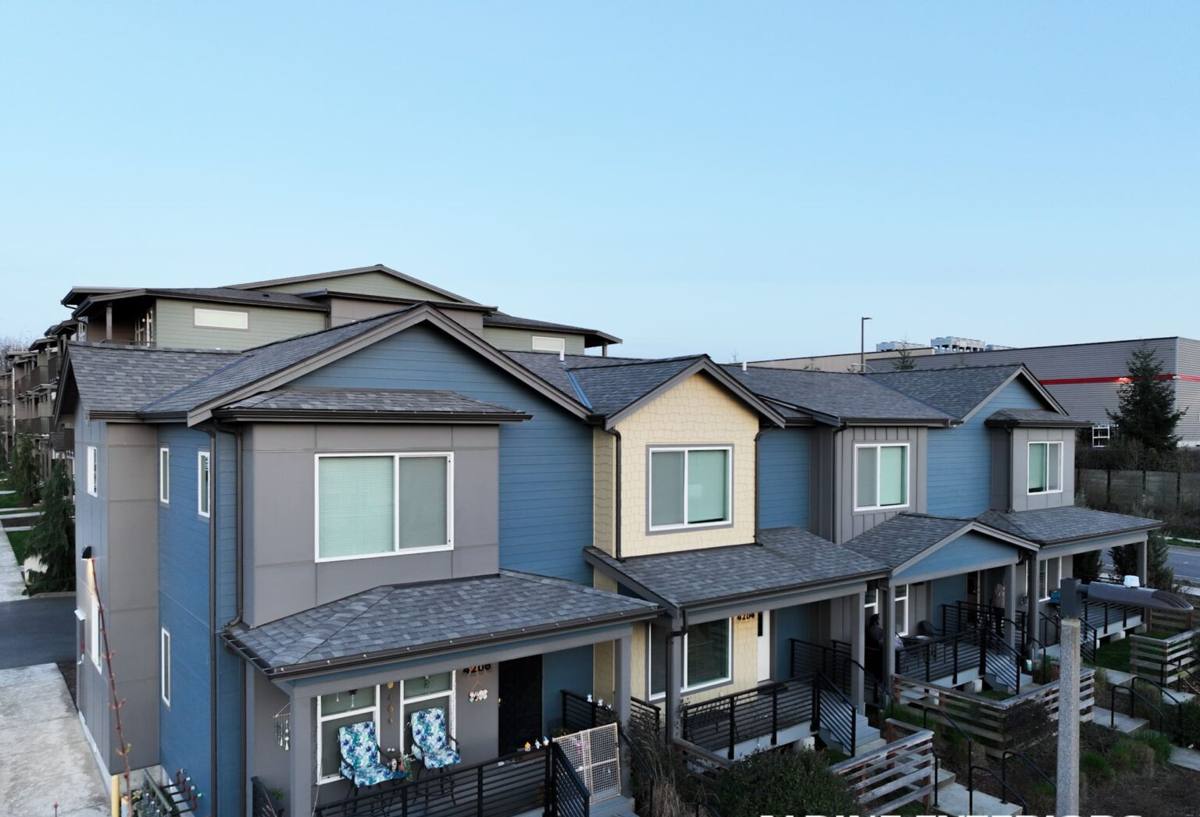
What a Correct Siding Installation Actually Involves
Siding is a system, not a single layer of material nailed to the wall. On a house exposed to the kind of wind-driven rain South Hill sees, every layer under the visible surface matters as much as the finish itself.
The Weather-Resistive Barrier
Before any siding goes up, the wall needs a continuous, properly lapped weather-resistive barrier (WRB). Laps have to shed water downward and outward at every seam, and every penetration — hose bibs, light fixtures, vents — needs to be flashed and sealed back into that barrier, not just caulked around after the fact. This is the layer that does the real work when rain is being pushed horizontally into a wall, and it's also the layer that's easiest to shortcut if a crew is moving fast.
Flashing and Drainage Plane
Behind the siding itself, a drainage plane gives any moisture that does get past the surface a path to escape rather than sitting against the sheathing. Window and door flashing has to integrate with that drainage plane in the correct order — head flashing last, sill flashing first — so water is always directed out, never trapped behind trim.
Fastening and Clearances
Fiber cement siding has specific fastening requirements: nail placement, penetration depth, and spacing all affect how the boards perform over time and whether the manufacturer's warranty stays valid. Ground clearance and clearance from roof lines, decks, and grade also matter more here than in a dry climate — siding installed too close to grade or a roof surface stays wet longer and is exactly where moss and mildew take hold first.
Caulking and Sealant Joints
Joints and butt seams need the right sealant, applied correctly, at the right points — and only at the points where the manufacturer specifies it. Over-caulking is almost as common a mistake as under-caulking; sealing a joint that's designed to allow drainage can trap moisture instead of releasing it.
Why We Install James Hardie Fiber Cement Here — Not Vinyl, Not Wood-Based Products
We standardized on James Hardie fiber cement siding for every home we work on, including South Hill, and it's worth explaining why in plain terms rather than just naming the brand.
Vinyl siding is affordable and low-maintenance in the sense that it doesn't need painting, but it's a thin material that expands and contracts significantly with temperature swings, and it relies on lap joints and J-channels rather than a sealed system — those joints are exactly where wind-driven rain finds a way in on an exposed site. It also softens and can warp under the kind of sustained damp-and-dry cycling that's normal for this region.
Wood-based composite and primed wood products (like LP SmartSide or primed spruce) perform reasonably well when maintenance stays current, but they depend on that maintenance — recaulking, repainting, and catching cut edges before moisture gets into the substrate. In a climate with this much sustained moisture exposure and moss growth, a missed maintenance cycle turns into a real problem faster than it would somewhere drier.
James Hardie fiber cement is a cement-and-cellulose composite that doesn't absorb and swell the way wood-based products can, and it's engineered specifically for climate zones like ours — the HZ5 product line is formulated for regions with sustained moisture and freeze-thaw cycling, which describes Whatcom County well. It's also non-combustible, which matters more each year as wildfire smoke seasons stretch further north. The factory-applied ColorPlus finish is baked on under controlled conditions rather than field-painted, so it holds color and resists the fading and chalking that field-applied paint shows first on a house exposed to constant moisture and salt air.
Comparing Siding Options for a South Hill Home
| Factor | Vinyl | Wood/Composite (e.g. LP SmartSide) | James Hardie Fiber Cement |
|---|---|---|---|
| Moisture resistance | Moderate — joint-dependent | Good if maintained; vulnerable at cut edges | Strong — engineered for wet climates |
| Maintenance burden | Low, but joints degrade over time | Ongoing — repaint/reseal on a schedule | Low — factory finish holds color for years |
| Fire resistance | Combustible | Combustible | Non-combustible |
| Performance in salt air / wind-driven rain | Fair | Fair to good, maintenance-dependent | Strong |
| Typical warranty structure | Prorated, material-only | Limited, often excludes labor | Long-term, transferable, material warranty |
Our Installation Process
The process is the same core sequence on every South Hill home we work on, adjusted for the specific exposure of the site — a wall facing prevailing weather off the water gets more attention at every seam than a sheltered wall.
- Assessment and tear-off: we remove existing siding and inspect the sheathing underneath for rot, soft spots, or prior water damage before anything new goes up. This is the step that reveals whether previous siding failed because of the product or because of how it was installed.
- Sheathing repair: any compromised sheathing gets replaced — installing new siding over damaged sheathing just hides the problem for a few more years.
- Weather-resistive barrier: a continuous WRB is installed and lapped correctly, with all penetrations flashed and integrated into the barrier.
- Trim, flashing, and drainage plane: window and door flashing, corner trim, and the drainage plane go in before siding, in the correct sequence for the products being used.
- Hardie siding installation: boards are fastened to manufacturer specification for nail type, placement, and spacing, with correct clearances from grade, roof lines, and decks.
- Joint sealing and finish detail: sealant is applied only where specified, and all cut edges are factory-primed or field-treated per Hardie's installation guidelines so no raw edge is left exposed to moisture.
- Final walkthrough: we check every elevation for consistent reveal, tight joints, and correct clearances before calling the job done.
Signs Your Current Siding Is Already Struggling
- Dark streaking or moss growth concentrated on north-facing or shaded walls
- Soft or spongy spots when you press on siding near the base of the wall
- Paint or finish that's bubbling, peeling, or chalking unevenly across a wall
- Visible gaps, warping, or separation at butt joints and corners
- Rust staining below fasteners or metal flashing
- Siding that sits tight against grade, a deck surface, or a roofline with little to no clearance
- Interior signs — musty smell, discoloration on interior walls — near exterior corners
Any one of these on its own isn't necessarily an emergency, but on a South Hill home they're worth having looked at before another wet season passes, since moisture problems behind siding tend to compound quietly.
Why Hiring a Crew That Already Works This Neighborhood Matters
Siding installation isn't just about following a manufacturer's install guide — it's about knowing how a specific site behaves. A crew that regularly works South Hill and the broader Bellingham area already understands which elevations take the worst of the wind-driven rain, how long moss season really runs here, and how much clearance actually holds up against a Whatcom County winter, not just what a spec sheet says on paper. That local pattern recognition shows up in small decisions — where to add extra flashing attention, which corners need tighter joint work — that a crew unfamiliar with the area's specific weather behavior might not think to prioritize.
It also matters for accountability. A local crew is easy to reach if a question comes up two years after installation, and stands behind a transferable manufacturer warranty backed by workmanship that was done to spec the first time.
What Ongoing Maintenance Looks Like
Correctly installed Hardie siding is genuinely low-maintenance, but "low" isn't "none." A yearly walk-around to check for moss buildup in shaded areas, confirm caulked joints still look intact, and make sure gutters and downspouts aren't dumping water directly onto a wall goes a long way. Because the ColorPlus finish is factory-applied, repainting generally isn't part of the maintenance picture the way it is with field-painted products — that alone removes one of the biggest recurring costs homeowners deal with on other siding types.
Get a Straightforward Estimate
If your South Hill home's siding is showing its age, or you're planning ahead for a replacement before the next wet season, we're happy to come take a look and give you a straightforward, no-pressure estimate. Use the form below to get started.