 Bellingham Roofing
 Decking Built for Blaine's Coastline, Not a Catalog Photo
Blaine sits right on the water at the northern edge of Whatcom County, and that location shapes everything about how a deck ages here. Homes close to Semiahmoo Bay and the Strait of Georgia deal with salt-laden air, near-constant winter rain, and a moss season that can stretch from October well into spring. A deck that looks great going in but wasn't specified for this environment usually shows problems within a few years — fading, staining, slick surfaces, or fasteners that start to corrode. Composite decking, installed correctly for this climate, is one of the more reliable ways to avoid that cycle.
This page covers what we actually do when we build or replace a composite deck for a Blaine property: what the salt air and rain demand from the materials and framing, how we structure the job, and why it matters that the crew doing the work already understands this stretch of coastline.
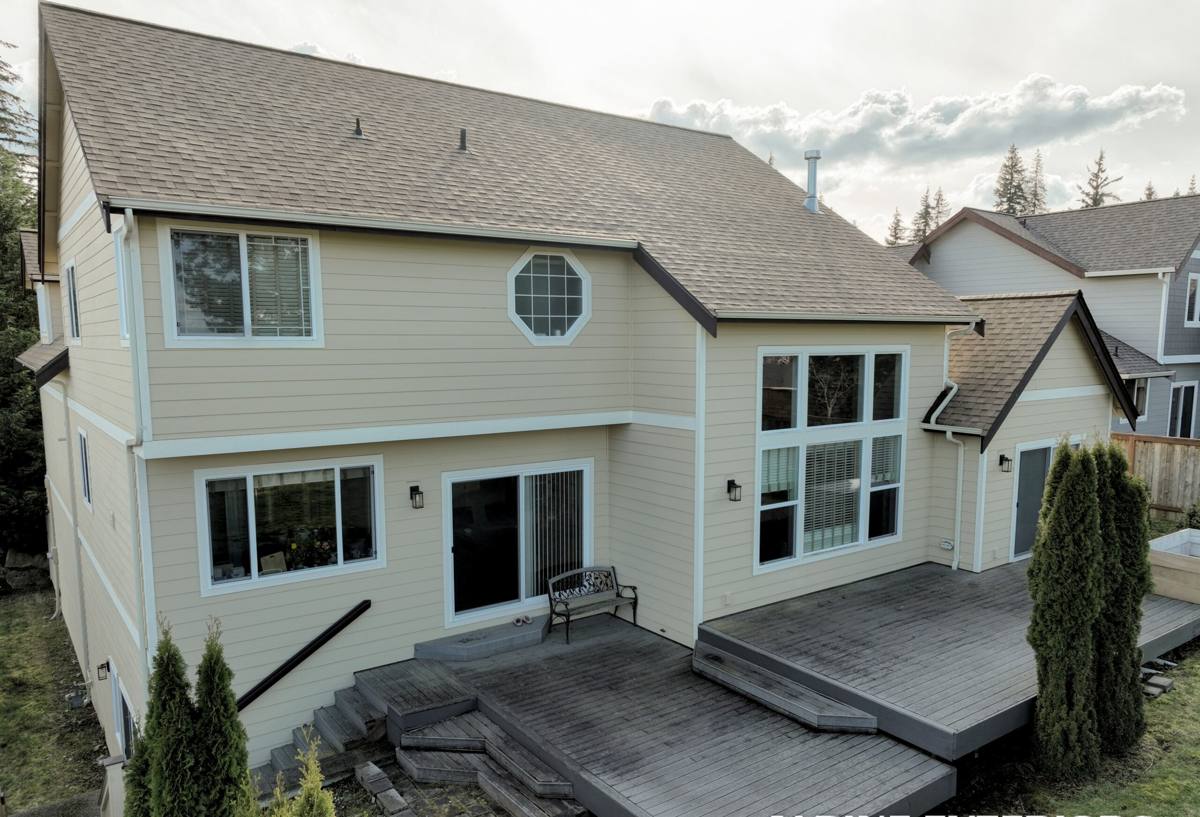
Why Blaine's Climate Is Harder on Decks Than Most People Expect
Salt Air and Coastal Moisture
Properties near the water in Blaine get a steady dose of salt-laden moisture in the air, even when it's not actively raining. Over time that salt exposure accelerates corrosion on any exposed metal — screws, joist hangers, railing brackets — and it can dull or discolor lower-grade decking surfaces faster than the same product would age a few miles inland. Fastener choice and flashing details matter more here than in a landlocked neighborhood.
Driving Rain and Standing Water
Whatcom County's weather pattern brings rain that often comes in sideways off the water, driven by wind. That means water doesn't just fall on a deck — it gets pushed under railings, into board gaps, and against the house where the ledger board attaches. If drainage, gapping, and ledger flashing aren't handled correctly, water finds its way into the structure underneath, which is where the real damage happens.
Moss, Algae, and a Long Wet Season
Shaded decks, or ones under trees, stay damp for extended stretches through fall, winter, and spring. That's exactly the environment moss and algae need to take hold. On wood decking this often means soft, slippery patches. On composite decking, the surface itself resists rot, but moss and algae can still grow on top of it if the board isn't ventilated underneath and cleaned periodically — so material choice solves part of the problem, not all of it.
What "Correctly Installed" Actually Means Here
A composite deck is only as good as the framing and detailing underneath it. In a coastal Whatcom County climate, a handful of details separate a deck that lasts decades from one that needs early repairs.
- Corrosion-resistant fasteners and hardware — stainless steel or coated fasteners rated for coastal exposure, not standard galvanized hardware that can start rusting within a few seasons near the water.
- Proper board gapping — composite boards expand and contract with temperature and moisture; gapping has to account for our wet winters and drier summers, not a one-size-fits-all spacing.
- Ledger board flashing — the point where the deck attaches to the house is the single most common source of hidden rot if it isn't flashed and sealed correctly against driving rain.
- Joist tape or joist protection — protecting the tops of framing lumber from trapped moisture, which matters more in a climate where framing rarely gets a chance to fully dry out between storms.
- Airflow underneath the deck — adequate ventilation below the boards so moisture doesn't sit trapped against the underside, which contributes to both structural wear and moss growth on the surface above.
- Grading and drainage away from the foundation — especially important on properties with any grade toward the house, where deck runoff and yard drainage can combine into a moisture problem at the foundation line.
Skipping any one of these doesn't usually show up right away. It shows up in year three or four, as soft spots, staining, or a deck that starts to feel less solid underfoot — after the visible boards have already convinced the homeowner everything is fine.
Composite vs. Wood for a Blaine Deck
Both materials can work in this climate. The right choice depends on how much upkeep a homeowner wants to take on and what the deck will be used for.
| Factor | Composite Decking | Pressure-Treated Wood |
|---|---|---|
| Moisture & rot resistance | High — core material doesn't absorb water like wood fiber | Moderate — treatment resists rot but isn't permanent, especially at cut ends |
| Maintenance | Periodic washing to prevent surface moss/algae; no staining or sealing | Annual or biannual cleaning, staining, and sealing to hold up in coastal rain |
| Salt air exposure | Surface generally holds color and texture well with proper care | More prone to graying, splitting, and splintering near the water |
| Upfront cost | Higher material cost | Lower material cost |
| Long-term cost | Lower — minimal recurring maintenance spend | Higher over time due to recurring maintenance |
| Fastener/hardware sensitivity | Still requires coastal-grade hardware for a full lifespan | Same requirement — hardware choice matters regardless of decking material |
We install both, but for most Blaine homeowners who want to spend less time maintaining a deck and more time using it, composite is the more practical long-term choice given how much rain and salt exposure this location sees.
Our Process for a Blaine Composite Deck
1. On-Site Assessment
We look at the deck's exposure — how close it is to the water, how much sun and shade it gets, existing drainage patterns, and the condition of any structure we'd be building on or replacing. This is also where we flag anything unusual about the site, like grading issues or an existing ledger connection that needs attention.
2. Material and Layout Planning
We walk through composite board options, color and finish choices, and railing systems, and talk through realistic maintenance expectations for each. Layout gets planned around drainage and airflow first, appearance second — a deck that's beautiful but traps water underneath isn't a good long-term outcome.
3. Framing and Structural Work
This is where the coastal-specific details happen: corrosion-resistant fasteners, correct ledger flashing, joist protection, and framing spaced and supported to meet code and to handle our wet season without excess deflection.
4. Composite Board Installation
Boards are installed with manufacturer-specified gapping and fastening systems, with attention to consistent spacing so the deck drains evenly rather than pooling in low spots.
5. Railings, Trim, and Finish Details
Railing systems, fascia, and stair details get finished out, with the same coastal-grade hardware standard applied throughout — not just on the primary deck surface.
6. Final Walkthrough
We walk the finished deck with the homeowner, cover basic care — periodic washing, what to watch for near the ledger and under railings — and answer questions before calling the job done.
What to Ask Before Hiring Anyone for Deck Work Near the Water
- Do they use corrosion-resistant fasteners and hardware as standard, or only if asked?
- How do they flash and seal the ledger board connection to the house?
- Do they explain gapping and drainage planning, or just talk about board color and style?
- Are they licensed and insured to work in Washington, and can they show it?
- Have they built decks in coastal Whatcom County specifically, not just inland projects?
- Do they give a clear, written scope before work starts — framing, fasteners, board brand, and railing system all spelled out?
Why a Crew That Already Works Blaine Matters
A deck built to a generic spec can still fail in a coastal environment, even with good materials, if the installer isn't accounting for what this location actually does to a structure over time. A crew that regularly works Blaine and the surrounding Whatcom County coastline already knows which hardware holds up near the water, how aggressive the moss season gets on shaded decks, and where driving rain tends to find weak points in a typical build. That's the difference between a deck that needs attention in year four and one that's still solid well past year fifteen.
We're a Bellingham-based crew that works this whole corner of Washington, and Blaine's coastal conditions are a normal part of how we plan and build every deck out here — not an afterthought.
Get a Straight Answer on Your Deck Project
If you're planning a new composite deck or replacing one that's showing its age, we're glad to take a look and give you an honest read on what it needs. Reach out for a free, no-pressure estimate using the form below.