 Bellingham Roofing
 Edgemoor's Climate Challenge: Salt Air, Rain, and Moss
Edgemoor sits close to the water, tucked under a heavy canopy of mature evergreens, and that combination creates one of the tougher siding environments in the Bellingham area. Homes here deal with three things at once: salt-laden air drifting up from Bellingham Bay, long stretches of driving rain typical of Whatcom County winters, and deep shade from the tree cover that keeps north- and east-facing walls damp for days after a storm. That shade is also why moss season runs longer here than it does in more open parts of town — moss doesn't just grow on roofs, it colonizes siding seams, trim joints, and anywhere water sits instead of shedding.
None of this is unusual for the Pacific Northwest, but Edgemoor gets a concentrated version of it. Salt air accelerates corrosion on fasteners and metal trim. Persistent shade slows drying time after every rain event. And moss holds moisture directly against the siding surface, which is exactly the condition that causes rot, paint failure, and coating breakdown over time. A siding product and installation that would be perfectly adequate in a drier, sunnier neighborhood can struggle here if it isn't matched to these specific conditions.
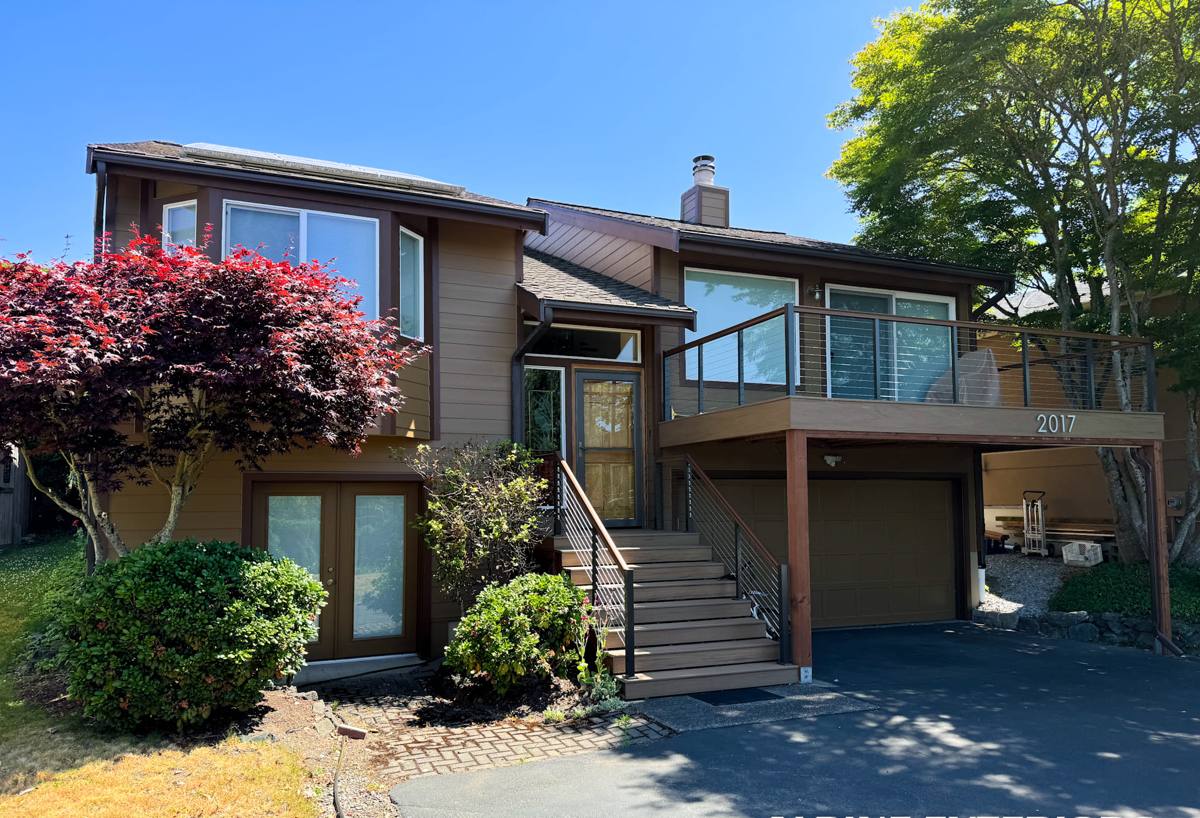
Why Fiber Cement Is the Right Match for This Setting
Fiber cement siding is cement, sand, and cellulose fiber pressed and cured into a dense, stable board. It doesn't absorb water the way wood does, it doesn't warp or delaminate the way some engineered wood products can when moisture gets past the surface, and it holds paint and factory finishes far longer than wood substrates in a shaded, damp environment. For a neighborhood like Edgemoor, that stability matters more than in most parts of Bellingham.
It's also non-combustible, which is a real consideration on wooded, tree-lined lots where defensible space is limited by mature landscaping that homeowners understandably don't want to remove. Fiber cement won't contribute fuel to a fire the way wood-based siding products can, and it holds up to the freeze-thaw and wet-dry cycling that comes with a marine climate without the swelling and shrinking that stresses paint film and joints over years of exposure.
Why We Install Only James Hardie — Not Alternatives
We install James Hardie fiber cement exclusively. We don't install LP SmartSide, vinyl, Cemplank, Allura, primed spruce, or cedar, and we think Edgemoor homeowners deserve to know why before they choose a siding product, not after.
Each of those alternatives has legitimate strengths — vinyl is inexpensive and low-maintenance in mild conditions, cedar has a natural look many people love, LP SmartSide is a genuinely engineered wood product with real fire and moisture treatments. But each also carries a trade-off that becomes more pronounced in a wet, shaded, salt-influenced environment like Edgemoor: engineered wood products rely on an intact factory seal that, once breached at a cut edge or fastener hole, allows moisture into the wood fiber core. Vinyl expands and contracts significantly with temperature swings and can crack in cold snaps. Cedar needs regular refinishing to keep water out once the natural oils weather away, and in constant shade that finish breaks down faster. Other fiber cement brands may be dimensionally similar to Hardie, but we don't have the same installation history, warranty backing, and factory finish consistency with them that we do with Hardie, and we'd rather stand fully behind one system we know inside and out than split our expertise across several.
| Material | Where it holds up well | Where it struggles in Edgemoor's conditions |
|---|---|---|
| James Hardie fiber cement | Damp, shaded, coastal-influenced sites; long-term color retention | Higher material cost than vinyl |
| Vinyl siding | Budget projects, dry or moderate climates | Cold-weather brittleness, fading, doesn't stop moisture at the wall |
| LP SmartSide / engineered wood | Drier regions, well-ventilated walls | Vulnerable once cut edges or fasteners breach the factory seal |
| Cedar / primed spruce | Traditional appearance, dry-climate maintenance schedules | Needs frequent refinishing in constant shade and salt air |
| Other fiber cement brands (Cemplank, Allura) | Comparable material properties to Hardie | Less installation history and finish-warranty depth for our crews |
What Correct Fiber Cement Installation Actually Involves
Fiber cement is only as good as the installation behind it. The board itself resists moisture, but the wall assembly around it is what actually keeps water out of the structure — and this is where a lot of siding jobs, on any product, quietly fail.
Water-Resistive Barrier and Flashing
Every window, door, and penetration needs proper head flashing and a correctly lapped water-resistive barrier underneath the siding, installed shingle-style so water is always directed outward and down, never trapped behind the board. In a rain-heavy, shaded neighborhood, this layer is doing more work than the siding itself — it's the actual water management system.
Fastening and Clearances
Hardie specifies fastener type, spacing, and placement for a reason: improper nailing patterns can cause buckling or crack the board over time. Ground clearance and clearance from roof lines, decks, and grade also matter more here than in a drier climate, since standing moisture and splash-back are more persistent under tree cover.
Caulking and Finish Details
Joints, trim intersections, and butt seams need the right sealant applied correctly — not as a substitute for good flashing, but as a secondary defense. Factory-primed and factory-finished (ColorPlus) boards reduce the number of field-painted cut edges, which is one less place for moisture to find a way in.
Choosing the Right Hardie Line and Color for Edgemoor Homes
James Hardie makes climate-engineered product lines (the HZ system) specifically because the same siding shouldn't be installed identically in Arizona and in the Pacific Northwest. For Edgemoor and the rest of the Bellingham area, that means specifying the HZ5 line, engineered for moisture, moderate freeze-thaw, and damp-climate performance rather than the drier-climate HZ10 formulation used in the desert Southwest.
Color matters here too, though maybe not for the reason people expect. In a shaded, moss-prone neighborhood, darker colors can show algae and mildew streaking more readily on north-facing walls, while ColorPlus factory finishes — baked-on rather than field-applied — hold up better against UV and salt exposure than a standard field paint job regardless of shade. We walk homeowners through how a specific color and board profile (lap siding, shingle-style panels, or a mix) will actually perform on their specific elevations, not just how it looks on a sample chip.
Our Installation Process, Start to Finish
The process starts with a walk-around of the home to assess the existing siding, wall assembly, trim condition, and any moisture or rot damage that needs to be addressed before new siding goes on — covering up a wet wall with new siding just hides the problem. From there we cover product and color selection, confirm the right Hardie line and accessories for the home's exposure, and pull the necessary Bellingham/Whatcom County permits before any work begins.
Installation itself follows in sequence: removal of old siding and inspection of the sheathing underneath, repair of any damaged framing or sheathing found, installation of the water-resistive barrier and flashing details, then the Hardie boards, trim, and caulking. We finish with a full site cleanup, including magnetic sweeps for stray fasteners, and a final walkthrough so the homeowner can see the completed work and ask questions before we consider the job done.
Living With Fiber Cement in a Moss-Prone Coastal Neighborhood
Fiber cement is low-maintenance compared to wood siding, but "low-maintenance" doesn't mean "no maintenance," especially under Edgemoor's tree cover. A little routine attention keeps the siding performing the way it's designed to for decades.
- Rinse siding (especially shaded, north-facing walls) once or twice a year to keep moss and algae from getting established
- Keep gutters clear so overflow doesn't run directly down siding faces during heavy rain
- Trim back branches and foliage that hold moisture against the wall or block airflow and sun
- Check caulking at trim joints and penetrations periodically and re-caulk if it's cracked or pulling away
- Address any paint or finish wear at cut edges or field-painted trim promptly, before moisture gets behind it
- Watch for efflorescence or staining at the base of walls, which can signal moisture wicking from grade
Cost Factors for Edgemoor Siding Projects
Every home is different, and we don't quote a number without seeing the house, but the same handful of factors drive cost on nearly every Edgemoor project we look at.
| Factor | Why it affects cost |
|---|---|
| Existing wall condition | Rot or moisture damage found during removal adds sheathing/framing repair before new siding goes on |
| Home size and wall complexity | Multiple gables, dormers, and cut-ins take more labor and material than a simple rectangular footprint |
| Number of stories and access | Steep or wooded lots with limited equipment access, common in Edgemoor, can increase labor time |
| Board profile and finish | Lap siding, shingle-style panels, and trim accessories vary in material cost |
| Layers being removed | Removing an existing layer of siding versus installing over a prepared surface changes labor scope |
As a general rule, expect a real cost range rather than a flat per-square-foot number — a full assessment is the only way to give an accurate figure, and that's exactly what a free estimate is for.
Why Local Experience in Edgemoor Matters
A crew that has already worked in Edgemoor knows things a crew from outside the area has to learn on your project. They know which elevations tend to hold moss the longest given the tree cover and orientation typical of the neighborhood. They know how Bellingham's permitting process works and what Whatcom County inspectors expect to see on a residential siding job. They've already seen how salt-influenced air interacts with fasteners and trim over a few winters, not just in a manufacturer's spec sheet.
That local pattern-recognition is what separates a siding job that looks good on installation day from one that still looks good — and is still keeping water out — five, ten, and twenty years later. It's also why we standardized on one product system instead of installing whatever a homeowner happened to ask for: it lets us build real depth of experience with how that system performs specifically in this climate, on homes like the ones in this neighborhood, rather than spreading that knowledge thin across five different products we'd each install less often.
If you're planning a siding project in Edgemoor, we're happy to take a look at your home, walk you through what we're seeing, and put together a free, no-pressure estimate — just fill out the form below to get started.