 Bellingham Roofing
 James Hardie Siding for Birchwood Homes
Birchwood is a settled, established neighborhood, and the homes in it show the same wear pattern you'll find across most of Bellingham: siding that looks fine from the sidewalk but is quietly losing ground on the sides of the house that face the weather. Whatcom County's marine climate doesn't announce itself with one big storm that damages a wall overnight. It works slowly — a little more moisture behind a joint here, a little more moss buildup on a shaded elevation there — until a homeowner is looking at soft spots, peeling paint, or a repaint bill that's come around again sooner than expected.
This page is about one thing: James Hardie fiber cement siding, installed correctly, on a home in Birchwood. We're not going to cover every siding material on the market or try to be a general resource for the whole region. We install James Hardie exclusively — no LP SmartSide, no vinyl, no Cemplank, no Allura, no primed spruce, no cedar — and this page explains what that means in practice for a house in this specific neighborhood, in this specific climate.
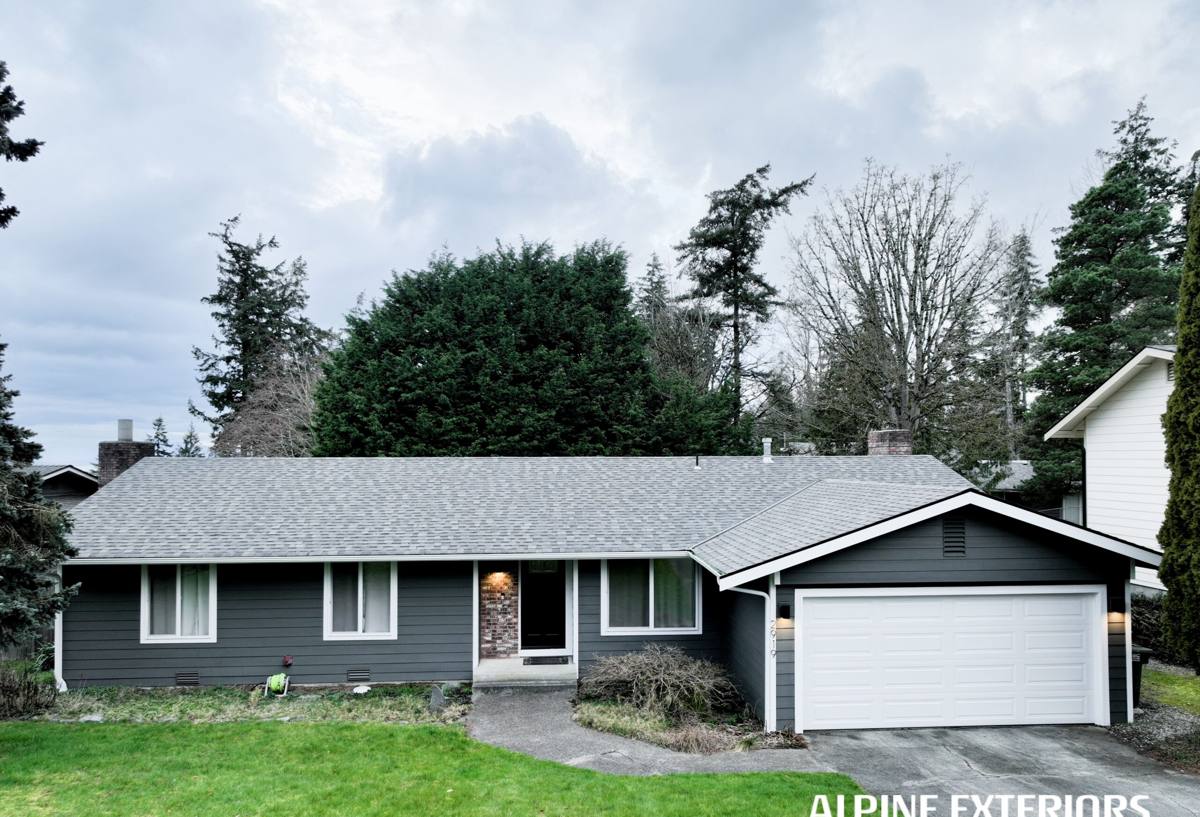
What Birchwood's Climate Does to Exterior Siding
Bellingham sits close enough to the water that salt-tinged marine air reaches homes well inland, and Birchwood is no exception. Combine that with a wet season that runs long by national standards and a moss cycle that barely lets up between fall and spring, and you get a set of conditions that are genuinely harder on siding than most of the country deals with.
Salt Air and Slow Corrosion
Salt in the air accelerates corrosion on anything metal — fasteners, flashing, trim connectors. Siding materials that rely on face-nailing with standard fasteners, or that depend on caulk and sealant to stay watertight at every seam, put a lot of pressure on hardware that's fighting a losing battle against salt exposure over the years. When that hardware starts to fail quietly behind the siding, the visible symptoms show up much later — staining, streaking, or a soft spot where water's been getting in.
Wind-Driven Rain
Rain in this part of Whatcom County doesn't just fall — wind off the Salish Sea regularly drives it sideways and forces it up under laps and edges that were only designed to shed water falling straight down. Siding profiles depend on correct lap dimensions, properly lapped house wrap, and flashing that's detailed for wind-driven conditions, not just a national minimum standard. Cut corners there and the wall can look fine for a year or two before problems start working their way to the surface.
A Long Moss Season on Shaded Walls
Any wall section in Birchwood that sits in shade for a good part of the day — north-facing elevations, walls behind trees or fences — stays damp longer after every rain event, and that dampness is what moss, algae, and mildew need to take hold. On a painted or absorbent surface, that damp cycle repeating for months at a time is a direct path to premature coating failure and, eventually, softening of the substrate underneath.
Why We Install Only James Hardie in This Neighborhood
Every siding material on the market has a legitimate use case, and other contractors install LP SmartSide, vinyl, and cedar competently. We made a professional decision to stop offering those options because, in a climate that punishes moisture-sensitive materials and stresses hardware and finishes the way Bellingham's does, we didn't want to keep telling homeowners "this will probably be fine" about products with real, well-documented trade-offs. James Hardie's fiber cement doesn't have those same trade-offs, and standing behind one system we trust completely lets us give a straight answer instead of a hedge.
| Material | Response to Moisture | Maintenance in Bellingham's Climate | Realistic Lifespan Here |
|---|---|---|---|
| James Hardie fiber cement | Dimensionally stable; doesn't swell, rot, or attract moss the way wood-based products do | Low; factory finish resists fading and staining | 30+ years with proper install |
| LP SmartSide (engineered wood) | Wood-based core is more vulnerable at cut edges and fastener penetrations if moisture gets in | Moderate; edge sealing and caulk lines need regular upkeep | 15-25 years, climate-dependent |
| Vinyl | Doesn't rot, but can warp, fade, or gap over time; seams rely on overlap rather than a sealed joint | Low, but hidden moisture behind the panels is hard to catch early | 20-30 years, variable |
| Cedar | Absorbs moisture readily; performance depends entirely on an ongoing sealing or painting schedule | High; recurring refinishing needed to hold up in this much rain | 15-25 years with consistent upkeep |
The pattern in that table is consistent across every material we chose not to install: they either depend on a wood-based core that's sensitive to the moisture cycle Bellingham puts it through, or they rely on maintenance discipline that a lot of homeowners reasonably don't want to keep up with for thirty years. Fiber cement sidesteps both problems by not being organic material in the first place.
The James Hardie System: Lines, Finish, and Warranty
"James Hardie siding" isn't one product — it's a system, and part of getting a Birchwood install right is choosing the right pieces of that system for the home.
- HardiePlank lap siding — the most common choice, available in several width and texture options, and the closest match to traditional lap-style siding already common in this neighborhood.
- HardieShingle — a shingle-style profile for homes where a more textured, traditional look is the goal.
- HardiePanel — vertical panel siding, often used for board and batten styling or as an accent alongside lap siding.
- HardieTrim — matching trim boards so window casings, corners, and fascia hold up to the same climate stresses as the field siding instead of becoming the weak point.
James Hardie formulates its siding for the specific climate zone it's going into, and Western Washington's freeze-thaw and moisture cycle calls for the company's cold-and-wet climate engineering rather than the formulation built for hot, humid regions. That's a real material science distinction, not a marketing label — the fiber cement mix is built to hold up to the conditions it's actually going to face on a Birchwood wall.
Most Hardie siding is installed with the ColorPlus factory finish — a baked-on, multi-coat finish applied under controlled conditions before the boards ever reach the job site. That matters here specifically because it removes weather and application-day conditions from the equation for the vast majority of the finish; only field-cut edges need touch-up priming, rather than the whole wall depending on how well a coat of paint cures outdoors in Bellingham's damp air. Hardie backs its siding with a 30-year, non-prorated limited warranty that's transferable if you sell the home, which is a meaningfully stronger position than a lot of alternative materials offer.
What a Correct Installation Involves in This Climate
The material is only half the equation. A James Hardie install that's done to spec, in a climate like this one, involves a specific set of details:
- House wrap or a weather-resistive barrier installed and correctly lapped before any siding goes up, shingle-style, so water is directed out and down rather than behind the barrier
- A drainage gap or rainscreen behind the siding on walls where that's called for, so incidental moisture can dry out instead of sitting against the sheathing
- Corrosion-resistant fasteners, sized and spaced to Hardie's published installation requirements rather than "close enough"
- Correct minimum clearance between siding and grade, decks, patios, and roof lines, so splashback and ponding water don't sit against the bottom edge of the siding
- Properly flashed and lapped transitions at every window, door, corner, and penetration — these are consistently where a home's actual water problems originate, not the flat field of the wall
- Factory-cured ColorPlus finish preserved by cutting boards face-down and priming any field-cut edges before they go up
Skip any one of these and the wall can still look correct on install day. The consequences — staining at seams, soft trim, paint failure around openings — take one or two wet seasons to show up, which is exactly long enough for a rushed install to be someone else's problem by the time it does.
Our Process for a Birchwood Siding Project
Walkthrough and Assessment
We start by walking the specific home — which walls take the brunt of the wind-driven rain, which sections sit in shade long enough to hold onto moisture, and whether there's already hidden damage in the existing wall assembly that needs to be addressed before new siding goes on. Installing new Hardie siding over an unresolved moisture problem just buries it under better-looking material.
Planning the Details
Before any material is ordered or cut, we work out flashing details, drainage strategy, and how the siding will meet trim, windows, and rooflines. Getting these decisions made on paper first, rather than improvised on install day, is what keeps the finished wall consistent from one elevation to the next.
Installation to Manufacturer Spec
Every fastener, clearance, and flashing lap follows James Hardie's published installation instructions for this climate zone. That's not a formality — it's what keeps the manufacturer's warranty valid and what actually determines whether the wall performs for decades rather than years.
Final Walkthrough
We walk the completed job with you, explain what little ongoing maintenance James Hardie siding actually needs, and make sure you know what a normal-looking wall should look like if you ever want to check it yourself down the road.
Why Hire a Crew That Already Works Birchwood
A lot of what separates a siding install that holds up for thirty years from one that starts showing problems in five isn't the product — it's judgment calls made in the field: how much drainage gap a particular wall orientation actually needs, which elevations in this neighborhood need extra flashing attention because of how the wind and rain hit them, where a rainscreen is worth the added cost and where it isn't. A crew that's already installed Hardie siding across Bellingham through multiple wet seasons has made those calls enough times to get them right by default, rather than treating every job as a fresh experiment.
Cost Factors for James Hardie Siding in This Area
James Hardie siding costs more up front than vinyl and is generally comparable to or somewhat less than cedar once you account for cedar's ongoing refinishing costs. Beyond the baseline material and labor, a few things move the price on a specific Birchwood home:
| Factor | Why It Matters |
|---|---|
| Home size and wall complexity | More corners, dormers, and roof transitions mean more cutting and flashing detail work |
| Existing wall condition | Rot, moisture damage, or inadequate house wrap found during tear-off needs to be repaired before new siding goes on |
| Siding profile and trim package | Lap width, shingle-style accents, and matching HardieTrim all affect material and labor cost |
| Number of windows and doors | Each opening needs its own flashing and finish detail, which adds labor time |
| Access and site conditions | Tight lots, slopes, or limited staging area can add time to the job |
We'll walk your specific home and give you real numbers based on what's actually there, rather than a rough per-square-foot guess — two similarly sized Birchwood homes can land at very different price points depending on how many of these factors come into play.
Getting It Right the First Time
Siding is not a job you want to redo in five years. Correcting an install that skipped drainage details or used the wrong fastener spec usually means pulling siding back off the wall, which costs more than doing it right the first time would have. That's why we treat the assessment and planning phase of a Birchwood project with the same seriousness as the installation itself — it's the cheapest point in the whole process to catch a problem.
If you're considering James Hardie siding for a home in Birchwood, we're glad to walk the property, talk through what your specific walls and exposure actually need, and put together a straightforward, no-pressure estimate. There's a form below — reach out and we'll get a time on the calendar.