 Bellingham Roofing
 Siding in Puget Has One Job: Survive the Water
Homes in and around the Puget neighborhood sit close enough to Bellingham Bay that the weather isn't an abstract concern — it's a daily condition. Salt-laden air moves off the water and settles on exterior surfaces year-round. Driving rain, pushed sideways by wind off the Sound, finds every gap a normal siding installation leaves behind. And because so many lots here carry tree cover and shade from the surrounding hills, moss and algae get a long, uninterrupted growing season instead of the quick summer dry-out that keeps siding cleaner elsewhere in the state.
None of that is unusual for Whatcom County. But it does mean that siding choices which hold up fine in a drier inland climate can fail faster here — and that installation details which don't matter much in Spokane matter a great deal in Bellingham. This page is about what James Hardie fiber cement siding does for Puget-area homes specifically, and what a correct installation looks like when salt air, wind-driven rain, and moss are the baseline, not the exception.
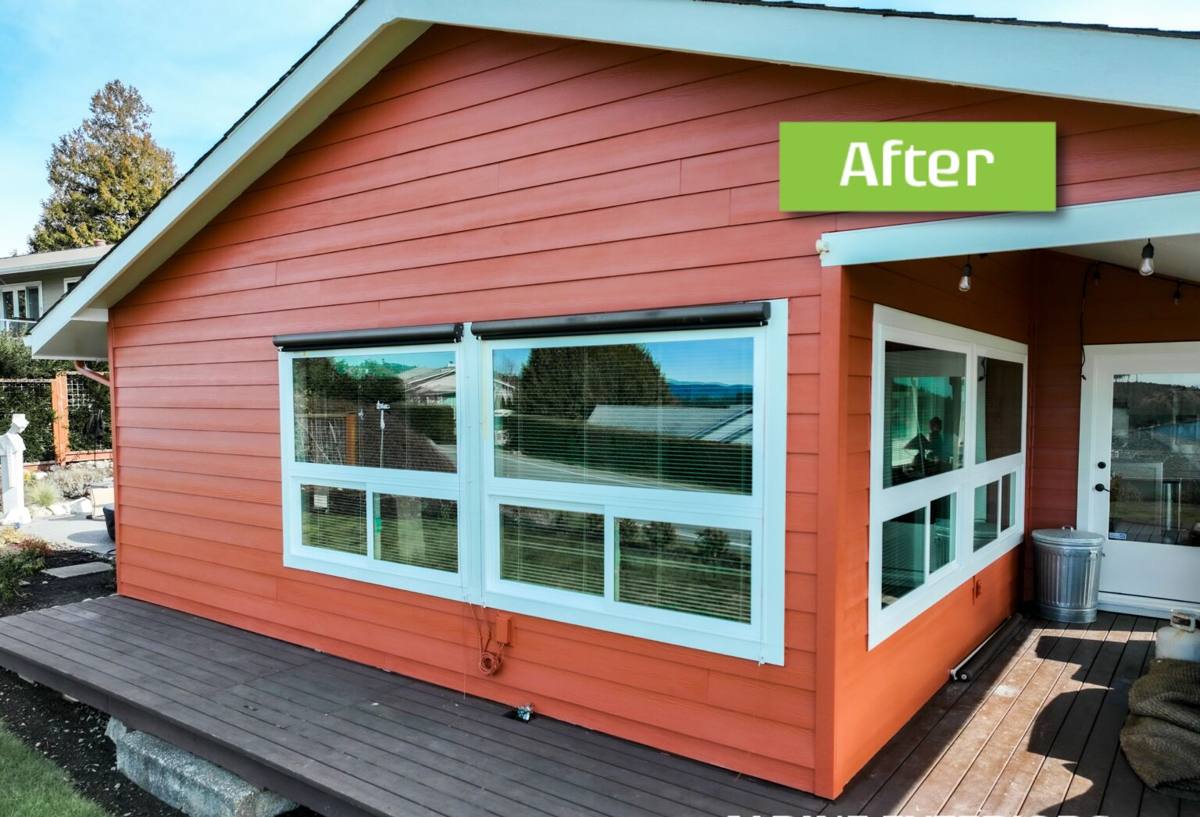
What Salt Air, Rain, and Moss Actually Do to Siding
Salt Air
Airborne salt is corrosive to exposed metal fasteners, flashing, and trim — and it accelerates the breakdown of paint film on wood and composite products that aren't engineered to resist it. Over years, homes closer to the bay tend to show fastener bleed-through, chalking paint, and edge deterioration sooner than homes further inland.
Driving Rain
Wind off the water doesn't just fall rain straight down — it pushes it sideways and up under laps, trim, and butt joints. Siding systems depend on correct overlap, flashing, and a drainage plane behind the cladding to manage that water. When those details are skipped or rushed, water gets behind the siding instead of running off it, and that's where rot and hidden damage start — regardless of what material is on the outside.
Moss and Algae
Shade plus moisture plus mild temperatures is exactly what moss and algae need to establish themselves, and Puget's tree cover gives them plenty of both. Porous or absorbent siding materials hold moisture longer and give moss more to grab onto. Siding that sheds water quickly and doesn't wick moisture into its surface stays cleaner longer and is far easier to rinse off when it does need attention.
Why We Install James Hardie Here — and Nothing Else
Our crew installs James Hardie fiber cement siding exclusively. That's not a marketing position — it's a standard we hold because we've seen what this climate does to other materials over time, and we don't want to hand a homeowner a siding job we'd have to caveat five years later.
Hardie's fiber cement is non-combustible, dimensionally stable in wet-dry cycling, and finished with the ColorPlus factory-baked finish, which resists fading and chipping far better than field-applied paint. For homes in wetter, colder regions like ours, Hardie engineers a specific product line — HardieZone 5 (HZ5) — formulated for climates with more moisture exposure and freeze-thaw cycling, as opposed to the HZ10 line built for hot, humid, high-UV regions. That distinction matters: siding engineered for the wrong climate zone is asking for trouble it doesn't need to have.
We get asked why we don't install vinyl, LP SmartSide, cedar, or other fiber cement brands. The honest answer is trade-offs. Vinyl can warp and its seams open paths for wind-driven rain. Wood and primed spruce need consistent repainting and are more vulnerable to moisture and moss in a climate that doesn't give them much time to dry out. Engineered wood products depend heavily on maintaining an intact factory coating — any breach lets moisture into the substrate. We'd rather install one product correctly and stand behind it than offer several and hedge on which one holds up.
Material Comparison for a Salt-Air, High-Moss Climate
| Material | Moisture Resistance | Moss/Algae Resistance | Maintenance Burden | Fire Resistance |
|---|---|---|---|---|
| James Hardie Fiber Cement (HZ5) | Engineered for wet climates | Sheds water, doesn't wick | Low — occasional wash | Non-combustible |
| Vinyl Siding | Seams vulnerable to driving rain | Moderate; traps grime in seams | Low but seam issues compound | Combustible, can warp near heat |
| Primed Wood/Cedar | Absorbs moisture, needs sealed coating | Higher risk if shaded/damp | High — repaint/reseal cycles | Combustible |
| LP SmartSide / Engineered Wood | Good if coating stays intact | Moderate | Moderate — monitor cut edges/coating | Combustible |
What a Correct Installation Involves
Fiber cement siding only performs as designed when it's installed to spec — the material isn't the whole story. The details that matter most in a climate like ours:
- Drainage plane and rainscreen gap: A properly installed water-resistive barrier and airspace behind the siding lets any moisture that does get past the cladding drain and dry out instead of sitting against the sheathing.
- Flashing at every penetration: Windows, doors, vents, and roof-to-wall transitions are where wind-driven rain gets pushed hardest. Correct flashing sequencing — installed shingle-style so water always sheds outward — is non-negotiable.
- Fastener placement and type: Corrosion-resistant fasteners, set per Hardie's specifications (not overdriven, not underdriven), keep the siding secure without cracking the board or creating entry points for moisture.
- Proper clearances: Gaps at grade, roofline, and adjoining surfaces so the siding never sits in standing water or constant dampness.
- Caulking discipline: Sealant only where Hardie specifies it — not as a substitute for correct flashing, which is a common shortcut that traps moisture instead of shedding it.
Skipping any one of these doesn't usually show up as a problem on day one. It shows up two or three wet seasons later, as staining, soft trim, or moss creeping in at a seam that should have shed water cleanly.
Signs Your Current Siding Is Losing the Fight
If your home is already sided in something other than fiber cement, or in an older Hardie installation that predates current flashing standards, here's what to watch for:
- Persistent moss or algae growth that returns quickly after cleaning, especially on shaded or north-facing walls
- Soft or discolored trim boards, particularly around windows and at the base of walls
- Visible fastener corrosion or rust streaking below nail heads
- Paint that's chalking, peeling, or fading unevenly across the same wall
- Warping, bowing, or separation at panel seams and butt joints
- A musty smell or visible staining on interior walls that share an exterior with problem siding
Any of these can mean water is getting behind the siding rather than off of it — worth a look before it becomes a larger repair.
Our Process for Puget-Area Projects
We approach every siding project here the same methodical way, adjusted for what we find on site:
- On-site assessment: We walk the exterior, check for existing moisture damage, evaluate current flashing and drainage, and look at sun/shade exposure that affects moss risk.
- Tear-off and sheathing check: Removing old siding lets us inspect the sheathing underneath for hidden rot before anything new goes up — a step that shouldn't be skipped in a climate this wet.
- Weather barrier and rainscreen installation: We install a proper water-resistive barrier and drainage gap suited to the wall assembly.
- Flashing and trim: Every window, door, and penetration gets flashed before siding closes it in.
- Hardie panel/plank installation: Installed to manufacturer spec — correct fastener spacing, clearances, and reveal.
- Final walkthrough: We review the finished exterior with the homeowner and confirm caulking, trim, and paint lines are clean.
Why Hiring a Crew That Already Works Puget Matters
Siding crews that mostly work drier, inland parts of Washington don't always carry the same instincts about wind-driven rain direction, moss-prone shade patterns, or how close to the water a given lot sits. A crew that regularly works Bellingham's bayside neighborhoods already knows to double-check drainage details on shaded walls, expects to deal with salt exposure on fasteners and trim, and isn't guessing at how the local climate behaves — it's routine. That familiarity shows up in fewer callbacks and a job that's built for the conditions it'll actually face, not generic conditions.
Warranty and Long-Term Value
James Hardie backs its products with a manufacturer's limited warranty that's transferable to a future homeowner, which matters for resale in a market where buyers increasingly ask what the siding is and how old it is. Combined with correct installation, the ColorPlus finish is engineered to hold its color far longer than field-painted alternatives — a real advantage in a climate that's hard on paint. The warranty protects the material; correct installation is what protects the warranty and the wall behind it.
Ready to Talk About Your Siding?
If you're weighing a siding replacement or repair on a Puget-area home, we're happy to walk the exterior with you, point out anything we see, and give you a straightforward, no-pressure estimate. Use the form below to get started.