 Bellingham Roofing
 Why Cordata Homeowners Are Looking at Metal Roofing
Cordata sits far enough inland to avoid the worst of Bellingham Bay's direct salt spray, but the neighborhood still gets the same weather pattern that shapes every roofing decision in Whatcom County: long wet winters, a heavy moss season, and enough wind-driven rain off the Strait of Georgia to expose any weak point in a roof system within a few years. Asphalt shingle roofs in this area typically hold up for fifteen to twenty years before moss, moisture cycling, and granule loss force a replacement. A correctly installed metal roof is a different proposition — with the right panel, underlayment, and fastening details, it can outlast several shingle roofs on the same house.
We install metal roofing across Bellingham and Whatcom County, and Cordata comes with its own mix of housing stock — a blend of older single-story ranch homes near the established streets and newer two-story construction closer to the Cordata Parkway corridor and the business park. Roof pitches, attic ventilation, and tree cover vary block to block, which is why we walk every roof in person before recommending a system rather than quoting a generic package.
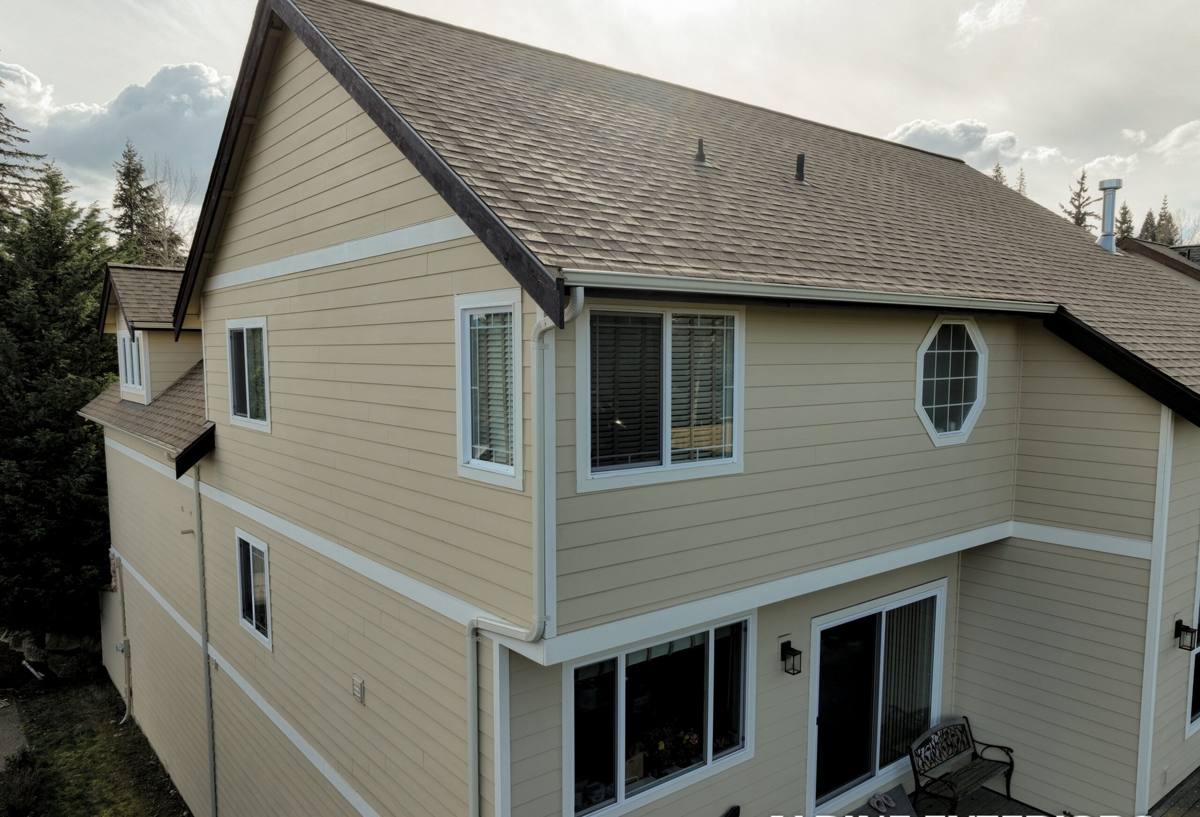
What Bellingham's Climate Actually Does to a Roof
Moss and Organic Growth
Whatcom County's moss season runs most of the year, not just the rainy months. Any roof with shade from mature conifers or cedar trees — common throughout Cordata's residential streets — will see moss and algae growth on the north-facing slopes first. On a shingle roof, moss roots into the granule layer and lifts shingle edges, letting water track underneath. On a properly installed metal roof, moss has nothing to grip; it can still form on dust and debris that collects in valleys or behind poorly flashed obstructions, but it doesn't damage the panel itself the way it damages asphalt.
Driving Rain and Wind
Storms moving through from the Strait of Georgia and the Salish Sea don't just drop rain straight down — wind pushes it sideways, up under eaves, and into any gap in flashing or fastening. This is where installation quality matters more than the material itself. A metal roof with poor edge detailing or under-driven fasteners will leak in a wind-driven rain event even though the panels themselves are watertight. We detail eaves, rakes, and penetrations specifically for this wind pattern, not a generic install spec written for a drier climate.
Salt Air Exposure
Cordata is inland from Bellingham Bay, so salt exposure here is lighter than it is for waterfront properties, but it's not zero — coastal air still carries salt particulate inland on windy days, and it accelerates corrosion on any exposed fastener, flashing seam, or lower-grade metal over time. This is one of the biggest reasons we're selective about coatings and fastener hardware on every metal roof we install in this area, covered in more detail below.
Choosing the Right Metal Roofing System for This Neighborhood
"Metal roofing" covers a range of products, and the right choice depends on the home's roof pitch, budget, and how long the owner plans to stay. We install standing seam and exposed-fastener (screw-down) panel systems, and we'll tell you honestly which one fits your house rather than upselling the more expensive option by default.
| Factor | Standing Seam | Exposed-Fastener Panel |
|---|---|---|
| Fastening method | Concealed clips, no exposed screws | Screws through the panel face with rubber-washered heads |
| Long-term maintenance | Very low — no fasteners to re-seat | Washers age and may need replacement over decades |
| Best fit | Longer-term ownership, higher-visibility roofs | Budget-conscious projects, outbuildings, secondary roofs |
| Wind/rain performance in this climate | Excellent — seams shed driving rain cleanly | Good, if fasteners are torqued and re-checked over time |
| Typical upfront cost | Higher material and labor cost | Lower upfront cost |
For most primary residences in Cordata, we lean toward standing seam because the concealed-fastener design removes the one component (exposed screws) most likely to loosen or corrode under repeated wind-driven rain over a 30-to-50-year service life. Exposed-fastener panels are a legitimate, cost-effective option too — we install them regularly on garages, shops, and secondary roof sections where the tradeoff makes sense.
Panel Coating and Gauge
We don't install bare or minimally coated steel panels on homes in this region. Given the year-round moisture and the light salt exposure Cordata gets on windy days, we specify factory-applied coatings rated for coastal Pacific Northwest conditions, and we stay within panel gauges that hold their shape under snow load and foot traffic during maintenance. Thinner, lighter-gauge panels marketed at lower price points tend to oil-can (show visible waviness) and are more prone to denting from hail or debris — we'll walk you through the tradeoffs on your specific roof rather than defaulting to the cheapest option.
What a Correct Metal Roof Installation Involves
The panel is only part of the system. Most metal roof failures we get called out to inspect trace back to installation shortcuts underneath the panel, not the metal itself.
- Deck inspection and repair — any soft, rotted, or water-damaged decking gets replaced before a single panel goes down; installing over a compromised deck just hides the problem.
- High-temperature underlayment — metal roofing needs a synthetic or high-temp underlayment rated for the heat cycling metal panels go through, not standard felt.
- Ice-and-water shield at vulnerable points — eaves, valleys, and low-slope transitions get self-adhering membrane as a second line of defense against wind-driven rain.
- Proper attic ventilation — metal roofs are more sensitive to trapped attic moisture than shingles; correct intake and exhaust venting prevents condensation from forming under the panels.
- Flashing at every penetration — chimneys, vents, skylights, and wall transitions are the most common leak points on any roof, metal or not, and get custom-formed flashing rather than generic boot kits wherever possible.
- Correct fastener spacing and torque — for exposed-fastener systems, following the manufacturer's spacing and torque spec is what keeps washers sealing for decades instead of years.
Our Process for a Cordata Metal Roofing Project
1. On-Site Inspection and Roof Assessment
We walk the roof, check the decking and attic ventilation, note tree cover and moss exposure, and measure pitch and roof geometry. This is also when we flag anything unusual — an undersized valley, a chimney needing new flashing, or ventilation that's inadequate for a metal roof.
2. Written Estimate and System Recommendation
You get a written scope covering panel type, gauge, coating, underlayment, and flashing details specific to your roof — not a one-line "metal roof replacement" quote. We'll explain why we're recommending standing seam over exposed-fastener (or vice versa) for your situation.
3. Tear-Off, Deck Prep, and Underlayment
Old roofing comes off, decking is inspected and repaired as needed, and underlayment goes down before any metal is installed.
4. Panel Installation and Flashing
Panels are installed to manufacturer spec with attention to the wind and rain exposure specific to this part of Whatcom County, and every penetration is flashed individually.
5. Final Walkthrough
We walk the finished roof with you, review the work, and go over any maintenance basics — mainly keeping valleys and gutters clear of needle and leaf debris, which matters more in a neighborhood with mature tree cover like Cordata.
Why Local Installation Experience Matters
Metal roofing installed correctly for a dry climate is not the same job as metal roofing installed correctly for Bellingham. A crew used to working in areas with less rain, less moss, and less wind-driven weather can install a technically sound panel system that still leaks here, because the underlayment choice, flashing detail, and ventilation plan weren't built around Whatcom County conditions. We work in Bellingham and the surrounding communities year-round, so the moss cycle, the rain patterns, and the way wind moves through neighborhoods like Cordata are things we plan for by default, not an afterthought.
We also know that permitting, inspection, and local code requirements in Whatcom County and the City of Bellingham are part of the job, not paperwork to skip. A properly permitted and inspected metal roof protects your investment and avoids problems if you sell the home later.
Metal Roofing Maintenance in a Moss-Heavy Climate
One of the real advantages of metal roofing in this region is how little ongoing maintenance it needs compared to shingles — but "little" isn't "none."
- Clear needles, leaves, and debris from valleys and gutters at least once a year, more often under heavy tree cover.
- Rinse off moss or algae buildup on shaded slopes before it accumulates into thick mats — it won't damage the metal, but it holds moisture against flashing and fasteners.
- Have flashing and fastener condition checked periodically, especially after major windstorms.
- Keep overhanging branches trimmed back to reduce both debris accumulation and the risk of impact damage.
Is Metal Roofing the Right Call for Your Cordata Home?
Metal roofing isn't automatically the right answer for every house or every budget, and we'll tell you if a well-installed asphalt shingle system makes more sense for your timeline and plans. It tends to be the strongest long-term value when you're planning to stay in the home for decades, when the roof has heavy tree cover and moss exposure, when you want to stop dealing with recurring shingle maintenance, or when the roof's pitch and exposure make it a good candidate for standing seam's clean water-shedding performance.
If you're weighing metal roofing for a home in Cordata or elsewhere in Bellingham, we're happy to take a look and give you a straight answer — including telling you if metal isn't the best fit for your specific roof. Use the form below to request a free, no-pressure estimate and we'll get back to you to schedule a time to come take a look.