 Bellingham Roofing
 Why Edgemoor's Waterfront Setting Is Tough on Roofs
Edgemoor sits close enough to Bellingham Bay that homes here deal with a different kind of weather stress than roofs a few miles inland. Salt-laden air moves off the water and settles on every exposed surface, including your roof. Over years, that salt exposure accelerates corrosion on metal fasteners, flashing, and any coating that isn't rated for coastal conditions. Add in wind-driven rain that comes at roofs sideways rather than straight down, and you get water intrusion problems in places a roof in a calmer, drier location would never see trouble.
Then there's the tree canopy. Much of Edgemoor is wooded, with mature conifers shading roofs for large parts of the day. That shade keeps things cool in summer, but it also keeps roof surfaces damp far longer after a storm. Combined with Whatcom County's long, wet fall-through-spring stretch, that's a recipe for an extended moss season — moss doesn't just look bad, it holds moisture against the roof surface and works its way under shingle edges and around fasteners.
None of this means a roof here is doomed. It means the roofing system, the installation details, and the maintenance plan all need to account for salt, wind-driven rain, and moss pressure specifically — not just be a generic roof that happens to be installed in Bellingham.
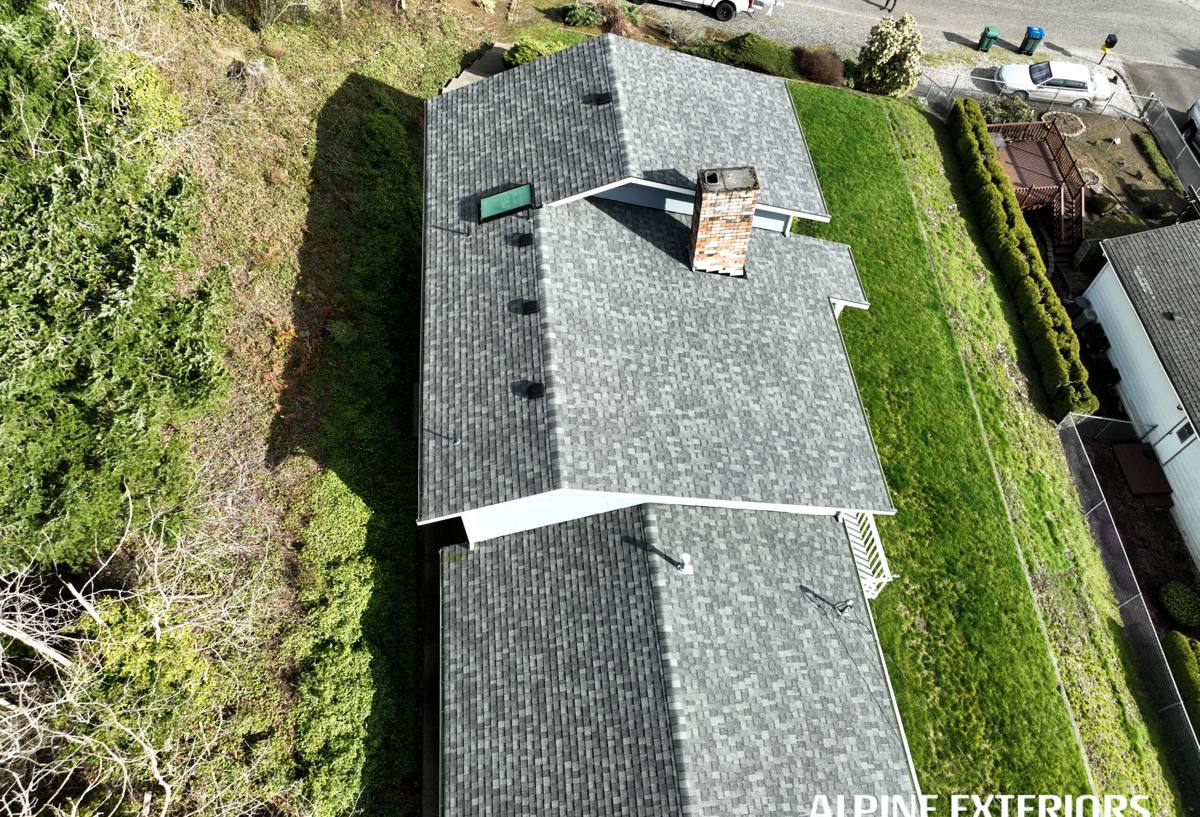
Why Metal Holds Up Better Here Than Composition Shingles
Composition shingles rely on granules and an asphalt mat to shed water. In a shaded, damp environment like much of Edgemoor, that surface stays wet longer, which is exactly what moss and moss-related algae need to take hold. Once moss establishes itself under shingle tabs, it can lift edges and create entry points for wind-driven rain — the same rain that comes off the bay at an angle instead of falling straight down.
Metal roofing handles this differently for a few reasons:
- A smooth, hard metal surface gives moss and moss-related growth far less to grip onto compared to the textured surface of asphalt shingles.
- Properly installed metal panels shed water fast, so surfaces dry out sooner between the region's frequent rain events.
- Standing seam profiles, in particular, have no exposed fastener heads for wind-driven rain to work against over time.
- Metal doesn't absorb water the way an asphalt mat can, which matters through decades of Whatcom County's wet season.
That doesn't mean metal is maintenance-free or immune to the coastal environment — it isn't. It means the failure points shift from "shingle degrades and lets water in" to "flashing, fasteners, and seams need to be detailed correctly for salt air and driving rain from day one." That's an installation-quality problem, which is where the right crew matters more than the material itself.
Where Metal Still Needs Respect
Salt air is hard on unprotected metal and low-grade fasteners. A metal roof installed with the wrong coating, the wrong fastener alloy, or sloppy flashing work will corrode and leak faster than a well-installed asphalt roof would. The material advantage only holds up if the installation matches the environment it's going into.
What a Correct Metal Roof Installation Involves
A metal roof is only as good as what's underneath it and how the details are handled. For an Edgemoor home, we pay particular attention to:
Underlayment and Water Protection
A full synthetic underlayment across the whole roof, with self-adhering ice-and-water membrane at eaves, valleys, and around every penetration. In a driving-rain environment, this secondary water barrier is what protects the deck if wind ever pushes moisture past the panel seams — it's not optional, it's the backup plan built into a correct install.
Flashing Details
Valleys, chimneys, skylights, and wall intersections are where most roof leaks actually start, on any roofing material. Flashing needs to be formed and layered correctly — not caulked as an afterthought — so wind-driven rain can't work its way underneath.
Fastening for Wind Exposure
Homes on elevated, more exposed lots near the bay see stronger gusts than sheltered inland properties. Fastener spacing and panel clip systems need to be matched to that exposure, not just installed to the manufacturer's minimum spec for a calmer climate.
Ventilation
A shaded, damp roof needs proper intake and exhaust ventilation to keep moisture from building up in the attic space underneath. Poor ventilation shortens the life of the roof deck and undercuts the value of a metal roof that's otherwise built to last decades.
Panel Types and Coatings: What We Actually Recommend
Not every metal roofing product is a good fit for a coastal, tree-shaded neighborhood. The table below covers the tradeoffs we walk homeowners through.
| Option | Best For | Tradeoff to Know |
|---|---|---|
| Standing seam, steel substrate | Most Edgemoor homes; strong wind and rain performance | Higher upfront cost than exposed-fastener panels |
| Standing seam, aluminum substrate | Homes closest to the water with heaviest salt exposure | Costs more than steel, but resists salt corrosion better long-term |
| Exposed-fastener panels | Outbuildings, garages, budget-driven projects | Exposed fasteners and gaskets are a maintenance point in wind-driven rain areas |
| Premium (PVDF/Kynar-type) coating | Any panel type, especially near the bay | Better fade and chalk resistance in salt air; higher material cost |
| Standard baked-enamel coating | Lower-budget projects, less coastal exposure | Shorter coating lifespan under salt air and UV combined |
Our default recommendation for most Edgemoor properties is a standing seam steel panel with a premium coating system, stepping up to aluminum for homes with the most direct exposure to the bay. We'll walk your specific lot and orientation with you before recommending a product — a sheltered, inland-facing roof doesn't need the same spec as one facing open water.
Our Process, Start to Finish
- On-site inspection. We look at your existing roof, deck condition, ventilation, tree cover, and exposure to prevailing wind and rain direction.
- Honest scope and product recommendation. You get a written plan covering panel type, coating, underlayment system, and flashing approach — no guessing at what you're paying for.
- Tear-off and deck check. Old roofing comes off, and we inspect the deck for rot or soft spots, especially in shaded areas that have held moisture longer.
- Underlayment and flashing installation. Full water-resistant underlayment goes down first, followed by properly formed flashing at every valley, wall, and penetration.
- Panel installation. Panels and seams are installed to spec for your home's wind and rain exposure, not just the manufacturer's baseline.
- Site cleanup. Magnetic sweep for fasteners and full debris removal — important around mature landscaping and tree roots common on Edgemoor lots.
- Final walkthrough. We go over the finished roof with you and explain what to watch for and how to maintain it going forward.
Living With a Metal Roof in a Moss-Prone, Tree-Canopy Neighborhood
A correctly installed metal roof needs far less attention than an asphalt roof in the same setting, but "far less" isn't "none." A simple seasonal checklist keeps things in good shape:
- Clear needles, leaves, and debris from valleys and around penetrations, especially after fall windstorms.
- Check gutters and downspouts for buildup — clogged gutters on a metal roof still cause the same backup and overflow problems they would on any roof.
- Look for any moss or algae starting on the north-facing or heavily shaded sections and address it early rather than letting it spread.
- Trim back branches that overhang the roofline to reduce debris load and keep sections drying out faster after rain.
- After any major windstorm off the bay, do a visual check for lifted flashing or displaced panels.
What Affects the Cost of a Metal Roof in Edgemoor
| Factor | Why It Matters Here |
|---|---|
| Roof pitch and complexity | Multiple valleys and dormers mean more flashing work and labor time |
| Panel and coating choice | Aluminum and premium coatings cost more but hold up longer against salt air |
| Tear-off vs. install over existing roof | Full tear-off costs more but lets us properly inspect and treat the deck underneath |
| Site access | Wooded, sloped, or bluff-adjacent lots can require extra care and equipment staging |
| Ventilation upgrades | Older homes often need added intake or exhaust venting brought up to a proper standard |
We provide a written estimate that breaks these factors down for your specific home rather than a flat per-square number that doesn't account for your roof's actual conditions.
Why Hire a Crew That Already Works Edgemoor
A roofing crew that regularly works this part of Bellingham already understands what a bay-adjacent, tree-covered lot demands — the fastener and coating choices that hold up against salt air, the flashing details that stop wind-driven rain, and how to work around mature trees and established landscaping without unnecessary damage. That familiarity also extends to the practical side: knowing what Whatcom County and City of Bellingham permitting typically requires for a reroof, and being upfront with you about it rather than treating it as an afterthought.
Edgemoor homes also tend to be established properties where the roofline is a visible part of the home's overall character. We take that into account in panel profile and color recommendations, not just performance specs, so the finished roof looks like it belongs on the house.
If you're weighing a metal roof for your Edgemoor home, we're happy to walk the roof with you, talk through honest options for your specific exposure, and put together a written estimate — no pressure, no obligation. Use the form below to request a free estimate and we'll get in touch to schedule a time.