 Bellingham Roofing
 Siding Repair on South Hill: What the Climate Is Doing to Your Walls
South Hill sits up above much of Bellingham, which is exactly what makes it such a desirable place to live — and exactly why the siding on these homes takes a beating most inland neighborhoods never see. Elevation means more wind exposure. More wind exposure means driving rain gets pushed sideways into joints, laps, and trim that were never designed to handle water moving horizontally instead of falling straight down. Add in Bellingham Bay's salt air drifting up the slope, and you've got a slow, steady corrosive process working on fasteners, flashing, and any siding material that isn't built to shrug it off.
Then there's moss season, which in Whatcom County isn't really a season so much as most of the year. Shaded north- and west-facing walls on hillside lots stay damp longer, moss and algae get a foothold in seams and butt joints, and that organic growth holds moisture against the siding face far longer than a dry wall ever would. Over years, that's what turns small cosmetic issues — a cracked lap, a gapped joint, a soft spot near a window — into rot, delamination, or hidden sheathing damage.
Repairing siding correctly on a South Hill home means understanding this combination of wind-driven rain, salt exposure, and persistent moisture, not just patching the visible damage and moving on.
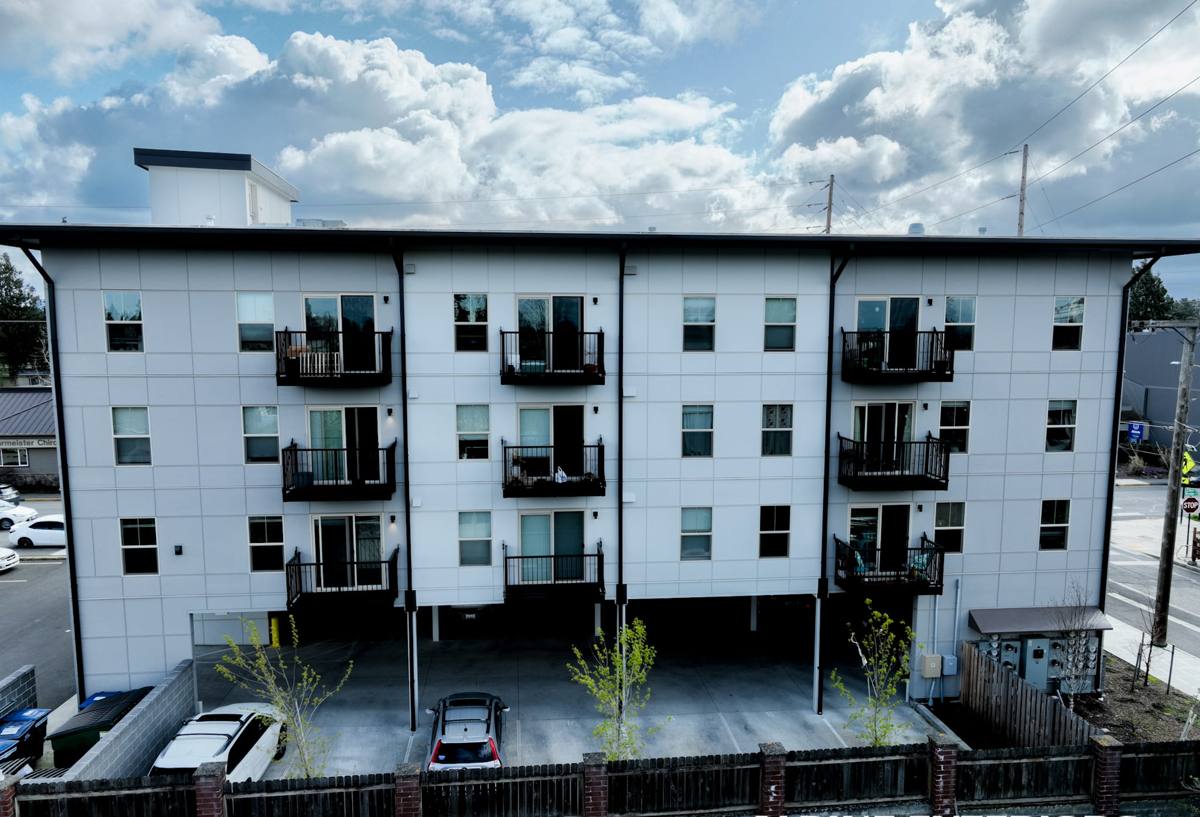
Signs Your South Hill Home Needs Siding Repair
Some damage is obvious. Some isn't — and on an elevated, wind-exposed lot, the damage you can't see is often the damage that matters most. Here's what we look for on every inspection:
- Cracked, split, or warped boards, especially on the windward or uphill-facing side of the house
- Soft or spongy spots when you press on the siding near window sills, corners, or the bottom courses
- Peeling or bubbling paint, which often signals moisture trapped behind the siding rather than a simple paint failure
- Visible gaps at butt joints, corner boards, or where siding meets trim, doors, and windows
- Persistent moss, algae, or black streaking that keeps coming back within a season of cleaning
- Rust staining around nail heads or fasteners, a sign of corrosion working from the inside out
- Musty odors or visible staining on interior walls that share an exterior wall with damaged siding
- Sections that look fine from the ground but show damage when viewed up close from a ladder
If you're seeing two or more of these, especially combined, it's worth having someone look at the wall assembly, not just the surface.
What a Correct Siding Repair Actually Involves
It starts behind the siding, not on top of it
A repair that only addresses what's visible from the driveway is a repair that fails again in a year or two. Before we replace a single board, we check what's happening underneath: is the house wrap intact, is there evidence of water having tracked behind the cladding, is the sheathing still solid wood or has it gone soft. On a hillside home exposed to driving rain, water rarely stays where it first got in — it follows gravity and framing until it finds somewhere to pool or soak in.
Matching material and matching performance
If your home already has fiber cement siding, a proper repair means replacing damaged boards with material that matches in profile, reveal, and finish — not a mismatched patch that stands out or behaves differently in weather. If the existing siding is a product prone to the same failure mode that caused the damage in the first place, a patch just buys time until the next one shows up nearby.
Flashing and water management get fixed, not just covered
Most siding failures we find on South Hill trace back to a flashing detail, not the siding material itself — a window head flashing that's missing or reversed, a butt joint with no flashing behind it, or trim that was caulked instead of properly flashed. Replacing the board without correcting the water path underneath means the same failure returns.
Repair vs. Replace: How We Make the Call
Not every damaged wall needs a full re-side, and not every problem is fixable with a patch. We look at the extent of the damage, the age and condition of the surrounding siding, and what's happening structurally before recommending either path.
| Factor | Repair usually makes sense | Replacement usually makes sense |
|---|---|---|
| Extent of damage | Isolated to a few boards or one wall section | Spread across multiple walls or hard to isolate |
| Sheathing condition | Solid, dry, no rot found | Soft, delaminated, or rot present in framing |
| Existing material | Fiber cement in otherwise good condition | Aging hardboard, untreated wood, or failing vinyl |
| Age of siding | Under roughly 10-15 years, well maintained | Original siding nearing or past expected service life |
| Cause of damage | One-time impact or isolated flashing failure | Systemic moisture intrusion across the wall assembly |
We'll always tell you honestly which side of that line your home falls on — including when a repair is the right, more affordable call, even if a full replacement would be the bigger job for us.
Why We Only Repair and Replace With James Hardie Fiber Cement
When a repair calls for new material — whether it's a few replacement boards or a full section of wall — we use James Hardie fiber cement, and only James Hardie. We don't install or patch with vinyl, LP SmartSide, Cemplank, Allura, primed spruce, or cedar, and on a site exposed to the kind of wind-driven rain and salt air South Hill gets, the reasoning is practical, not brand loyalty.
Vinyl expands and contracts with temperature swings and can warp or crack under wind loading over time, which is a poor match for an exposed hillside wall. Wood species like primed spruce and cedar look good initially but need ongoing maintenance to stay ahead of moisture, and a missed maintenance cycle in a damp climate shows up fast as rot. Engineered wood products like LP SmartSide use a treated wood-strand core that performs well when detailed correctly, but wood-based cores remain more sensitive to sustained moisture exposure than fiber cement. Fiber cement products from other manufacturers exist, but James Hardie's ColorPlus factory-applied finish and its HZ5 product engineering for the Pacific Northwest's wet climate are why we standardized on it years ago and haven't second-guessed it since.
Fiber cement is non-combustible, doesn't rot, resists moss and algae better than wood-based products, and holds its factory finish far longer than field-applied paint. For a repair, that means a patched section that's built to outlast the rest of the wall around it — not the next weak point.
Our Siding Repair Process, Start to Finish
- On-site inspection: We walk the exterior, check suspect areas by hand, and look at flashing details around windows, doors, and butt joints.
- Moisture and sheathing check: Where damage suggests water intrusion, we open the wall enough to check sheathing and framing condition before quoting anything.
- Honest scope and quote: You get a clear explanation of what's damaged, what's causing it, and whether repair or replacement is the right call — with pricing broken out so you understand what you're paying for.
- Correct the water path first: Any flashing, house wrap, or trim issue behind the damaged siding gets fixed before new material goes up.
- Install matching Hardie material: New boards are installed to Hardie's fastening and clearance specifications, not shortcuts, so the repair performs the way the product is designed to.
- Final walkthrough: We show you what was done and why, including anything we found that's worth keeping an eye on going forward.
Cost Factors in a South Hill Siding Repair
Every home is different, but a few factors consistently drive the cost of a repair up or down:
| Factor | Impact on cost |
|---|---|
| Number of boards or square footage affected | More material and labor for larger repair areas |
| Sheathing or framing damage found | Adds carpentry work beyond the siding itself |
| Accessibility of the damaged wall | Steep hillside lots or upper-story walls can require additional staging |
| Flashing or trim corrections needed | Fixing the underlying cause adds labor but prevents repeat failures |
| Color and profile matching | Matching existing Hardie material is straightforward; matching discontinued products is not |
We'd rather walk you through these variables during the estimate than hand you a number with no explanation behind it.
Why a Crew That Already Works South Hill Matters
Siding repair on an elevated, wind-exposed lot is different work than a flat, sheltered lot across town, and a contractor who already works this part of Bellingham has seen where the water actually goes on hillside framing, which wall orientations take the worst of the weather, and how quickly moss reestablishes on shaded siding here versus elsewhere in Whatcom County. That's the kind of judgment that comes from repeated exposure to the same conditions, not from a general checklist.
It also means we're not guessing at permitting requirements, working around the realities of steep or tight lots, or relearning local conditions on your dime. A crew that already knows the neighborhood gets to the right diagnosis faster and gets the repair right the first time.
Get an Honest Look at Your Siding
If your South Hill home is showing any of the warning signs above, it's worth getting a straight answer on whether you're looking at a simple repair or something bigger, before it turns into the latter on its own. We offer free, no-pressure estimates — fill out the form below and we'll take a look.