 Bellingham Roofing
 Siding Repair Built Around How Silver Beach Actually Weathers
Silver Beach is a quiet, established part of Bellingham, and like most Whatcom County neighborhoods close to the water, the siding on these homes works harder than siding does almost anywhere else in the state. Salt-tinged marine air moves through constantly, driving rain hits siding sideways for months at a time, and the long, damp shoulder seasons here give moss and algae months to get established before a dry stretch ever shows up to slow them down. None of that is dramatic on its own. It is the accumulation, year after year, that turns a small problem into a real one.
We repair siding in Silver Beach on a regular basis, which means we see the same failure patterns over and over: caulk that gave out at trim joints, paint that held on the south side but failed on the north, panels that look fine from the sidewalk but are soft to the touch near the bottom edge. A repair done right addresses the actual cause, not just the visible symptom — and that distinction matters more here than in drier parts of the state.
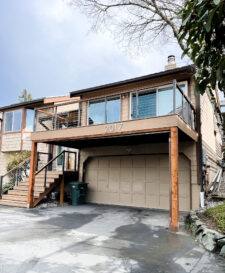
What Bellingham's Climate Does to Siding Over Time
Three things drive most of the siding repair calls we get in this part of Whatcom County:
- Salt-laden marine air. It accelerates corrosion on fasteners, flashing, and any exposed metal trim, and it works into hairline cracks in caulking and paint faster than drier inland air would.
- Driving, wind-blown rain. Bellingham doesn't just get a lot of rain — a good share of it comes in sideways off storms moving through the Strait. That pushes water into laps, seams, and butt joints that would stay dry in a calmer climate.
- A long moss and algae season. Shaded north- and west-facing walls, fence lines, and anything under tree cover stay damp for extended stretches. Moss holds moisture directly against the siding surface, which is exactly the condition that lets rot get started underneath paint or a factory finish that still looks intact.
Individually, none of these are unusual for the Pacific Northwest. Together, over enough winters, they're why siding in a neighborhood like Silver Beach tends to show wear in specific, predictable places — and why a repair crew that already knows those patterns can diagnose a problem faster than one seeing it for the first time.
Where We See Damage Most Often
Certain areas of a home take the brunt of it: the bottom courses of siding closest to grade or a deck, inside corners where two rooflines meet and shed extra water, anywhere caulking was never renewed after the original install, and the shaded sides of the house where moss gets a head start every fall. Repairs that only address the spot that's visibly failing, without checking these related areas, tend to come back within a season or two.
Signs Your Siding Needs a Repair — Not Just a Paint Job
A lot of siding problems get treated as cosmetic when they're actually structural. Here's what tells us a section needs real repair rather than a fresh coat of paint:
- Soft or spongy spots when you press on the siding, especially near the bottom edge or below windows
- Paint that's bubbling, peeling, or flaking in a way that keeps coming back in the same spot
- Visible gaps at seams, corners, or trim where caulking has shrunk, cracked, or fallen out
- Dark streaking or persistent moss and algae growth that doesn't clear up with a wash
- Warping, buckling, or panels that no longer sit flush against the wall
- A musty smell near an exterior wall, or interior drywall staining that lines up with an exterior spot
- Visible rust bleed around nail heads or trim fasteners
Any one of these on its own might be minor. Two or three in the same area of the house usually means water has been getting behind the siding for a while, and the repair needs to include whatever is happening underneath, not just the surface.
What a Correct Siding Repair Actually Involves
A siding repair that holds up in this climate isn't just about swapping a damaged board for a new one. It has a sequence, and skipping steps is exactly how a "fixed" section fails again within a year or two.
1. Find the actual water path, not just the visible damage
Damaged siding is often a symptom of a failure point somewhere else — a flashing detail, a caulk joint, a gap where two materials meet. We look at what's feeding water into the area before we touch the siding itself.
2. Remove damaged material and check what's behind it
Once siding is off, we check the water-resistive barrier, sheathing, and framing underneath. If there's rot or moisture damage in the structure, that gets addressed before anything new goes back on — patching over a wet wall just hides the problem.
3. Correct the detail that caused the failure
This is the step that separates a real repair from a cosmetic one. Re-flashing a joint, adding a kickout where a roofline meets a wall, or re-caulking with a product rated for this climate — whatever let water in gets fixed, not just covered.
4. Match or replace the siding properly
Where the existing siding can be matched, we match it. Where a section is too far gone, or the material itself is the reason the failure keeps happening, we'll say so plainly and talk through what replacing that section — or that side of the house — actually involves.
5. Finish and seal to hold up to what's coming
Paint, caulk, and trim details all get finished to shed water the way they're supposed to, accounting for the direction this specific wall usually takes weather from.
Repair or Replace? How We Help You Decide
Not every repair call ends in a repair, and not every damaged section needs a full re-side. The honest answer depends on a handful of factors, and we'll walk through them with you before recommending either direction.
| Factor | Leans toward repair | Leans toward replacement |
|---|---|---|
| Extent of damage | Isolated to one section or wall | Recurring in multiple areas or spreading |
| Underlying structure | Sheathing and framing are sound | Rot has reached structural framing |
| Age of existing siding | Siding is otherwise in good condition | Siding is near the end of its service life |
| Material match | Matching material is available | Original product is discontinued or mismatched |
| Root cause | A specific, fixable detail (flashing, caulk) | A systemic issue with the material itself |
When a repair makes sense, we'll do the repair — we're not in the business of upselling a full re-side to a homeowner who just needs a section fixed. When the damage points to a bigger issue, we'll explain exactly why, in plain terms, before you decide anything.
A Note on Materials: What We Repair, and What We Recommend Going Forward
We work on siding repairs regardless of what's currently on the house — vinyl, wood, fiber cement, whatever was installed originally. But when a repair turns into a conversation about replacing a section or a full wall, our recommendation is James Hardie fiber cement siding, and it's worth being direct about why.
We've made the decision not to install vinyl, LP SmartSide, primed wood, cedar, or other fiber cement brands as new siding on the homes we work on. That's not a knock on every homeowner who has one of those products — plenty of it is out there performing fine, and we'll repair it. It's a statement about what we're willing to put our name behind going forward, in a climate that's this consistently hard on exterior materials. Vinyl can warp and fade, and it has limited repair options when it's damaged. Wood needs ongoing maintenance to keep moisture out. Some fiber cement products don't carry the same factory-applied finish or climate-specific engineering that James Hardie's HZ5 product line was built around for the Pacific Northwest. James Hardie is non-combustible, holds its ColorPlus factory finish far longer than field-applied paint, and comes with a strong transferable warranty when installed to spec.
If your Silver Beach home ever needs more than a targeted repair, that's the direction we'll point you — but a repair call is a repair call, and we'll treat it as one.
Why a Crew That Already Works Silver Beach Matters
Siding repair is one of those jobs where local, repeated experience actually changes the outcome. A crew that's worked this neighborhood before already knows which orientations take the worst weather, which older homes tend to have outdated flashing details, and how long moss has typically had to work on a given wall before anyone notices a problem. That's the difference between a repair that gets diagnosed correctly the first visit and one that gets patched, then called back out again the following winter.
It also means we're not guessing at what "normal" looks like for Bellingham. A crack pattern or moisture reading that might raise questions somewhere drier is often just expected wear here after a certain number of years — and knowing which is which keeps us from either underselling a real problem or recommending work that isn't needed yet.
Keeping Repaired Siding Ahead of the Next Moss Season
A repair is only as good as what happens after it. A few habits go a long way toward making sure a fix holds:
- Keep gutters clear so overflow doesn't run down the siding face repeatedly through the winter
- Trim back landscaping and tree limbs that keep a wall shaded and damp longer than it needs to be
- Rinse moss and algae off before it gets a firm hold, rather than after it's been growing for a season
- Check caulk joints at trim and corners once a year, since this is usually the first thing to fail again
- Address small paint or finish issues early, before moisture gets a chance to work underneath
None of this replaces a proper repair, but it does stretch the life of one considerably in a climate that doesn't give siding much of a break.
Get an Honest Look at What Your Siding Needs
If you're seeing soft spots, persistent moss, cracked caulking, or paint that won't stay put on a Silver Beach home, it's worth having someone look at it before the next wet season adds to the damage. We'll give you a straight answer on whether it's a repair, what caused it, and — if it's headed toward replacement — what that would actually involve. Reach out for a free, no-pressure estimate using the form below.