 Bellingham Roofing
 South Hill's Exposure Is Different From a Typical Bellingham Lot
South Hill sits up above the flats of Bellingham, with open exposure toward Bellingham Bay and the Georgia Strait beyond it. That elevation is part of what makes the neighborhood desirable — the views, the light, the breeze on a hot day. It's also exactly what makes siding work harder up there than it does a mile away at sea level. Wind off the water carries salt-laden moisture that settles on exterior surfaces, and homes on higher, more open ground catch more of it, more often, than homes tucked into a valley or behind a windbreak of trees.
Add to that the reality of a Whatcom County winter and spring: months of driving rain, short days, and long stretches where siding simply does not get a chance to fully dry out between storms. Where South Hill has mature tree cover — and a lot of it does — you get the flip side of that same moisture problem: shade and reduced air movement that let moss, algae, and mildew get a foothold on siding, trim, and roofing alike. A siding product and installation method that isn't built for this specific combination of salt, rain, and shade will show it early, usually in the form of paint failure, swelling at the edges, or staining that no amount of pressure washing fully removes.
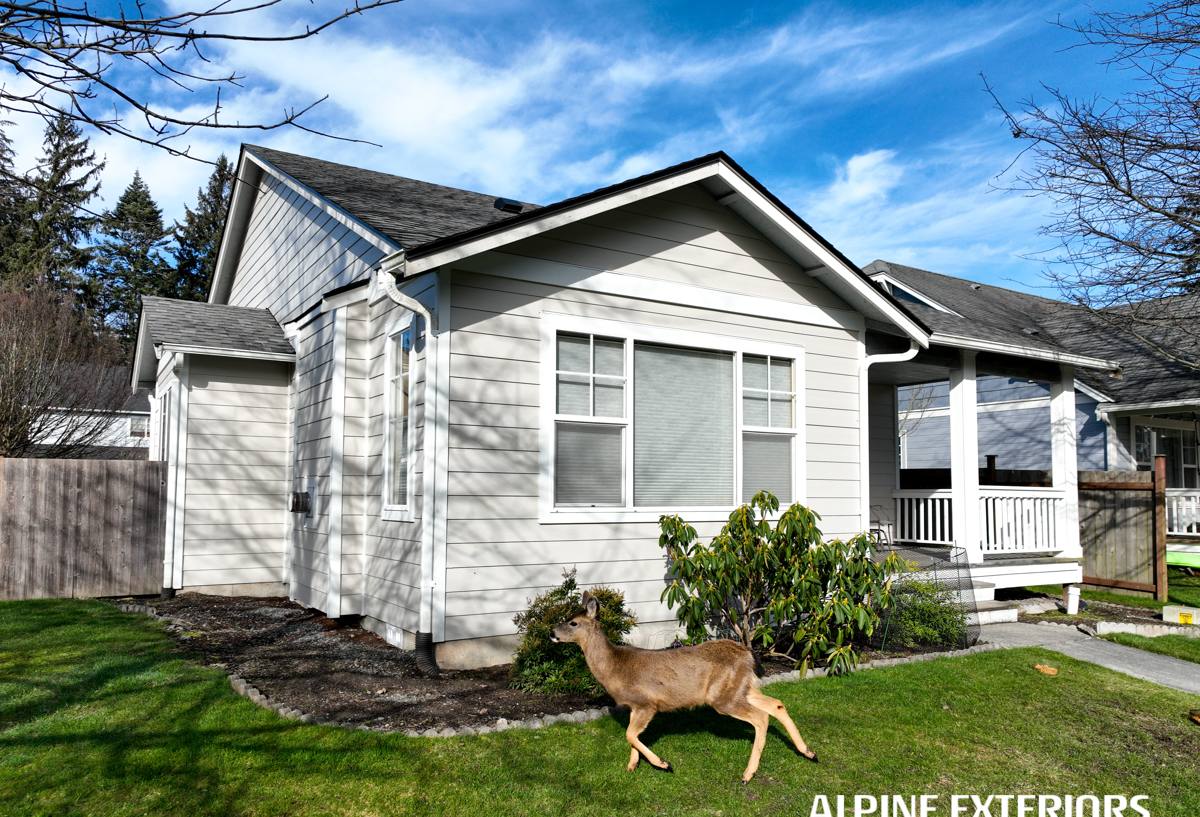
Why James Hardie Fiber Cement Fits This Climate
We install James Hardie fiber cement siding exclusively — not as a marketing choice, but because after years of doing exterior work in Bellingham and the surrounding county, it's the product we've seen hold up to conditions like South Hill's without the maintenance headaches that come with wood-based or vinyl alternatives. Fiber cement is made from cement, sand, and cellulose fibers, which means it doesn't absorb and swell the way engineered wood products can, and it doesn't soften, warp, or become brittle the way vinyl can under the Pacific Northwest's combination of cool temperatures and constant moisture.
James Hardie also factory-finishes its boards with a baked-on ColorPlus finish rather than relying entirely on field-applied paint. That finish is formulated to resist fading and cracking, and because it's cured at the factory under controlled conditions, it bonds to the board more consistently than paint applied on-site in variable weather — which matters in a region where you rarely get a long, dry, low-humidity stretch to paint in.
Climate-Engineered HZ Product Lines
James Hardie makes region-specific versions of its siding, engineered for the climate zone they're sold into. Homes in our part of Washington are specified with the HZ5 product line, which is formulated for regions with damp, moderate climates and freeze-thaw cycles — as opposed to the HZ10 line built for hot, humid climates elsewhere in the country. That distinction matters more than most homeowners realize: it affects the moisture resistance of the substrate and how the product is expected to perform over its service life. Installing the wrong regional formulation, or installing HZ5 board incorrectly, undercuts the whole reason to choose Hardie in the first place.
What a Correct Installation Involves
Fiber cement siding is only as good as the assembly behind it. Most of the siding failures we get called out to inspect in this area aren't a problem with the board itself — they're a problem with what's underneath it, or how it was fastened, flashed, and finished. On a hill exposed to wind-driven rain, these details aren't optional extras; they're the difference between siding that lasts decades and siding that traps water against the sheathing.
Drainage Plane and Weather-Resistive Barrier
Correct installation starts with a continuous weather-resistive barrier over the sheathing, lapped properly from the bottom up so water sheds outward rather than working its way behind the barrier. On exposed, wind-driven sites like South Hill, we pay close attention to how that barrier integrates with window and door openings, since that's where most water intrusion actually starts.
Rainscreen Gap
James Hardie's own installation guidance calls for a drainage gap between the back of the siding and the weather barrier in many assemblies, and we treat that gap as standard practice rather than an upgrade. A rainscreen gap lets any moisture that does get behind the siding drain and dry out instead of sitting against the wall assembly — which is exactly the kind of detail that matters most in a climate where the siding rarely gets a long dry spell.
Fastening and Nailing Pattern
Fiber cement has to be fastened according to the manufacturer's specified pattern and fastener type, with the correct nail depth — not so shallow that the board can work loose in wind, not so deep (a "blown" nail) that it cracks the board or breaks the water seal at the fastener. On a site with regular wind exposure, a sloppy nailing pattern shows up as loose boards and rattling within a few winters.
Flashing, Caulking, and Trim Details
Every penetration, corner, and horizontal trim piece needs its own flashing or properly sequenced caulking. Butt joints between boards, the top of window and door trim, and any place siding meets a roofline or deck ledger are the highest-risk spots for water intrusion. We treat these as installation-critical, not cosmetic finishing steps.
How We Approach a South Hill Siding Job
Our process doesn't change dramatically from house to house, but on South Hill we go into a project already accounting for the site conditions rather than discovering them mid-job.
- Site and exposure assessment — we look at which elevations of the house take the most wind and rain, where tree cover is holding moisture against the wall, and where existing moss or algae growth signals a moisture pattern worth solving, not just cleaning.
- Tear-off and sheathing inspection — removing the old siding lets us actually see the sheathing condition underneath, which is often where hidden rot or past water damage shows up. We address any damaged sheathing before anything new goes on.
- Weather barrier and drainage gap installation — installed and lapped correctly, with the rainscreen detail built in on the elevations that need it most.
- Flashing at every penetration — windows, doors, hose bibs, vents, and any deck or roof intersections.
- Hardie board installation to manufacturer nailing and clearance specifications, including the ground clearance and roofline clearance Hardie requires to keep the bottom edge of the siding out of standing moisture.
- Trim, caulking, and finish work, followed by a final walk-through so you know exactly what was done and why.
Comparing Siding Options for a Site Like South Hill
We only install James Hardie, but homeowners deserve a straight answer about how the alternatives actually perform in this specific kind of exposure — not a sales pitch against them.
| Factor | James Hardie Fiber Cement | Vinyl Siding | Wood or Engineered Wood (e.g. LP SmartSide) |
|---|---|---|---|
| Moisture absorption | Minimal — cement-based, doesn't swell | Doesn't absorb, but seams and laps can trap moisture behind panels | Wood-based substrate is vulnerable to swelling and rot if the finish is compromised |
| Performance in salt air | Non-organic composition resists salt-driven deterioration | Can become brittle and discolor faster under coastal wind and UV exposure | Salt-laden moisture accelerates finish breakdown at seams and edges |
| Moss and algae resistance | Factory finish resists staining; surface can be cleaned without damaging the substrate | Resists staining but can trap growth in overlapping panel gaps | Textured or wood-grain surfaces give moss and algae more to grip |
| Fire resistance | Non-combustible | Combustible, can melt or deform near heat sources | Combustible |
| Typical factory finish | ColorPlus baked-on finish with a long finish warranty | Color is through-body but can fade and chalk over time | Factory-primed or pre-finished; still relies on quality of field maintenance |
Maintenance a South Hill Homeowner Should Actually Expect
No siding product is maintenance-free in this climate, but correctly installed Hardie siding asks very little compared to the alternatives. Here's what reasonable upkeep looks like:
- Rinse the siding with a garden hose once or twice a year to clear salt residue and organic buildup, especially on shaded or tree-covered elevations.
- Keep an eye on caulking at trim joints and penetrations — caulk is a wear item and should be checked every few years, sooner on the most exposed sides of the house.
- Trim back vegetation and tree limbs that keep a wall shaded and damp longer than the rest of the house.
- Watch gutters and downspouts near the roofline — overflow running down the siding is one of the most common causes of localized staining and premature wear.
- Address any moss or algae growth early with a gentle wash rather than letting it build up over multiple seasons.
Why It Matters That We Already Work This Neighborhood
A siding crew that mostly works flatter, more sheltered parts of Whatcom County can still do competent work, but they're often applying a generic approach to a site that doesn't behave generically. Knowing that a given block on South Hill catches more wind-driven rain than the rest of the street, or that a particular elevation stays damp longer under tree cover, changes decisions we make before the first board goes up — where we add extra flashing attention, where a rainscreen gap earns its keep, and where we'd flag an existing moisture problem in the sheathing before it becomes your problem.
There's also a practical side to hillside work: staging materials, ladder and lift access, and protecting landscaping on sloped lots takes more planning than a flat lot in a newer subdivision. A crew that's done that logistics work on South Hill before isn't guessing at it on your job.
Warranty and Long-Term Performance
James Hardie backs its siding with a manufacturer warranty that is transferable to a future homeowner — a genuinely useful detail if you ever sell the house, since prospective buyers and their inspectors do notice fiber cement siding with documented professional installation. That warranty is tied to installation meeting Hardie's specifications, which is another reason correct installation isn't a detail to shortcut: an improperly installed board can void warranty coverage even though the material itself is sound. When it's installed to spec on a site like South Hill, Hardie siding is designed to hold its finish and structural integrity for decades, well beyond what most wood-based or vinyl products are rated for under comparable exposure.
Ready to Talk About Your South Hill Home
Every South Hill property has its own mix of sun, shade, wind exposure, and existing wear, and the right approach depends on actually looking at your house rather than guessing from the street. If you'd like a straightforward look at your siding's condition and what a correct James Hardie installation would involve, we're glad to come take a look. Fill out the form below for a free, no-pressure estimate.