 Bellingham Roofing
 Building new in Sudden Valley puts windows in an unusual position: they're one of the only components on the house that get built into the structure rather than added to it later. Get the flashing sequence, frame material, and fit right the first time, and those windows will perform for decades. Get it wrong, and the mistake gets buried behind siding and trim before anyone notices — usually until moisture finds its way in. For a lake-adjacent, tree-shaded community like Sudden Valley, southeast of Bellingham in Whatcom County, that first install matters more than it does almost anywhere else in the region.
What Sudden Valley's Setting Means for New-Construction Windows
Sudden Valley sits in a wooded, lake-side setting, and that combination of shade and standing moisture changes what a window install needs to survive. Heavy tree cover keeps large parts of many lots damp well after a storm has passed, which is exactly the environment moss and algae need to take hold on siding, trim, and window sills. A window that isn't properly flashed and sloped to shed water will hold moisture against the frame long after the rain has stopped.
Driving rain off Pacific storm systems is the other half of the equation. Whatcom County gets wind-driven rain that pushes water sideways into wall assemblies, not just straight down — which means a window's flashing and sealant details have to work under pressure, not just under gravity. And across the broader Bellingham area, including the salt-air influence near Bellingham Bay, exterior materials see faster wear on fasteners and finishes than they would further inland. All of that adds up to one conclusion: a new-construction window in Sudden Valley needs to be installed like it's going to be tested every winter, because it will be.
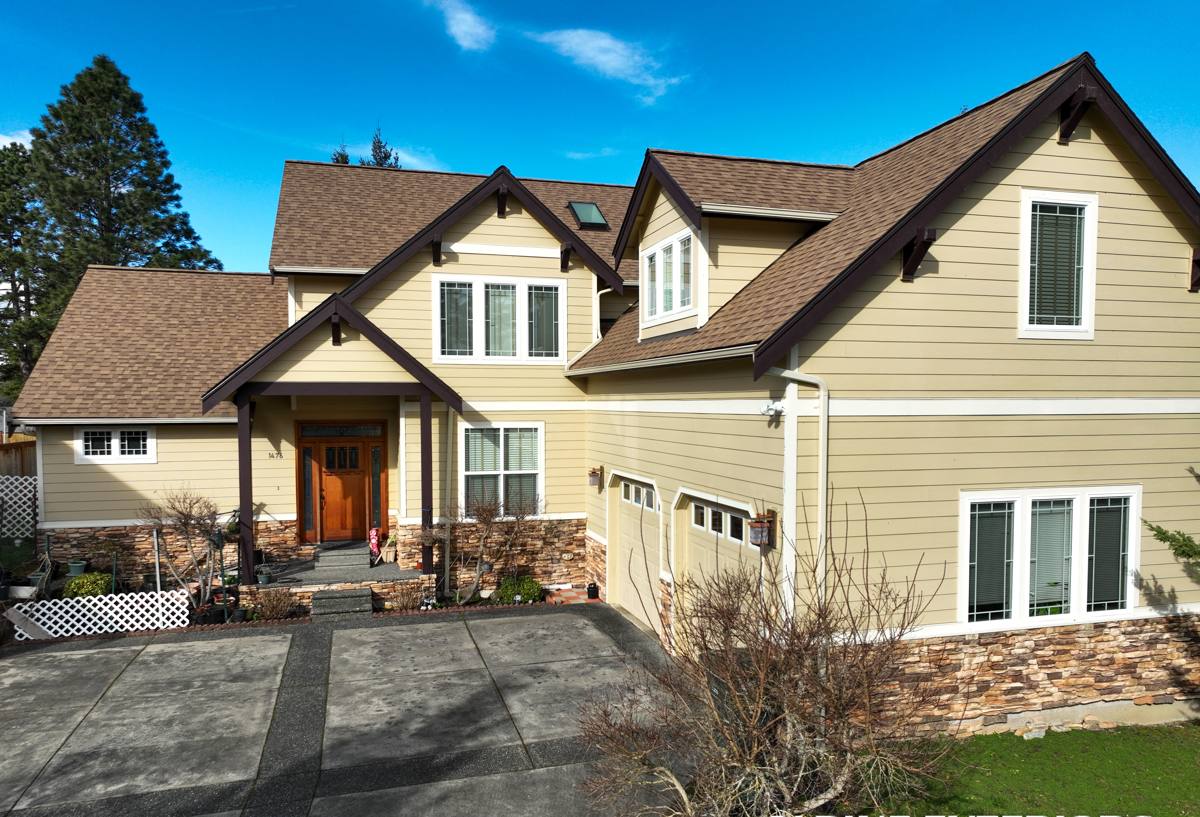
New-Construction Windows vs. Replacement Windows
These are two different products installed two different ways, and mixing up the approach is one of the most common mistakes on a new build. A new-construction window has a nailing fin around its perimeter that gets fastened directly to the wall sheathing before the weather-resistive barrier (WRB) and siding go on. A replacement window is designed to go into an existing, already-finished opening without disturbing the siding around it. Because a new build starts with bare sheathing, it's the ideal time to install the fin type and use the flashing sequence that gives the longest service life — there's no siding in the way and no shortcuts to take.
| Factor | New-Construction (Nail Fin) | Replacement (Block Frame) |
|---|---|---|
| When it's installed | Before siding and WRB are closed up | Into an existing finished opening |
| Flashing integration | Fully integrated with the WRB and sill pan | Limited to what the existing opening allows |
| Best use case | New builds, additions, full wall rebuilds | Swapping windows without disturbing siding |
| Long-term moisture control | Highest, when sequenced correctly | Good, but constrained by the existing opening |
For a Sudden Valley build, this is the one chance to set the sill pan, tape, and fin fastening exactly right before it's covered forever. It's worth doing carefully rather than quickly.
What a Correct Installation Actually Involves
A window opening that looks fine from the outside can still be flashed wrong underneath. The details that matter are mostly invisible once siding goes on, which is exactly why they need to be right the first time — nobody is going to open the wall back up to check.
- A sloped sill pan under every opening, so any water that gets past the window drains back out rather than pooling on the sheathing
- Self-adhered flashing tape applied in the correct shingle-style order — sill first, then jambs, then head — so water always sheds outward and down
- Proper integration with the weather-resistive barrier, with the head flashing lapped over the WRB, not tucked under it
- Nailing fin fastened at the manufacturer's specified spacing, not just "enough nails to hold it"
- Window set plumb, level, and square before it's fastened off — a racked frame stresses the seal and can bind the sash for years
- Backer rod and sealant at the interior, used as a backup to the flashing system, not as the primary defense against water
Caulk and sealant are a second line of defense, not the first. A window that depends on a bead of caulk to stay dry is a window that will eventually leak — usually quietly, behind the wall, in exactly the kind of shaded, damp spot Sudden Valley has plenty of.
Choosing a Frame Material for a Sudden Valley Build
There's no single "best" window material — there's a best fit for the site conditions and the look the build calls for. On a shaded, lake-humid lot, moisture tolerance and maintenance load matter as much as upfront cost.
| Frame Material | Moisture Tolerance | Maintenance | Notes |
|---|---|---|---|
| Vinyl | Good | Low | Cost-effective; check reinforcement on larger openings common in new builds |
| Fiberglass | Very good | Low | Dimensionally stable through temperature and moisture swings |
| Wood-clad | Good, if maintained | Higher | Warm interior look; exterior cladding needs upkeep in shaded, damp settings |
Our standard is to match the frame to the site, not just to a price point. A wood-clad window on a sun-exposed south wall is a very different maintenance conversation than the same window tucked under tree cover on a shaded north elevation. We'll walk through what each material actually asks of you over the next twenty years, not just what it costs on day one.
Our New-Construction Window Process
- Review the plan set and rough opening sizes before framing is finalized, so window sizing and swing direction are locked in early
- Confirm the flashing sequence and materials with the builder or general contractor, so everyone on site is working from the same detail
- Install sloped sill pans and lap flashing tape at every opening before the windows go in
- Set each window plumb, level, and square, and fasten the nailing fin per spec
- Integrate the WRB over the flashing and seal all penetrations
- Inspect every opening before siding closes the wall assembly for good
- Final adjustment and walkthrough once siding and trim are complete, checking operation and seal on every unit
That inspection step before siding closes things up is one we don't skip, even under schedule pressure. It's the last point where a flashing mistake can be caught and fixed for the cost of a few minutes, instead of years later as a repair.
Cost Factors for New-Construction Windows in Sudden Valley
New-construction window costs for a single-family home vary a lot based on the build itself, so we don't quote off a flat per-window number. These are the factors that actually move the price up or down.
| Factor | How It Affects Cost |
|---|---|
| Window count and size | More openings and larger units (common in newer floor plans) add material and labor |
| Frame material | Vinyl runs lower, fiberglass and wood-clad run higher |
| Glass package | Dual-pane vs. triple-pane and Low-E coatings affect both cost and performance against driving rain and cooler winters |
| Site access | Sloped or wooded lots common around the lake can require extra staging or lift access |
| Schedule coordination | Installing on the builder's framing timeline, rather than as a standalone job, usually keeps costs down |
As a broad range, most single-family new-construction window packages land somewhere between a few thousand and several tens of thousands of dollars depending on how many of these factors stack up. We'll give you real numbers once we've seen the plans.
Why a Crew That Already Works in Sudden Valley Matters
Sudden Valley operates under its own community association with design review for new construction, which is worth planning around from the start rather than discovering partway through a build. A crew that's already familiar with that process can help keep window selections and scheduling aligned with it, instead of adding delays later.
The lots themselves add a practical layer too. Sloped, wooded, lake-adjacent sites often mean tighter staging areas and more thought given to how materials and equipment get to the opening, especially on homes set back from the road. We've worked on builds throughout Sudden Valley and know how to plan around those site conditions rather than treating each one as a surprise.
Just as important is understanding the microclimate itself — which elevations of a given lot stay shaded and damp longest, where moss pressure will be worst, and which details need extra attention because of it. That's the kind of knowledge that comes from working this specific area repeatedly, not from a general new-construction checklist.
If you're planning a new build in Sudden Valley and want window details done right the first time, we're happy to walk the plans with you and put together a straightforward, no-pressure estimate — just fill out the form below.