 Bellingham Roofing
 Why Sudden Valley Roofs Take a Different Kind of Beating
Sudden Valley sits close to Lake Whatcom, wrapped in mature tree cover, and that combination shapes almost every roofing problem we see out there. The tree canopy keeps roof surfaces shaded and damp longer after a storm than a roof out in the open would be. Add the marine air that moves through Whatcom County off the Salish Sea, and you get a steady, low-grade combination of moisture and salt exposure that never really lets a roof fully dry out or reset between weather events.
None of that is dramatic on its own. A single windstorm doesn't usually tear a roof apart in Bellingham the way it might somewhere with regular severe thunderstorms. What we actually deal with is cumulative: driving rain that finds the smallest gap in flashing or underlayment, wind that lifts a shingle edge just enough to break the seal, and moss that gets a foothold in shaded valleys and around chimneys and slowly works itself under the shingle mat. Storm damage repair in this neighborhood is rarely about a single catastrophic event. It's about catching what a storm exposed before the next one, and the one after that, turns it into a much bigger repair.
What Actually Counts as Storm Damage Here
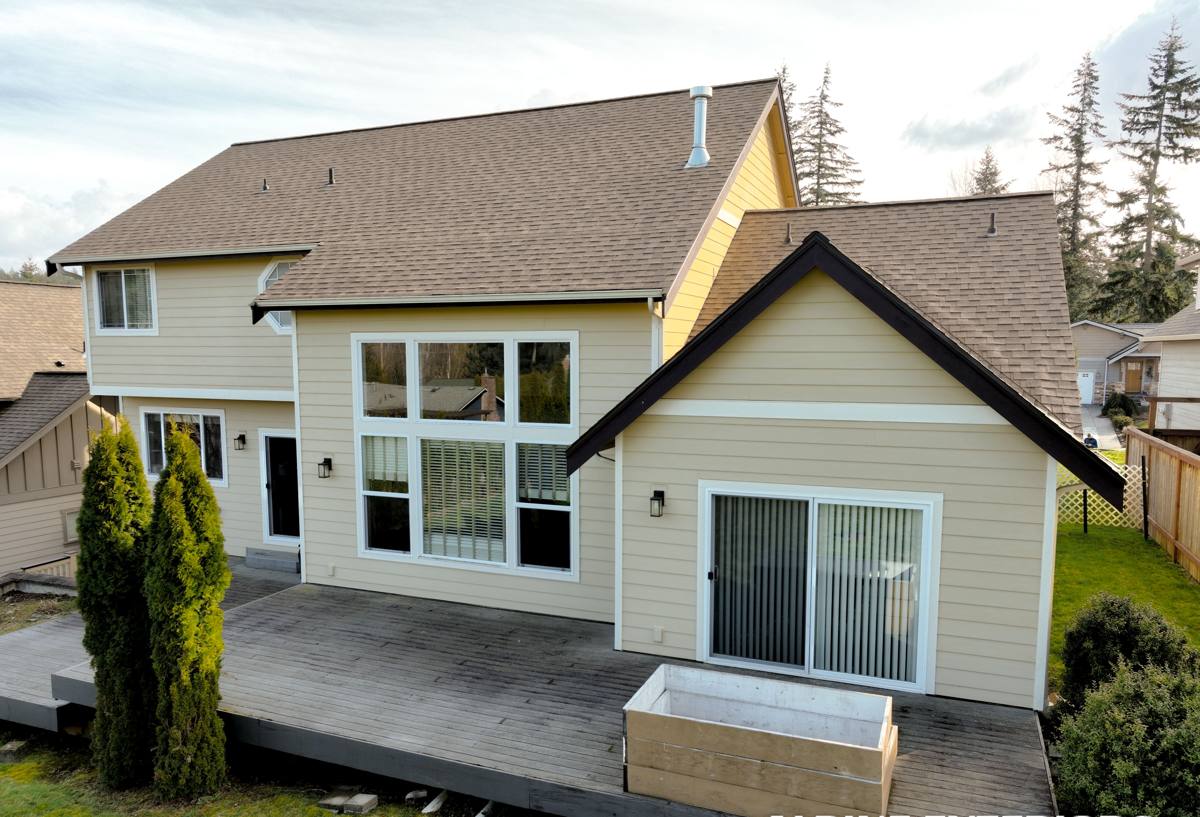
Homeowners often picture storm damage as missing shingles scattered across the yard. That happens, but around Sudden Valley the more common pattern is quieter: a wind gust breaks the adhesive seal on a shingle without tearing it loose, rain gets forced sideways under a ridge cap, or a branch dropped by wind scuffs granules off a section of roof without puncturing it. All of these are legitimate storm damage. They just don't look as urgent as they are, which is exactly why they tend to get ignored until a ceiling stain shows up weeks later.
- Shingles that look intact from the ground but are lifted, cupped, or loose at the tab when checked up close
- Granule buildup in gutters or downspouts after a windstorm — a sign of accelerated wear, not just age
- Fresh gaps or bent tabs on flashing around chimneys, skylights, and roof-to-wall transitions
- New or growing moss patches in shaded valleys, especially on the north side or under overhanging limbs
- Soft spots, sagging, or discoloration on interior ceilings near exterior walls after a storm
- Debris strikes — even small branch impacts can crack a shingle or knock loose a section of ridge cap
- Water staining inside the attic along rafters or decking, which usually shows up before any ceiling stain does
If you can check your attic after a storm, do it before you check the roof from the yard. Attic staining almost always shows up first, and it tells you where the problem actually is instead of where it's easiest to see from the ground.
What a Correct Storm Damage Repair Actually Involves
Inspection Before Anything Gets Touched
A real storm damage repair starts with figuring out the full extent of what happened, not just patching the one spot that's visibly leaking. We walk the roof, check the attic from the inside, and look at flashing, valleys, and any penetrations — vents, chimneys, skylights — separately from the field of the roof itself, because those are the spots that fail first and get missed most often in a quick look.
Decking Comes Before Shingles
If water has been getting into the roof system for any length of time before the storm damage was noticed, the plywood or OSB decking underneath may be soft, delaminated, or stained. Replacing shingles over compromised decking is a short-term fix that fails again quickly. Any section with damaged decking gets that decking replaced first — that's a non-negotiable part of doing the repair right, not an upsell.
Underlayment and Flashing Get Matched to the Exposure
Given how much this area deals with wind-driven rain, we pay particular attention to underlayment at eaves, valleys, and any low-slope transitions, and we don't reuse old flashing that's been bent, corroded, or previously patched. Flashing is cheap compared to the water damage it prevents, and it's the single most common point of failure we find on storm-related leaks in this neighborhood.
Shingle Matching and Tie-In
Where only part of a roof slope needs repair, we tie the new shingles into the existing field in a way that keeps the water-shedding pattern correct — not just cosmetically similar. Exact color matching isn't always possible if the existing roof has faded or the original shingle is discontinued, and we'll tell you honestly if that's the case rather than promise a seamless match we can't deliver.
Repair or Full Replacement? What Actually Drives That Decision
Storm damage is sometimes the moment a roof that was already near the end of its service life finally gets noticed. Deciding between a targeted repair and a larger replacement should come down to a few honest factors, not guesswork.
| Factor | Favors Repair | Favors Replacement |
|---|---|---|
| Roof age | Under 15 years, or a newer roof with isolated damage | Nearing or past its expected lifespan for the material |
| Extent of damage | Isolated to one slope, valley, or penetration | Spread across multiple slopes or found in more than one storm inspection |
| Decking condition | Solid, no rot or soft spots found | Widespread soft decking or repeated past patch jobs |
| Moss and moisture history | Minor, treatable moss with no underlying rot | Long-term moss growth that's already compromised the shingle mat |
| Shingle availability | Matching shingles still available | Discontinued product, poor match likely |
We'll always give you the repair option first if it's a sound long-term fix. If the damage or the roof's underlying condition means a repair would just be a temporary patch on a roof that needs replacing soon anyway, we'll say so plainly and explain why — not because replacement pays more, but because a repair we don't believe in isn't worth your money or our name on it.
Our Process, Start to Finish
- Initial call and scheduling — we ask what you noticed and when, which helps us prioritize active leaks over cosmetic damage.
- On-site inspection — roof surface, attic interior, flashing, and penetrations, with photos documenting what we find.
- Written scope and estimate — a clear explanation of what's damaged, what needs to be done, and why, before any work starts.
- Temporary protection if needed — for active leaks, we can get a roof weathertight quickly while a full repair is scheduled.
- The repair itself — decking, underlayment, flashing, and shingle work performed in that order, not shingles-only.
- Cleanup and final walkthrough — debris and old material removed, and we walk the roof and attic with you if you'd like, so you can see what was done.
Insurance Claims for Storm Damage
Many storm damage repairs in this area do get filed as insurance claims, especially when wind or falling debris caused the damage. We're glad to provide the documentation and photos an adjuster will want to see, and we'll point out anything we find that's relevant to a claim. What we won't do is promise a specific claim outcome or tell you what your policy covers — that's between you and your insurer, and any contractor who guarantees your claim will be approved before an adjuster has even looked at the roof is making a promise they can't back up. Our job is to document the damage accurately and repair it correctly, whether that repair is paid out of pocket or through a claim.
Moss, Salt Air, and What Happens After the Repair
A storm repair that ignores the conditions that caused the damage in the first place is only a partial fix. In Sudden Valley's tree cover, moss is often part of the underlying picture even when wind or rain triggered the actual leak — moss holds moisture against the shingle surface and works its way under tabs and around fasteners over time. Where moss contributed to the failure, we address it as part of the repair rather than leaving it to keep working on the surrounding shingles. Salt-laden marine air is a slower factor, but it does accelerate corrosion on exposed metal flashing and fasteners over the years, which is one more reason we don't reuse questionable flashing during a repair just to save a step.
After the repair, the same conditions that caused the original damage are still there — that doesn't change. What does change is that the specific vulnerability the storm exposed has been fixed properly, with the right materials in the right order, instead of patched over.
Why It Matters That We Already Work in Sudden Valley
Storm damage brings out contractors from out of the area who show up after a bad windstorm, do quick work, and are hard to reach if something isn't right six months later. A crew that already works this neighborhood regularly has a practical advantage: we've seen how roofs here actually age under this tree cover and this weather pattern, we're not guessing at what "normal wear" versus "storm damage" looks like on a Whatcom County roof, and we're still a local call away if a repair needs a follow-up visit. That matters more here than in a lot of places, given how much moisture and shade play into whether a repair holds up.
If a recent storm has you wondering whether your roof took damage, or you've already spotted something that doesn't look right, we're happy to come take an honest look. The estimate is free, there's no pressure to move forward, and if the answer is "this doesn't need repair yet," we'll tell you that too — just fill out the form below to get started.