 Bellingham Roofing
 Why Birch Bay's Waterfront Location Is Hard on Siding
Birch Bay sits right on the water in unincorporated Whatcom County, and that location cuts both ways. The same shoreline that makes it a great place to live also means homes here take a different kind of weather beating than houses a few miles inland in Bellingham. Onshore wind carries salt spray onto exterior walls, especially on homes that face the water directly. Salt residue holds moisture against siding longer than plain rain does, and it accelerates corrosion on fasteners, flashing, and any exposed metal trim.
Add in wind-driven rain during fall and winter storms, and siding here has to shed water horizontally, not just vertically — water gets pushed sideways into seams, laps, and trim joints that would stay dry on a more sheltered inland wall. Then there's the moss and algae season, which in this part of Whatcom County runs long. Shaded, north-facing, or tree-covered walls stay damp for extended stretches, and that damp surface is exactly what moss and mildew need to take hold. Over years, that combination — salt exposure, driving rain, and persistent moisture — wears out siding and fasteners faster than a textbook maintenance schedule would predict.
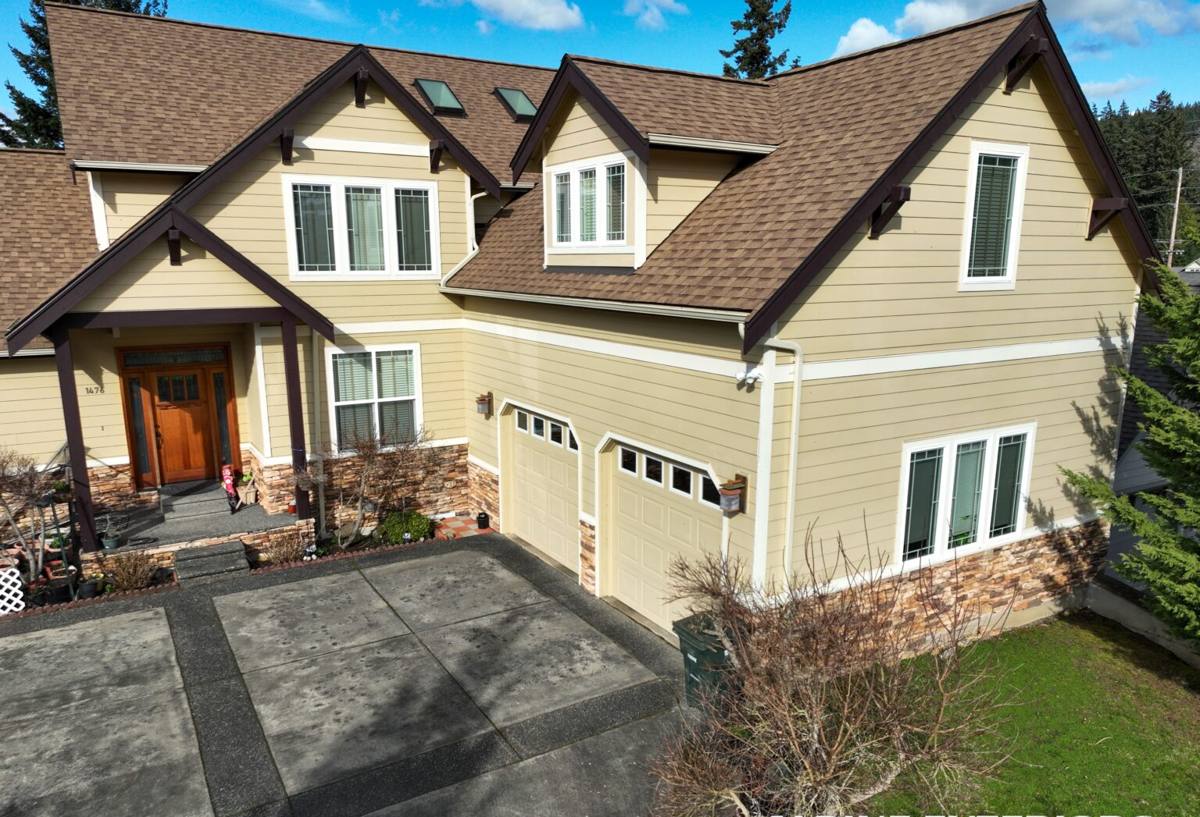
Signs Your Birch Bay Home Needs Siding Repair
Most siding problems don't show up as one dramatic failure. They show up as small signals that get easy to ignore until they aren't. Here's what we tell Birch Bay homeowners to watch for:
- Soft or spongy spots when you press on the siding, especially near the bottom courses or under windows
- Streaking, staining, or discoloration that doesn't wash off, particularly on water-facing or shaded walls
- Visible cracking, buckling, or bowing in individual boards or panels
- Gaps opening up at seams, corner boards, or where siding meets trim
- Paint that's peeling, bubbling, or failing faster than it should
- Moss or algae buildup that keeps returning even after cleaning
- Rust streaks bleeding down from fastener heads or metal flashing
- Warping or separation near the ground line, deck ledgers, or roofline
Any one of these on its own might be minor. Several together, especially on the same wall, usually means water has been getting behind the siding for a while.
What a Proper Siding Repair Actually Involves
A repair that's just caulk and a matching paint touch-up treats the symptom, not the cause. On a house exposed to Birch Bay's salt air and driving rain, that kind of surface fix tends to fail again within a season or two. A repair we stand behind starts with figuring out how water got in and where it's been going since.
That means checking moisture levels behind the siding with a meter, not just guessing from the outside. It means pulling back enough siding to inspect the house wrap and flashing at windows, doors, and any wall penetrations — because siding damage is very often a downstream symptom of a flashing detail that failed years earlier. It means matching the replacement material's profile and exposure so the new section doesn't create a visible seam or, worse, a new water path. And it means giving corner boards, trim, and butt joints the same attention as the field of the wall, since those are the spots that fail first on a coastal home.
Repair or Replace? How We Help You Decide
Not every damaged section needs a full re-side, and not every homeowner needs to hear "you need all new siding" when a targeted repair will hold up fine. We walk Birch Bay homeowners through the decision using a few honest factors:
| Factor | Repair Usually Makes Sense | Replacement Usually Makes Sense |
|---|---|---|
| Extent of damage | Isolated to one or two walls or sections | Spread across multiple elevations |
| Moisture intrusion | Caught early, sheathing still sound | Sheathing or framing already compromised |
| Age of existing siding | Still well within its expected service life | Near or past the end of its useful life |
| Material on the house | Sound James Hardie fiber cement elsewhere | Original material has ongoing, systemic issues |
| Cost relative to full re-side | Repair cost is a small fraction of full replacement | Repair scope starts approaching full re-side cost |
We'll tell you flat out when a repair is the right call — a full re-side isn't automatically the "better" answer, it's just sometimes the necessary one.
Why We Repair — and Rebuild — with James Hardie Fiber Cement
We only install James Hardie fiber cement siding, and that standard applies to repair work too. When we patch a damaged section, we're not going to tie in a piece of vinyl, primed spruce, or a different composite just because it's what happened to be on the wall before. Mixing materials on a repair almost always creates a maintenance headache down the road — different expansion rates, different moisture behavior, different paint life, and a seam that ages unevenly and calls attention to itself.
James Hardie's HZ product lines are engineered specifically for climate zones like ours, which matters more in a place like Birch Bay than it does further inland. Fiber cement doesn't absorb and swell the way wood-based products can, and it's non-combustible, which is a real advantage regardless of exposure. The factory-applied ColorPlus finish is baked on under controlled conditions, so it holds color and resists the fading and peeling that field-applied paint struggles with in a wet, salt-exposed environment. When we match a repair to existing Hardie siding, we're matching a product designed to behave consistently for decades — not hoping a substitute holds up as long.
Our Siding Repair Process
We keep the process straightforward and don't skip the diagnostic steps just to get to the visible fix faster:
- Inspection and moisture testing — we check the damaged area and the surrounding wall with a moisture meter, not just a visual look
- Finding the source — failed caulk, damaged flashing, grade or drainage issues, or a fastener problem — we identify what let water in before we close anything back up
- Scoping the repair — we tell you exactly what's being replaced and why, including anything behind the siding that needs attention
- Matching materials — Hardie boards matched to profile, exposure, and ColorPlus color so the repair blends in
- Correcting the water path — repairing or upgrading flashing and house wrap details so the same failure doesn't repeat
- Fastening to spec — proper fastener type, spacing, and placement per Hardie's installation requirements, which matters more in salt air than most homeowners realize
- Cleanup and walkthrough — we show you what was found and what was done before we consider the job finished
Common Trouble Spots on Birch Bay Homes
Water-Facing Walls and Corners
Elevations that face the bay directly take the brunt of wind-driven rain and salt spray. Corner boards and butt joints on these walls tend to show wear first, since they're where water concentrates and where small gaps have the most opportunity to let moisture behind the siding.
Shaded, Moss-Prone Sides
North-facing walls and anything shaded by trees or neighboring structures dry out slowly. That extended damp period is exactly what moss, algae, and mildew need, and it's also what keeps siding — and the fasteners holding it — wet longer than they should be.
Older Cabins and Additions
A lot of Birch Bay properties started as smaller cabins and were added onto over the years. The transition points between original construction and later additions are common trouble spots, since flashing and siding details at those tie-ins don't always get the same attention as a clean, single-phase build.
Why Hire a Crew That Already Works Birch Bay
Siding repair isn't just a generic skill — the right approach depends heavily on what's actually attacking the wall. A crew that works Bellingham and the Whatcom County coastline regularly already knows how salt exposure, wind direction, and shaded moisture pockets show up differently in Birch Bay than they do on a sheltered inland lot. That's the difference between a repair that lasts and one that's patching the same symptom you'll be dealing with again in two years.
Local also means practical things: familiarity with Whatcom County permitting where it applies, a realistic sense of how weather windows work for exterior work on this stretch of coast, and faster response when storm damage needs attention before the next system rolls in. And because we're not driving in from out of the area, we're accountable to the same community we're working in.
Keeping Your Siding Sound After the Repair
A correct repair should hold up with minimal upkeep, but a little maintenance goes a long way in this environment. Rinse salt spray off exterior walls periodically, especially on water-facing sides. Keep gutters clear so runoff isn't sheeting down the siding face. Trim back vegetation that's shading a wall and keeping it damp longer than it needs to be. And do a walk-around once or twice a year to catch small issues — a cracked caulk line, a loose corner board — while they're still small.
If you're seeing any of the warning signs above, or you just want an honest read on whether your siding needs a repair or something more, we're happy to take a look. Request a free, no-pressure estimate below and we'll tell you straight what we find.