 Bellingham Roofing
 Blaine's Climate Is Harder on Siding Than It Looks
Blaine sits right where Whatcom County meets the water, and that location shapes everything about how a home's exterior ages. Homes here deal with a near-constant mix of salt-laden air, wind-driven rain coming off the water, and long stretches of grey, damp weather that keep siding wet for days at a time. Add in a moss season that can run from fall through spring, and you have a climate that quietly punishes any siding material with a weak point in its finish, its water management, or its installation.
None of this is dramatic. It's not a single storm that wrecks a house. It's years of salt air working into seams, moisture sitting behind panels that were installed too tight to the trim, and moss holding water against a wall long after the rain has stopped. By the time a homeowner notices a problem, it's usually been building for a while.
That's the backdrop for every siding decision in Blaine. Whatever goes on the wall needs to handle salt exposure without corroding fasteners or degrading finish, shed driving rain without letting water track behind it, and resist moss and mildew growth in a climate that barely dries out for half the year.
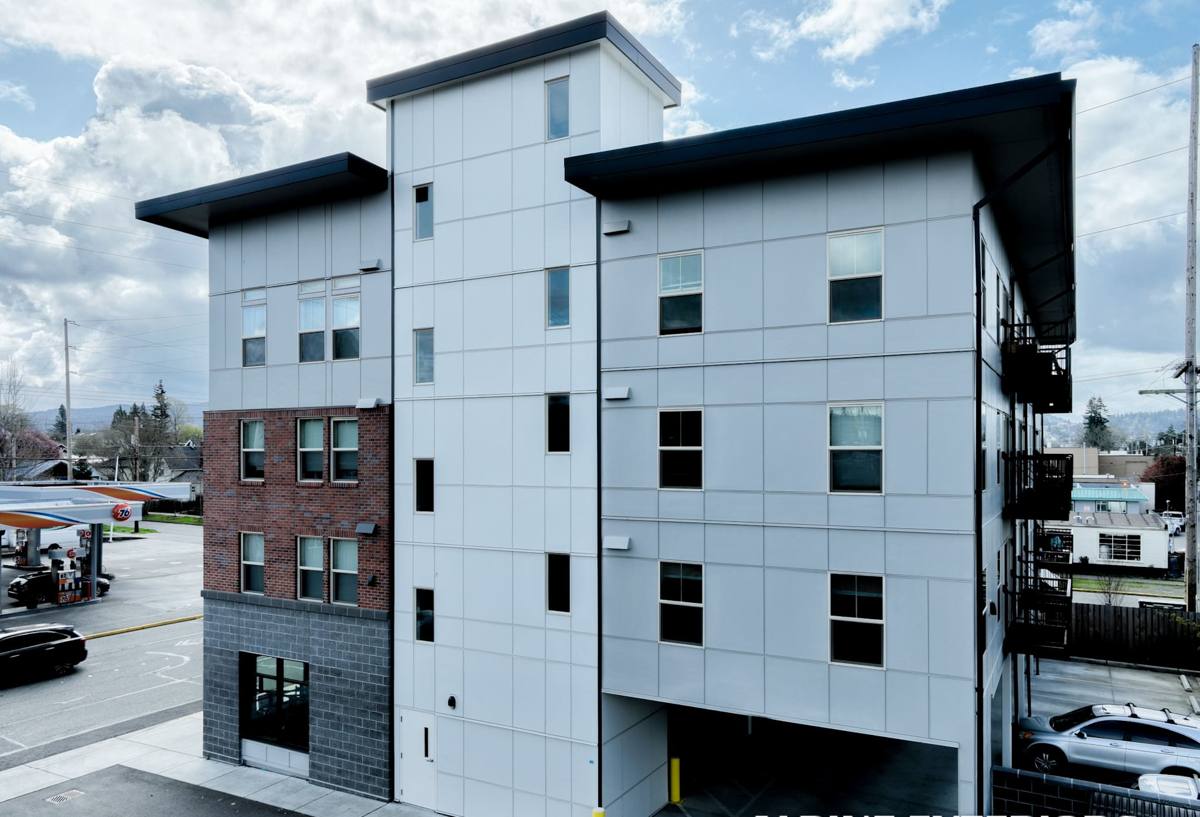
Why We Only Install James Hardie Fiber Cement
We install James Hardie fiber cement siding exclusively. We don't install vinyl, LP SmartSide, Cemplank, Allura, or bare wood siding like primed spruce or cedar. That's not a marketing position — it's a standard we hold because of what we've seen these materials do, or fail to do, in exactly this kind of coastal, wet climate.
Fiber cement is a mix of Portland cement, sand, and cellulose fibers, pressed and cured into a dense, stable board. It doesn't rot, it isn't a food source for insects, and it holds up to sustained moisture exposure far better than wood-based products. James Hardie's ColorPlus finish is baked on at the factory rather than sprayed or brushed on site, which matters in a place like Blaine where UV exposure combined with salt air can break down field-applied paint faster than inland areas ever see.
Hardie also engineers its products by climate zone. The HZ5 formulation used in the Pacific Northwest is built specifically for regions with sustained moisture and freeze-thaw cycles, which is a meaningfully different product than what gets installed in a dry, hot climate. That regional engineering, combined with a manufacturer that's been refining this specific product category for decades, is why we standardized on it rather than splitting our crew's expertise across several siding systems.
What This Means in Practice for a Blaine Home
Non-combustible, dimensionally stable, and finished at the factory rather than in the field. Those three things matter more here than in a lot of markets — the moisture load is higher, the salt exposure is real, and any weak point in the finish or the substrate gets found out faster than it would somewhere dry.
What a Correct Installation Actually Involves
Fiber cement siding is only as good as the installation behind it. A huge share of the siding failures we get called out to inspect aren't material failures at all — they're installation shortcuts that let water get where it shouldn't. In a climate like Blaine's, those shortcuts show up faster than they would in a drier region.
Water Management Comes First
Before a single piece of siding goes up, the wall needs a water-resistive barrier installed correctly, with all seams lapped the right direction and taped or sealed at penetrations. Flashing at windows, doors, and any horizontal trim has to be integrated with that barrier so water is directed out and down, never trapped behind the cladding. This is the step that's invisible once the job is done — and it's the step that determines whether the siding lasts twenty years or develops rot behind the wall in five.
Clearances and Gaps
James Hardie specifies minimum clearances between siding and other surfaces — roof lines, decks, grade, and horizontal trim all need a gap that lets water drain and air circulate. In a climate with as much sustained rainfall as Blaine sees, skipping these clearances is one of the fastest ways to create a spot where water sits against the board and moss or mildew gets a foothold.
Fastening and Joints
Fasteners need to be corrosion-resistant and driven correctly — not overdriven, which crushes the material and creates a water entry point, and not underdriven, which leaves the board loose. Butt joints and panel seams need to be treated correctly, whether that's caulked and painted per specification or, better, backed with flashing so they're not depending on caulk alone to stay watertight for the life of the siding.
None of this is exotic. It's a checklist of details that have to be done right, every time, on every wall — and it's the difference between siding that earns its warranty and siding that becomes a callback.
James Hardie Product Lines We Work With
Hardie makes several distinct product lines, and the right one for a given home depends on the style of the house, the exposure of each wall, and the look the homeowner wants. We walk through these options during the estimate rather than defaulting to one product for every job.
| Product Line | Typical Use | Why It Fits Blaine |
|---|---|---|
| HardiePlank Lap Siding | Traditional horizontal lap look, most common on single-family homes | Widest color and texture range, proven long-term performance in wet coastal climates |
| HardiePanel Vertical Siding | Modern vertical or board-and-batten styling | Clean look for accent walls or full elevations, same HZ5 climate-engineered core |
| HardieShingle | Staggered or straight-edge shingle style | Alternative to cedar shingle look without the moisture and moss vulnerability of real wood |
| HardieTrim | Corner boards, window and door trim, fascia | Matches the siding's durability so trim doesn't become the weak point in the system |
Our Process for a Blaine Siding Project
Every job starts the same way: an on-site assessment, not a phone estimate. We look at the current siding, the condition of the sheathing underneath where accessible, drainage around the foundation, and any spots where past water intrusion has already left a mark. That assessment tells us whether we're dealing with a straightforward re-side or whether there's underlying damage that needs to be addressed before new siding goes up.
- On-site assessment and measurement, including a look at trim, flashing, and any existing moisture damage
- Detailed written estimate covering product line, color, and scope — no vague allowances
- Removal of existing siding and inspection of the sheathing and framing underneath
- Repair of any rot or water damage found during tear-off before new material goes on
- Installation of water-resistive barrier, flashing, and trim per manufacturer specification
- Fiber cement installation with correct fastening, clearances, and joint treatment
- Final walkthrough and cleanup
We don't quote a re-side without seeing the house in person, because a home near the water with decades-old siding often has surprises behind the wall that a photo or a phone call can't reveal. Finding those issues during tear-off, rather than after the new siding is up, is what keeps a project from turning into a warranty problem down the road.
Cost Factors for a Blaine Siding Project
There's no single price that applies to every home, but the factors that move the number around are consistent. Understanding them helps homeowners read an estimate and know what they're actually paying for.
| Factor | Why It Matters |
|---|---|
| Home size and wall complexity | More corners, dormers, and cutouts mean more labor and material waste |
| Product line and texture | Lap, panel, and shingle profiles differ in material and labor cost |
| Condition of existing sheathing | Rot repair found during tear-off adds cost but prevents a bigger problem later |
| Trim and detail work | Corner boards, window trim, and fascia replacement add scope beyond the field siding |
| Access and site conditions | Steep lots, limited access, or height requirements affect labor time |
Living With Fiber Cement Through Moss Season
Fiber cement doesn't rot and isn't a food source for moss the way wood siding is, but that doesn't make a home maintenance-free — it just means the maintenance is simpler and the stakes are lower when it's skipped. In a climate with as long a wet season as Whatcom County sees, a little seasonal attention goes a long way toward protecting the finish and the caulked joints.
- Rinse siding periodically to clear salt residue and organic buildup, especially on walls facing prevailing wind and rain
- Keep gutters clear so overflow isn't running down the face of the siding
- Trim back vegetation and tree cover that keeps a wall shaded and damp longer than the rest of the house
- Inspect caulked joints at trim and penetrations annually and recaulk if you see cracking or separation
- Watch for moss or algae staining at the base of walls near grade, where moisture lingers longest
- Repaint per the ColorPlus warranty schedule if the home is due, rather than waiting until fading is obvious
Why Local Experience in Blaine Matters
A crew that regularly works Blaine and the surrounding coastal parts of Whatcom County has already seen how this specific climate treats siding installations over time — which details of a spec actually matter here, which corners get skipped elsewhere but can't be skipped this close to the water, and what a home near Drayton Harbor or the open coast needs differently than a home a few miles inland in Bellingham proper. That's not something you get from a general contractor who does a handful of siding jobs a year across a wide territory.
It also means we're not learning on your house. We know what correct flashing and clearance details look like in a climate that stays wet for months at a stretch, and we build every installation to that standard rather than a generic one.
Get a Straightforward Estimate
If your Blaine home's siding is showing its age — fading, staining near the base, or soft spots you can feel when you press on it — it's worth having someone look before another wet season adds to the damage. We offer free, no-pressure estimates and will give you an honest read on what your home actually needs. Reach out using the form below to get started.