 Bellingham Roofing
 Siding Built for Columbia's Piece of Bellingham
The Columbia neighborhood sits close enough to the water and the tree canopy that its homes take on a specific kind of weather stress — one that's a little different from siding needs on the drier east side of Whatcom County or up in the foothills. Salt-laden air moves through, driving rain comes in sideways off Bellingham Bay during winter storms, and the shade from mature trees means moss and algae get a long, cool season to take hold. None of that is dramatic on its own. But stacked together, year after year, it's exactly the combination that wears out the wrong siding material faster than most homeowners expect.
This page is about one service, in one part of town: correctly installed James Hardie fiber cement siding for Columbia-area homes. We're not going to cover every siding product on the market or every neighborhood in Bellingham — just what actually matters if you own a house here and you're deciding what goes on the walls next.
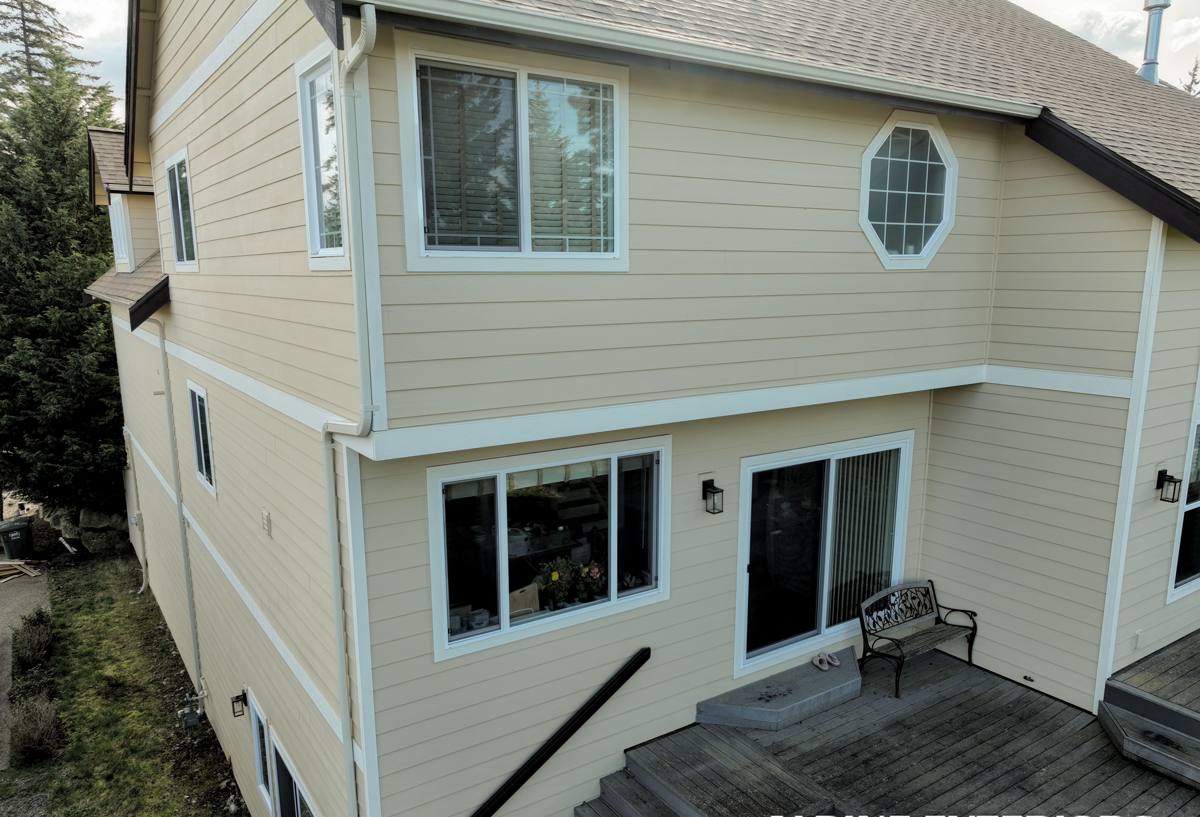
Why Columbia's Climate Is Harder on Siding Than It Looks
Salt air and moisture, working together
Proximity to Bellingham Bay means airborne salt is a real, if low-grade, factor on siding, trim, and fasteners. Salt itself doesn't rot wood or wood-composite siding, but it does two things that matter: it holds moisture against a surface longer than plain rain would, and it accelerates corrosion on any exposed metal fasteners or flashing that aren't properly rated for it. Combine that with our famously wet fall-through-spring stretch, and any siding product with a weak point for water intrusion will find that weak point tested constantly.
Moss season isn't a season — it's most of the year
In shaded, moisture-retentive spots — which describes a lot of lots around Columbia, especially those with tree cover — moss and algae growth on north-facing walls and anywhere siding stays damp longer than it should is close to a year-round condition, not a once-a-summer chore. Porous or textured siding surfaces give moss more to grip onto. Smooth, factory-finished surfaces give it far less.
Driving rain finds the gaps
Wind-driven rain doesn't just run down a wall — it gets pushed sideways into laps, seams, and butt joints. On a well-installed fiber cement system, that's accounted for with proper lap dimensions, flashing, and caulking at penetrations. On a poorly installed system — or a product not really designed for the Pacific Northwest's rain volume — that's where moisture starts working its way behind the cladding.
What Columbia Homes Actually Need From Their Siding
- A material that doesn't feed moss and algae the way porous wood-based products do
- Fastener and flashing details rated for coastal-adjacent, salt-air exposure
- A factory finish that holds color and resists moisture without relying on the homeowner to repaint on a tight schedule
- Lap and joint installation that accounts for wind-driven rain, not just vertical rainfall
- A product that's dimensionally stable through our wet winters and drier summers, so caulk lines and joints don't open up over time
This is the exact list we run through before we recommend anything to a Columbia homeowner, and it's a big part of why we standardized on James Hardie fiber cement rather than offering a menu of siding brands.
Why We Only Install James Hardie
We don't install LP SmartSide, vinyl, Cemplank, Allura, primed spruce, or cedar. That's not a marketing angle — it's a decision based on what holds up in exactly the conditions Columbia deals with.
Fiber cement vs. the alternatives, honestly
| Material | How it handles our climate | Where it falls short here |
|---|---|---|
| James Hardie fiber cement | Non-combustible, dimensionally stable, factory-sealed finish resists moisture and moss buildup | Higher upfront cost than vinyl; requires correct installation to perform as designed |
| Vinyl siding | Low cost, low maintenance in dry climates | Can warp or buckle with temperature swings; seams and laps are more vulnerable to wind-driven rain; fades over time |
| LP SmartSide (wood-strand composite) | Workable, budget-friendly | Wood-based core is more moisture-sensitive; edge sealing and maintenance matter a lot in a wet climate like ours |
| Cedar / primed spruce | Traditional look, renewable material | Needs regular refinishing, is moss-prone in shaded spots, and is combustible |
| Cemplank / Allura (other fiber cements) | Similar base material to Hardie | Different engineering, finish systems, and warranty structure — we standardized on one system we know inside and out |
Every one of those products has a legitimate use case somewhere. Our position is narrower: for the specific combination of salt air, driving rain, and long moss seasons that Columbia and the rest of Bellingham deal with, James Hardie's engineered fiber cement and ColorPlus factory finish give homeowners the fewest long-term headaches. We'd rather install one system well than offer six and cut corners on all of them.
The Right Hardie Product Line for This Area
James Hardie makes climate-specific product lines, and for the Pacific Northwest that means HZ5 formulations engineered for freeze-thaw cycling and sustained moisture exposure. For Columbia specifically, we also pay close attention to:
- Panel and lap profile choice — matching reveal and lap dimensions to shed water effectively on walls that see more shade and slower drying
- ColorPlus finish — a factory-applied, baked-on finish that resists fading and moisture intrusion far better than field-applied paint, and holds up better against surface moss than a porous painted surface
- Trim and fastener specification — using fasteners and flashing rated for the salt-air exposure this part of the county sees, not generic hardware
What a Correct Installation Actually Involves
Fiber cement siding is only as good as its installation. Hardie's own warranty terms hinge on installation matching their published specifications — this is one of the most common places installations go wrong, and it's invisible until moisture problems show up years later.
Before the siding goes up
- Inspect and repair the water-resistive barrier (house wrap) and address any existing moisture or rot damage — never side over a problem
- Install proper flashing at windows, doors, and every penetration
- Confirm rainscreen or drainage gap detailing where called for, so moisture that does get behind the cladding can drain and dry
During installation
- Correct nailing pattern and fastener depth — overdriven nails are a leading cause of premature siding failure
- Proper lap dimensions and butt joint treatment, sealed and flashed per manufacturer spec
- Minimum clearances from grade, roofing, and decks maintained so siding isn't sitting in standing moisture
Finishing details
- Caulking only at manufacturer-specified joints, with the right sealant — over-caulking can trap moisture instead of shedding it
- Touch-up paint matched to ColorPlus finish at any field-cut edges
Skipping any one of these steps doesn't usually cause an immediate, visible problem. It shows up two, five, or ten years later as trapped moisture, staining, or accelerated moss growth — exactly the failure modes Columbia's climate is primed to expose.
Why Hiring a Crew That Already Works This Area Matters
General siding experience isn't the same as local experience. A crew that regularly works Columbia and the surrounding Bellingham neighborhoods already knows which walls face the worst wind-driven rain, which lots hold shade and moisture the longest, and how the salt-air factor changes fastener and flashing choices. That's knowledge you don't get from a spec sheet — it comes from having done the work here, seen how older installations held up or failed, and adjusted accordingly.
It also matters for something less visible: warranty performance. James Hardie's transferable warranty is only as strong as the installation behind it. A contractor who understands the local failure points is a contractor whose installations are less likely to need a warranty claim in the first place.
What the Process Looks Like
- On-site assessment — we look at your home's exposure, existing siding condition, moisture barrier, and any trouble spots specific to your lot
- Product and color selection — choosing the right Hardie panel or lap profile and ColorPlus color for your home and its exposure
- Prep work — repairing or replacing damaged sheathing, correcting flashing issues, confirming the water-resistive barrier is sound
- Installation — to manufacturer spec, with attention to the fastener, flashing, and drainage details this climate demands
- Final walkthrough — checking caulking, trim, and finish work before we call the job done
Cost Factors Worth Understanding
| Factor | Why it affects your project |
|---|---|
| Home size and wall complexity | More corners, dormers, and trim details mean more labor and material cutting |
| Existing siding removal and repair | Hidden moisture or sheathing damage found during tear-off adds scope |
| Panel vs. lap siding choice | Different profiles have different material and labor costs |
| Trim and accessory scope | Corner boards, window trim, and fascia work add to the total |
| Access and site conditions | Tree cover, slope, and tight lot access can affect labor time |
We don't quote a number until we've actually looked at your home — broad online estimates rarely hold up once someone's on-site.
Get a Straight Answer for Your Home
If you're weighing a siding replacement for a home in the Columbia area, we're glad to come take a look, tell you honestly what condition your current siding is in, and walk through what a correct James Hardie installation would involve for your specific house. There's no pressure and no obligation — just use the form below to request a free estimate.