 Bellingham Roofing
 Why Cordata Homes Wear Out Windows Differently
Cordata sits far enough inland from Bellingham Bay that people sometimes assume salt air isn't a factor here — it is, just in a slower, quieter way than it is right on the water. Combine that with Whatcom County's long stretch of driving rain from fall through spring, plus the shaded, tree-heavy lots common in this neighborhood that keep moss and mildew active most of the year, and you get windows that age faster than the calendar suggests. Wood sashes swell and stick. Aluminum frames pit and streak. Seals on older dual-pane units fail early, and once that seal is gone, fog between the panes is permanent — no amount of cleaning fixes it.
None of this means Cordata is a hard place to keep windows looking good. It means the install has to account for moisture from day one, not just the glass itself but the flashing, the sill, and the gap between the window and the framing where water actually gets in.
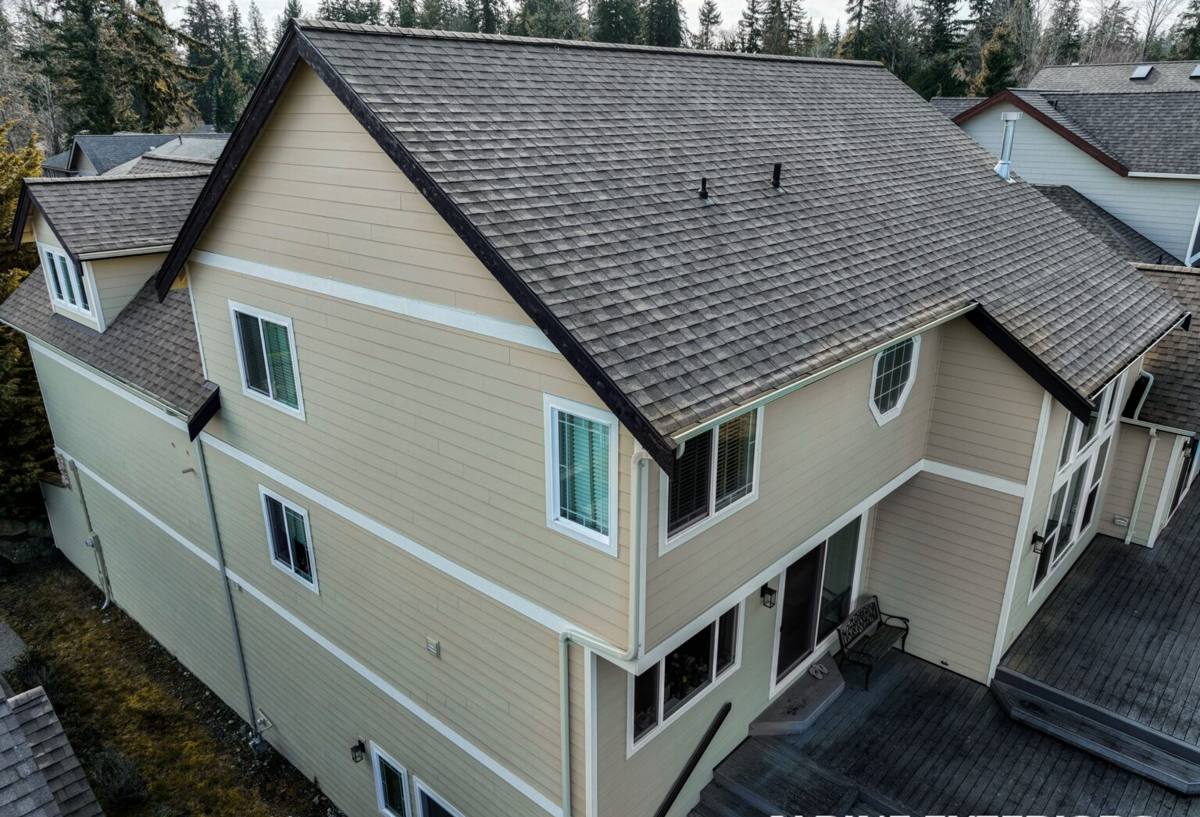
Signs Your Windows Are Actually Due for Replacement
Not every drafty window needs full replacement — sometimes it's a bad seal or worn weatherstripping. But in this climate, a few signs reliably mean it's time:
- Visible fogging or a haze between panes that won't clean off (failed seal)
- Soft or discolored wood at the sill or lower corners of the frame
- Windows that won't stay open, won't latch, or have become hard to operate
- A cold draft you can feel with your hand along the frame edge, even with the window closed
- Visible gaps, cracked caulking, or paint that's bubbling at the exterior trim
- Noticeably higher heating bills compared to similar-sized rooms in the house
If you're seeing soft wood or staining on interior drywall below a window, that's worth addressing sooner rather than later — it usually means water has already been getting past the frame for a while.
What a Correct Window Replacement Actually Involves
It's Not Just Swapping the Glass
A window replacement that holds up in this climate is really a small waterproofing project with a window in the middle of it. The frame gets removed down to the rough opening, the sill and jambs get inspected for rot or soft spots, and any damaged framing gets repaired before a new window ever goes in. Skipping that step is the single most common reason a "new" window leaks within a year or two — the window itself was fine, but it was installed over a compromised opening.
Flashing and Moisture Barrier
Proper flashing directs water that gets behind the siding down and away from the window opening instead of letting it pool at the sill. In a region with as much wind-driven rain as Whatcom County sees, this matters more than the window brand. We integrate flashing tape and a sloped sill pan with the house's existing weather-resistive barrier, so water has a clear path out even in a hard, sideways rain.
Sealing and Insulation
The gap between the new window frame and the rough opening gets filled with low-expansion foam or backer rod and sealant — not just caulked over on the outside. Caulk alone hides a gap; it doesn't insulate it, and it's usually the first thing to crack and let water back in.
Choosing the Right Window for a Cordata Home
| Frame Material | How It Handles This Climate | Maintenance |
|---|---|---|
| Vinyl | Doesn't rot, resists moisture well, handles salt-tinged air without corroding | Low — occasional cleaning |
| Fiberglass | Very stable in wet and temperature-swinging conditions, strong seal life | Low |
| Aluminum | Prone to condensation and pitting over time in coastal-influenced air | Moderate to high |
| Wood (clad exterior) | Warm interior look, but exposed wood is vulnerable if the exterior clad or paint fails | High if unclad; moderate if properly clad |
We install what fits the home and the homeowner's priorities, but for most Cordata houses we steer people toward vinyl or fiberglass for anything facing weather or getting minimal sun exposure. It's less about brand loyalty and more about not fighting the maintenance cycle every couple of years — an exposed wood sill in a shaded, damp spot is a long-term commitment, and we'd rather be upfront about that than sell a product that looks great on day one and becomes a maintenance chore by year three.
Glass and Performance Options
Double-pane, low-E glass is the practical standard for this area — it cuts heat loss in winter and reduces glare and UV fading in summer without the added cost of triple-pane, which rarely pays for itself in Bellingham's mild-winter climate. Argon gas fill between panes adds a modest efficiency bump for a small cost difference. Where it matters more is orientation: west- and south-facing windows benefit most from a stronger low-E coating to cut solar heat gain, while north-facing windows in shaded parts of a lot benefit more from a tight seal than from glass coating.
Our Process, Start to Finish
1. On-Site Assessment
We look at each window individually, not just as a set — frame condition, sill health, and how exposed each opening is to prevailing weather. Two windows on the same house can be in very different shape depending on which direction they face.
2. Measurement and Ordering
Exact measurements matter more than people expect. A window that's slightly undersized for its opening means more shimming and more sealant relied on to close the gap — more places for water to eventually find a way through.
3. Removal and Opening Repair
Old windows come out carefully to avoid damaging siding or trim that's staying. Any soft framing, damaged sill, or compromised barrier gets repaired before the new unit goes in — this is the step that gets skipped by crews trying to move fast, and it's the one that determines whether the job lasts.
4. Installation, Flashing, and Sealing
New window set, leveled and shimmed, flashed and integrated with the wall's moisture barrier, then insulated and sealed at the interior and exterior.
5. Trim, Cleanup, and Walkthrough
Interior and exterior trim finished to match the home, job site cleaned up, and a walkthrough so you know how the new windows operate and what (if any) maintenance they need.
What Drives the Cost
| Factor | Why It Matters |
|---|---|
| Frame material | Vinyl and fiberglass generally cost less over time than wood or aluminum once maintenance is factored in |
| Opening condition | Rot or framing repair adds labor and materials beyond the window itself |
| Window size and style | Larger units, custom shapes, and operable styles (casement vs. slider) vary in price |
| Number of windows | Doing a full house at once is usually more cost-efficient per window than one-off replacements |
| Access and story height | Second-story or hard-to-access windows take more time and equipment |
We're not going to quote a number here that doesn't mean anything without seeing the house — but broadly, full-frame replacement runs more than an insert (pocket) replacement because it addresses the frame and flashing, not just the sash. For a home with any sign of moisture damage, we generally recommend full-frame even though it costs more, because it's the only way to actually fix the underlying problem instead of covering it up.
Why a Crew That Already Works Cordata Matters
Window replacement done right depends on understanding how a specific house sits in its specific conditions — which walls take the worst of the driving rain, where moss and shade keep siding damp longer, how a home's age and construction era typically holds up. A crew that works this neighborhood regularly has already seen how Cordata-era construction details tend to age, what kind of flashing failures show up most, and which fixes actually last through a Whatcom County winter versus which ones look fine until the first real storm season tests them. That's not something you get from a crew driving in from outside the area for a one-off job.
Simple Maintenance to Extend the Life of New Windows
- Clean tracks and weep holes each fall before the rainy season picks up, so water has a clear path to drain
- Inspect exterior caulking annually and touch up any cracked or peeling sections before winter
- Keep gutters clear so overflow doesn't run down onto window heads and sills
- Trim back vegetation that keeps a window shaded and damp longer than the rest of the house
- Operate each window a few times through the year, even ones you rarely open, to keep seals and hardware working
If you're noticing drafts, fogged glass, or soft spots around your windows, it's worth getting a straightforward, no-pressure look before another wet season adds to the damage. We offer free estimates for Cordata homeowners — use the form below to get one scheduled.