 Bellingham Roofing
 Why Edgemoor Decks Wear Out Faster Than You'd Expect
Edgemoor sits close to the water, tucked under mature tree canopy, which makes it one of the more beautiful settings in Bellingham to own a home — and one of the tougher spots for an outdoor deck to survive. Three things work against wood and hardware here at the same time: salt-laden air off the bay, driving rain that comes in sideways during fall and winter storms, and a moss season that stretches longer than most homeowners realize.
None of these factors is dramatic on its own. Together, over years, they're why we see Edgemoor decks fail 5-10 years before a similar deck would in a drier, more inland part of Whatcom County. If your deck is soft underfoot, visibly stained green or black in shaded areas, or has hardware that's rusted and stained the boards around it, that's not cosmetic — it's the climate doing exactly what it does here.
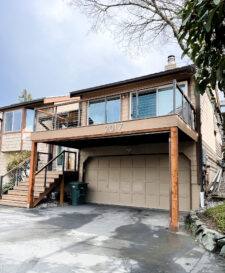
How the Local Climate Actually Damages a Deck
Salt Air and Fasteners
Homes closer to Bellingham Bay get a steady, low-level dose of salt in the air. It doesn't take a direct ocean-front lot to matter — moist salt air travels and settles on any exposed metal. Standard coated deck screws and joist hardware corrode faster under this exposure, and once a fastener starts rusting, it weakens exactly where you need strength most: where the decking meets the frame.
Driving Rain and Moisture Intrusion
Bellingham's rain rarely falls straight down. Wind-driven rain gets pushed under decking boards, into ledger connections, and into any gap where flashing was skipped or done poorly. Over time this hidden moisture rots the framing from the inside while the surface boards can still look okay — which is why so many "surprise" deck failures aren't actually surprises, just water finding the one weak point in the original build.
Moss Season
Between the tree cover common in Edgemoor and our long wet season, moss and algae get a real foothold on horizontal wood surfaces. Beyond looking bad, moss holds moisture against the board surface almost permanently, which accelerates rot and turns the deck surface slick and genuinely dangerous underfoot, especially on stairs.
Repair or Replace? Signs to Look For
- Boards that feel spongy, springy, or soft when you walk on them
- Visible gaps opening up between boards, or boards cupping and warping
- Rust streaks running down from screw heads or metal connectors
- Persistent moss or black staining that comes back within weeks of cleaning
- A ledger board attachment to the house that looks like it was never properly flashed
- Railings or stair stringers that feel loose or move when pushed
- A deck more than 15-20 years old that has never had the substructure inspected
A deck with one or two of these issues in isolated spots might be repairable. A deck with several of these signs, or with rot found at the ledger or main support posts, is usually more honestly addressed with a full replacement — patch repairs on a structurally compromised deck tend to just delay the same problem at higher long-term cost.
What a Correct Deck Replacement Actually Involves
A deck replacement done right isn't just swapping old boards for new ones. The parts you don't see are what determine whether the new deck lasts 10 years or 30.
Ledger Board and Flashing
Where the deck attaches to the house is the single most important connection on the whole structure, and it's the place local rain does the most damage when it's built wrong. Proper flashing — installed so water sheds away from the house, not into it — is non-negotiable, especially in a rainfall pattern like ours.
Framing and Fasteners
We frame to current code spacing for joists and beams, sized to the actual span and expected load, not just matched to whatever was there before. Given the salt air in Edgemoor, we specify corrosion-resistant fasteners and structural hardware rated for coastal exposure rather than standard-grade coated screws that will rust prematurely here.
Decking Material Selection
The decking surface is where homeowners have real choices, and the right one depends on budget, maintenance appetite, and how much shade and moisture the deck actually gets.
Comparing Decking Materials for This Climate
| Material | Moisture & Moss Behavior | Maintenance | Typical Lifespan |
|---|---|---|---|
| Pressure-treated wood | Absorbs moisture, needs sealing to resist moss and rot in shaded areas | Annual cleaning and re-sealing | 10-15 years locally |
| Cedar | Naturally rot-resistant but still needs upkeep in constant damp/shade | Periodic cleaning and finish maintenance | 15-20 years with upkeep |
| Capped composite | Shrugs off moisture and resists moss far better than wood | Occasional washing, no sealing or staining | 25-30 years, manufacturer-warrantied |
| PVC decking | Fully synthetic, essentially immune to rot and moisture absorption | Lowest maintenance of the group | 25+ years, manufacturer-warrantied |
We install real wood when a homeowner wants that look and understands the upkeep, and we install capped composite or PVC when the priority is minimizing maintenance in a shaded, damp lot. What we steer clients away from is uncapped, budget composite decking — the older generation of composite that lacks a protective outer shell tends to absorb moisture at the core and can mold or degrade faster than either solid wood or a properly capped product, which defeats the point of choosing composite in the first place.
Our Deck Replacement Process
- On-site assessment — we inspect the existing deck, ledger connection, and any visible framing to understand what's actually failing and why.
- Honest scope and estimate — a clear breakdown of what full replacement involves, with material options and pricing explained rather than a single number handed over.
- Permit and code check — we confirm what Whatcom County and City of Bellingham requirements apply to your project, including guardrail height, stair geometry, and footing depth.
- Demolition — full removal of the old decking, framing, and any compromised structural elements, with the ledger and house connection inspected once it's exposed.
- Rebuild — new footings or posts as needed, correctly flashed ledger, code-spaced framing, and corrosion-resistant fasteners throughout.
- Decking and railing installation — surface material and railing system installed to your selection, finished square and properly fastened.
- Final walkthrough — we review the finished deck with you before calling the job done.
Permits and Code in Whatcom County
Most deck replacement projects in Bellingham and unincorporated Whatcom County require a permit, particularly when framing, footings, or ledger attachment are being redone rather than just resurfaced. Requirements cover things like guardrail height for elevated decks, stair rise and run, and footing depth appropriate to our soil and frost conditions. Skipping this step doesn't just risk a stop-work order — it can also complicate things at resale if a buyer's inspector flags unpermitted structural work. We handle the permit process as part of the job rather than leaving it for the homeowner to sort out.
Why a Crew That Already Works Edgemoor Matters
Edgemoor's mix of waterfront exposure, mature trees, and sloped or wooded lots means access, drainage, and site conditions vary a lot from one property to the next, even within the same neighborhood. A crew that has already built and repaired decks in this specific area knows to check ledger flashing quality on homes of a certain age, knows which fastener grade actually holds up against the salt air here, and knows how much extra moss and drainage planning a shaded lot needs compared to a sunnier one across town. That local pattern recognition shows up as fewer surprises mid-project and a deck that's built for the conditions it will actually face, not a generic spec sheet.
Getting the Most Life Out of Your New Deck
- Sweep leaves and debris off the surface regularly, especially in fall when tree cover is heaviest
- Rinse or lightly scrub visible moss or algae before it has a chance to establish
- Keep gutters and downspouts near the deck clear so runoff isn't dumping directly onto it
- Reseal wood decking on the manufacturer's recommended schedule, not just when it looks dry
- Check railings and stair connections once a year for looseness or rust staining
- Have the ledger and under-deck framing glanced at every few years, even if the surface looks fine
If you're weighing a repair against a full replacement, or you just want an honest look at what your current deck's ledger and framing look like underneath, we're happy to come take a look. Estimates are free and there's no pressure — just a straightforward assessment of what your Edgemoor home actually needs.