 Bellingham Roofing
 Fairhaven's Climate Doesn't Go Easy on Siding
Fairhaven sits close to Bellingham Bay, and that waterfront position shapes what siding has to survive here. Salt-laden air moves off the water and settles on exterior surfaces year-round, accelerating corrosion on fasteners, trim, and any material that isn't built to handle it. Add in driving rain that comes sideways during Whatcom County's winter storms, and you've got a climate that tests siding from every angle — not just top-down like a drier region would.
Then there's moss. Bellingham's long wet season, combined with the mature tree canopy that gives many Fairhaven properties their shade, keeps north-facing and tree-shaded siding damp for extended stretches. Moss and algae don't just look bad — they hold moisture against the surface, and that sustained dampness is exactly what breaks down siding that isn't dimensionally stable or properly finished.
None of this is unique to one house on one block. It's the baseline condition every home in this neighborhood is up against, which is why the siding choice and the installation quality matter more here than they would in a milder, drier part of the state.
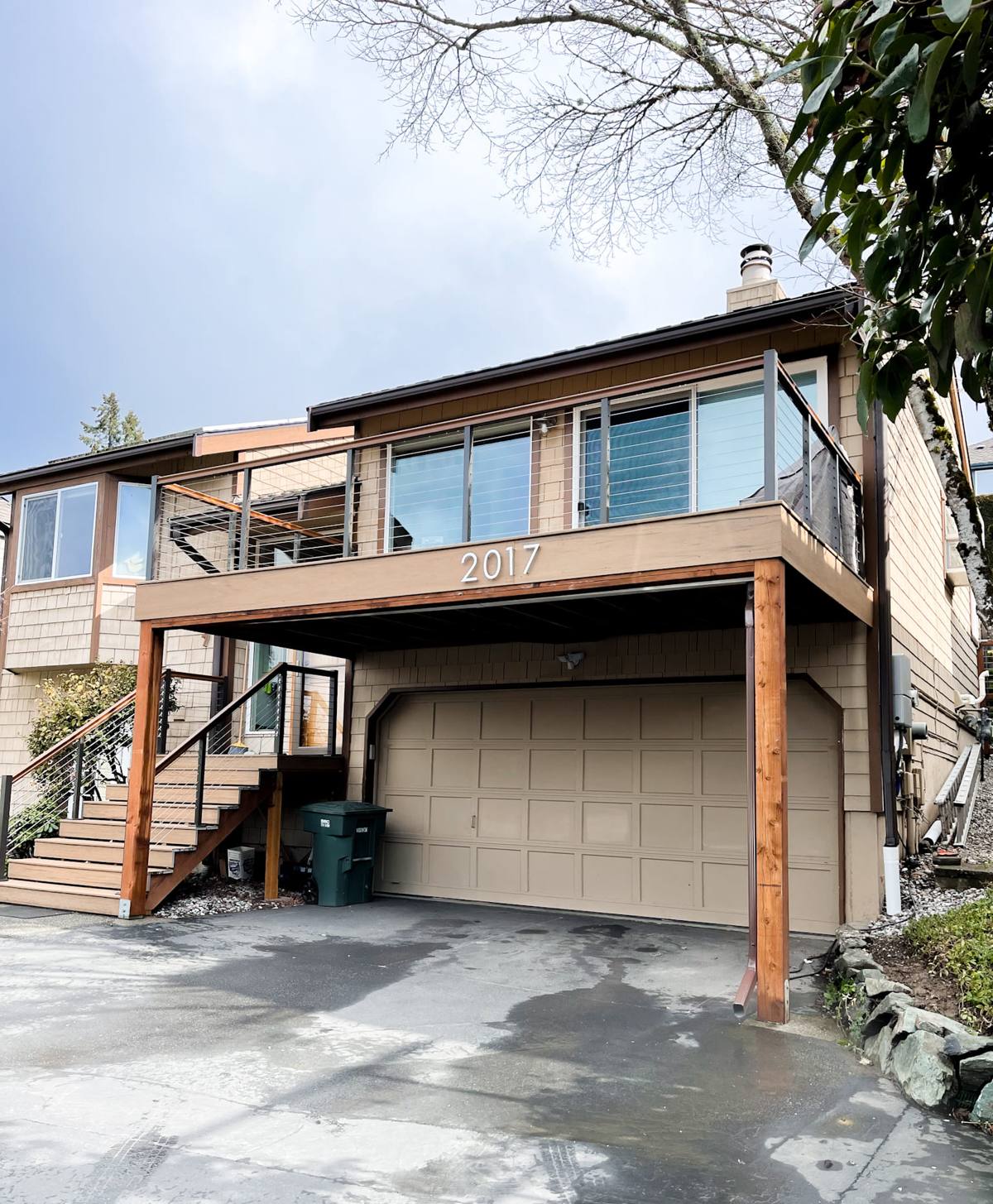
What That Climate Demands From Your Siding
Moisture Resistance That Doesn't Depend on Perfect Caulking
Every siding material relies on some sealant and flashing to manage water. But in a climate that delivers driving rain and near-constant humidity, you want a base material that isn't ruined the moment a bead of caulk fails or a seam opens up. Materials that swell, delaminate, or rot when they absorb moisture put the entire wall assembly at risk over time.
Resistance to Salt-Driven Corrosion and Fastener Failure
Salt air accelerates corrosion on exposed metal — nail heads, trim fasteners, flashing. Siding systems that rely on softer or less corrosion-resistant components tend to show that wear first at the fastener points, which is often where water intrusion starts.
A Finish That Holds Up to Repeated Wet-Dry Cycles
Bellingham doesn't get one rainy season and then a long dry stretch — it's cycles of wet and dry, over and over, most of the year. A finish that's only field-applied (painted on-site) tends to show that cycling faster: chalking, fading, and eventually peeling at seams and edges. A factory-cured finish holds color and adhesion through far more of those cycles before it needs attention.
Why We Only Install James Hardie Fiber Cement
We install one siding system: James Hardie fiber cement. That's not a marketing preference — it's a standard we hold because of what we've seen hold up, and what doesn't, in this exact climate. Fiber cement is non-combustible, dimensionally stable when it gets wet, and doesn't rot the way wood-based products can. James Hardie also engineers its HZ product lines by climate zone, which means the boards specified for the Pacific Northwest are formulated for repeated moisture exposure rather than a generic, one-size-fits-all climate assumption.
The factory-applied ColorPlus finish is a big part of why we standardized on this product. Because the finish is baked on at the factory under controlled conditions, it resists fading and holds adhesion far better than a coat of paint applied on-site after installation — which matters directly in a place where the finish is cycling wet and dry most weeks of the year. James Hardie also backs its product with a strong, transferable limited warranty, which gives homeowners real recourse if something in the material itself doesn't perform as engineered.
We don't install vinyl, LP SmartSide, Cemplank, Allura, primed spruce, or cedar. Each of those products has legitimate uses and real advantages elsewhere — cedar has a look some homeowners love, vinyl is inexpensive, engineered wood products have their place. But every one of them comes with a trade-off we're not willing to install and then walk away from: vinyl can warp and doesn't hold up structurally the way fiber cement does; engineered wood products are more sensitive to installation quality and ongoing moisture exposure; cedar and primed wood require an ongoing maintenance commitment most homeowners underestimate. In a climate like Fairhaven's, those trade-offs show up sooner rather than later. We'd rather install one product correctly than several products with an asterisk.
What a Correct Siding Replacement Job Actually Involves
Siding replacement is a wall-system job, not just a surface swap. Skipping any of the steps below is how a house ends up with hidden rot behind brand-new siding.
Tear-Off and Sheathing Inspection
Once the old siding comes off, that's the one chance to actually see the sheathing underneath. In a wet climate, this step matters more than almost anything else on the job — soft, delaminated, or water-stained sheathing needs to be identified and addressed before anything new goes back up. Covering damaged sheathing with new siding just hides the problem for a few more years.
Weather-Resistive Barrier and Flashing
A correctly installed weather-resistive barrier (house wrap) goes on before the siding, lapped properly so water sheds outward and down, never inward. Flashing at windows, doors, and any wall penetration has to be integrated with that barrier — this is where most water intrusion problems actually originate, and it's invisible once the siding is up, which is exactly why it needs to be done right the first time.
Fastening to Manufacturer Spec
James Hardie siding has specific fastening requirements — nail type, spacing, and depth — that are engineered for the product's performance and warranty coverage. Fastening it like a different material, or cutting corners on spacing, undermines both the wind and moisture performance and can void warranty coverage.
Trim, Caulking, and Finish Details
The visible finish work — trim, corner details, caulking at joints — is what most homeowners notice first, but it's also functional. Done correctly, it sheds water away from seams. Done poorly, it creates the small gaps where driving rain and salt air find their way in.
Our Process, Start to Finish
Inspection and Estimate
We start by walking the exterior with you, looking at the current siding's condition, checking for soft spots or signs of moisture behind the surface, and talking through what you're seeing and what concerns you. From there we put together a written estimate that reflects the actual scope — not a guess.
Preparation
Before tear-off begins, we protect landscaping, walkways, and anything else near the work area. We plan the job around weather where we can, since a wet climate like this one means timing matters for keeping sheathing dry during the exposed window between tear-off and closing the wall back up.
Installation
Tear-off, sheathing inspection and repair as needed, weather-resistive barrier, flashing, and then the James Hardie siding installed to manufacturer spec — fastening, spacing, and finish details included. We don't skip steps to move faster.
Final Walkthrough and Cleanup
We walk the finished job with you, point out the details, and make sure everything matches what was scoped. Site cleanup is part of the job, not an afterthought.
Signs Your Fairhaven Home May Be Due for Siding Replacement
Some of these show up gradually, which is part of why they get missed until the damage is more advanced. Worth checking for:
- Persistent moss or algae staining that comes back shortly after cleaning, especially on shaded or north-facing walls
- Soft or spongy spots when you press on the siding, particularly near the ground, under windows, or at corners
- Paint that's peeling, bubbling, or chalking heavily even after a recent paint job
- Visible warping, cupping, or gaps between siding boards
- Rust streaking near fasteners or trim
- A noticeable draft or higher heating bills that suggest the wall assembly isn't sealing the way it used to
- Musty smells near exterior walls, which can point to trapped moisture behind the siding
Any one of these on its own might be minor. Several together, especially on a home that's original to its build or has had patchwork repairs over the years, is usually a sign it's worth having someone look at the whole wall system rather than just the visible surface.
What Affects the Cost of Siding Replacement in Fairhaven
Every home is different, so we don't quote off square footage alone. These are the factors that actually move the number:
| Factor | Why It Matters Here |
|---|---|
| Extent of hidden sheathing damage | Wet climates increase the odds of finding rot once old siding comes off, which adds repair scope |
| Home size and wall complexity | More corners, dormers, and trim details mean more labor and material cutting |
| Access and site conditions | Waterfront-adjacent lots, slopes, mature landscaping, or tight setbacks can affect staging and scaffolding needs |
| Current siding material being removed | Tear-off complexity varies by what's coming off, and disposal requirements differ by material |
| Siding profile and color selection | James Hardie offers multiple plank profiles and ColorPlus colors; some involve more cutting and detail work than others |
| Trim and detail work | Corner boards, window trim, and fascia detailing add labor beyond the flat wall area |
We walk through these factors with you during the estimate so the number you get reflects your actual house, not a generic average.
Why Local Fairhaven Experience Matters
A crew that regularly works in Fairhaven knows what to expect before the tear-off even starts. That means anticipating moisture-related sheathing issues on homes exposed to the bay, understanding how shade and tree cover affect where moss and algae concentrate, and knowing how salt air factors into fastener and flashing choices. It also means familiarity with City of Bellingham permitting requirements and, where relevant, any neighborhood-specific considerations that come up on a given property.
None of that replaces a proper inspection of your specific home — every property is different, and we don't assume otherwise. But local, repeated experience in this exact neighborhood means fewer surprises mid-project and a crew that's already calibrated to the conditions your siding actually has to perform in, not a generic installation done the same way it would be in a drier inland climate.
If your Fairhaven home's siding is showing wear, or you're just not sure whether what you're seeing is cosmetic or structural, we're happy to take a look. Reach out for a free, no-pressure estimate using the form below.