 Bellingham Roofing
 Happy Valley Roofs Face a Specific Combination of Problems
Happy Valley sits close enough to Bellingham Bay to pick up salt-laden air, low enough in elevation to catch heavy runoff during Pacific storms, and shaded enough by mature tree canopy on many lots to stay damp longer than roofs out in the open. Any one of those factors will shorten a roof's life. Together, they're the reason we see certain failure patterns over and over in this neighborhood: moss establishing itself in shaded valleys and north-facing slopes, corrosion on fasteners and flashing that wouldn't show up the same way further inland, and water finding its way past worn-out underlayment during the driving, wind-blown rain that Whatcom County gets several times most winters.
A new roof installation here isn't just about swapping old material for new. It's about building a roof system that's specifically detailed for shade, moisture, and salt exposure, so you're not fighting the same problems again in ten years instead of twenty-five or thirty.
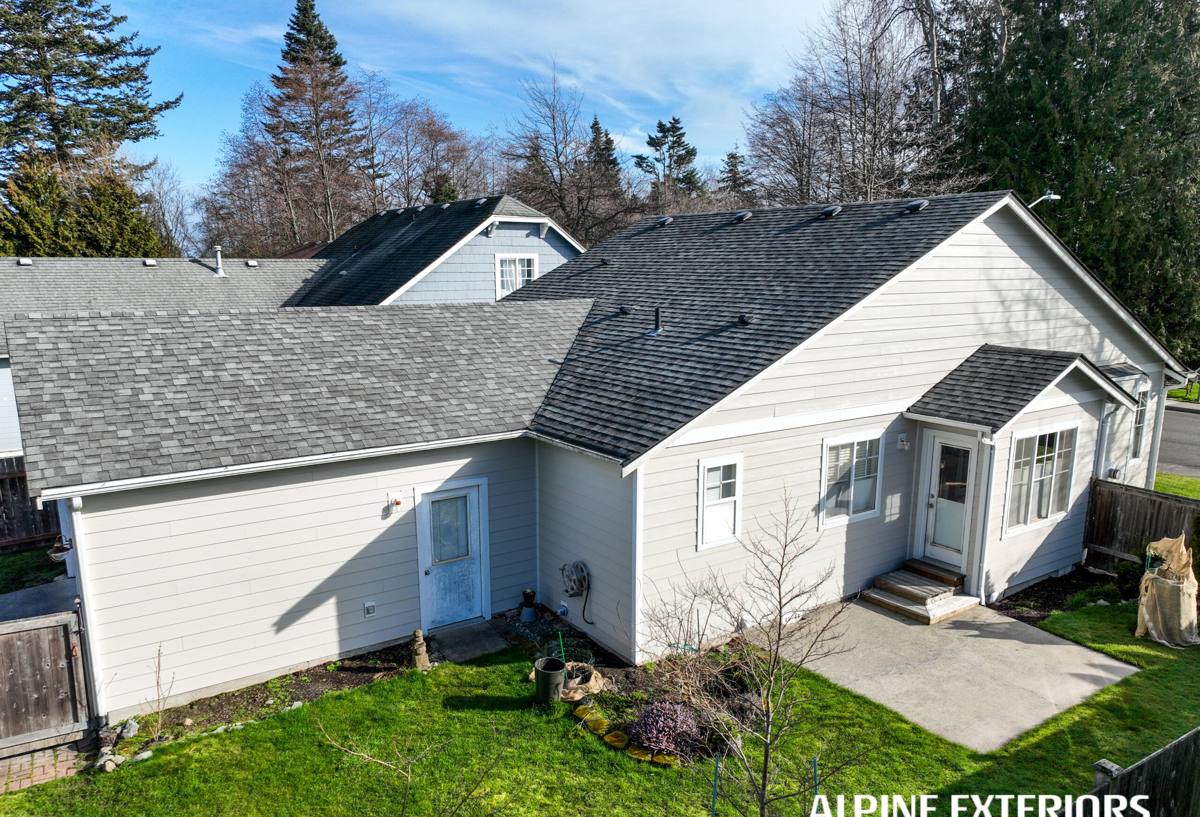
Tree Cover and Moss: The Slow Damage You Don't See Coming
Many Happy Valley properties have significant tree coverage, which is part of what makes the neighborhood pleasant to live in — and part of what makes roofs work harder. Shaded roof sections dry out slowly after rain, sometimes staying damp for days at a time during our wetter months. That moisture is exactly what moss, lichen, and algae need to take hold.
Moss isn't just cosmetic. As it grows, it lifts shingle edges, holds water against the roofing material longer, and works its root-like structures into seams and granule surfaces. Over a few seasons, that shortens the life of an otherwise sound roof. On an older roof, heavy moss can also add real weight, especially after a rain event.
What we do differently on a new install
- Recommend algae-resistant shingle products with copper or zinc granule treatment on shaded slopes, where it makes sense for the home
- Detail valleys and low-slope transitions so water sheds instead of pooling under debris and needles
- Advise on gutter and downspout sizing so shaded, tree-heavy roofs actually drain instead of backing up
- Talk through a realistic moss-prevention and light cleaning schedule so the new roof stays ahead of regrowth instead of catching up to it
Salt Air and Metal Components
Being close to Bellingham Bay means the air here carries more salt than a roof further inland would ever see. Salt exposure accelerates corrosion on anything metal — nails, flashing, vent stacks, and drip edge. A roof built with standard-grade fasteners or bargain flashing can start showing rust streaks and pinhole corrosion years before it should.
On new installations, we spec corrosion-resistant fasteners and flashing metals appropriate for coastal exposure rather than defaulting to whatever's cheapest. It costs a little more up front. It's the difference between flashing that's still sound at year twenty and flashing that's already staining the siding by year eight.
Driving Rain, Wind, and Where Roofs Actually Leak
Most roof leaks don't happen through the field of the shingles — they happen at the details: valleys, roof-to-wall transitions, chimney flashing, skylights, and eaves. Wind-driven rain off the Sound can push water sideways and uphill under poorly lapped material, which is a different stress than a simple straight-down rainstorm.
A correctly installed new roof accounts for this with:
- Ice-and-water shield membrane at eaves, valleys, and around penetrations — not just where code minimums require it
- Properly lapped underlayment installed shingle-fashion, so water always moves downhill over the next course
- Step flashing at every wall intersection, not just caulk or sealant standing in for proper flashing
- Drip edge at eaves and rakes to keep water off the fascia and out of the roof edge
None of this is exotic. It's standard good practice — but it's exactly the kind of detail that gets skipped when a crew is moving fast or unfamiliar with how hard this region's storms can push water into a roof assembly.
What a Correct New Roof Installation Actually Involves
A full new roof isn't just laying new shingles over what's there. Here's what a proper job includes, start to finish:
- Full tear-off of existing roofing material down to the deck, so we can actually see what's underneath instead of guessing
- Deck inspection and repair — replacing any rotted, soft, or delaminated sheathing before anything new goes down
- Ventilation check — confirming intake and exhaust airflow is balanced, since poor ventilation traps moisture and shortens roof life from the inside out
- Underlayment and ice-and-water membrane installed to current code and to our own higher standard for this climate
- Flashing at every valley, wall, chimney, and penetration — new, not reused
- Material installation per manufacturer specification, including proper nailing pattern and exposure
- Cleanup and magnetic sweep for nails and debris across the property, not just the immediate work area
- Final walkthrough so you understand what was done and what to expect going forward
Choosing Roofing Material for a Shaded, Coastal Lot
There's no single "best" roofing material for every home — the right choice depends on your roof's slope, sun exposure, budget, and how long you plan to stay in the home. Here's how the common options stack up for Happy Valley conditions specifically:
| Material | Moss/algae resistance | Salt-air durability | Typical lifespan | Best fit |
|---|---|---|---|---|
| Standard asphalt composition shingle | Moderate (better with algae-resistant granules) | Good with proper fasteners/flashing | 20–30 years | Most homes; best value-to-performance balance |
| Architectural/laminate shingle | Good with treated granules | Good | 25–30+ years | Homes wanting more curb appeal and thicker profile |
| Standing seam metal | Excellent — sheds moss growth almost entirely | Very good with coated/coastal-rated panels | 40–50+ years | Heavily shaded lots, steep-slope homes, long-term owners |
| Synthetic/composite shake or slate | Good | Good | 30–50 years | Homes wanting a specific look with less maintenance than natural material |
For heavily shaded Happy Valley lots where moss has been a recurring fight, metal roofing is worth a serious look even if it's not the first thing homeowners consider — the moss resistance alone can offset the higher upfront cost over the life of the roof. For most homes, though, a quality architectural shingle with proper detailing is the right, cost-effective call.
Our Process for a New Roof Installation
We keep this straightforward because roofing already involves enough unknowns without adding confusion on top of it:
- On-site inspection — we look at the existing roof, the deck condition where visible, ventilation, and how shade and drainage affect your specific property
- Written estimate — material options, scope of work, and a clear price, explained in plain terms
- Scheduling around weather — we plan installs with realistic windows for Whatcom County's rain patterns, not just whatever's convenient for us
- Installation — tear-off, deck repair as needed, and full system install per the details above
- Final walkthrough and cleanup — so you know exactly what you're getting and the property is left clean
Why a Crew That Already Works Happy Valley Matters
Roofing crews that work across Bellingham and Whatcom County day in and day out develop a feel for how local conditions affect different lots — which slopes hold moss, which streets catch more wind off the bay, which older homes tend to have deck or ventilation issues under the surface. That's not something you get from a crew passing through on a one-off job.
Local experience also means fewer surprises around permitting through the City of Bellingham, realistic scheduling around our wet season, and material recommendations based on what actually holds up here — not generic advice that ignores the salt air, tree cover, and rain patterns specific to this part of the county.
Signs Your Roof May Need Full Replacement, Not Just a Repair
| Sign | What it usually means |
|---|---|
| Granule loss showing bare asphalt in multiple areas | Shingles are past their protective life, not just cosmetically worn |
| Heavy, established moss across large sections | Moisture retention has likely already affected the material underneath |
| Soft or spongy spots when walked | Deck damage, usually from long-term moisture intrusion |
| Daylight visible through the attic roof boards | Compromised sheathing or flashing failure |
| Repeated leaks in different spots each season | System-wide wear rather than one isolated failure point |
If you're seeing one or two of these, a repair might still make sense. If you're seeing several at once, replacement is usually the more honest recommendation — and often the more cost-effective one once you factor in repeat repair calls.
If you're weighing a new roof for a Happy Valley home, we're glad to take a look and walk you through what your specific roof, slope, and shade situation actually needs — no pressure, no upsell. Use the form below to request a free estimate.