 Bellingham Roofing
 Siding Repair in Lynden: A Different Job Than New Construction
Lynden sits inland in the Nooksack valley, in the northern reach of Whatcom County near the Canadian border. It's not a waterfront town, but it still sits inside the same marine-influenced weather system that shapes exterior work across this whole corner of Washington. Salt-laden air drifts in off the Sound and moves up the valley, rain through fall and winter is frequent and often wind-driven rather than falling straight down, and mild temperatures give moss and mildew a growing season that can run close to year-round on shaded walls. All of that adds up to real wear on siding over time, and it means a repair has to account for the same conditions the original installation should have been built for.
Bellingham Roofing Co gets called into Lynden siding repairs for a wide range of reasons — a cracked or missing board, a soft spot near a downspout, staining that keeps coming back after cleaning, or a homeowner who just wants a second opinion before paying for another patch. Repair work is a different discipline than new installation. It means figuring out why a specific section failed, not just covering the visible damage, and being honest about whether a repair is actually the right long-term move for that wall.
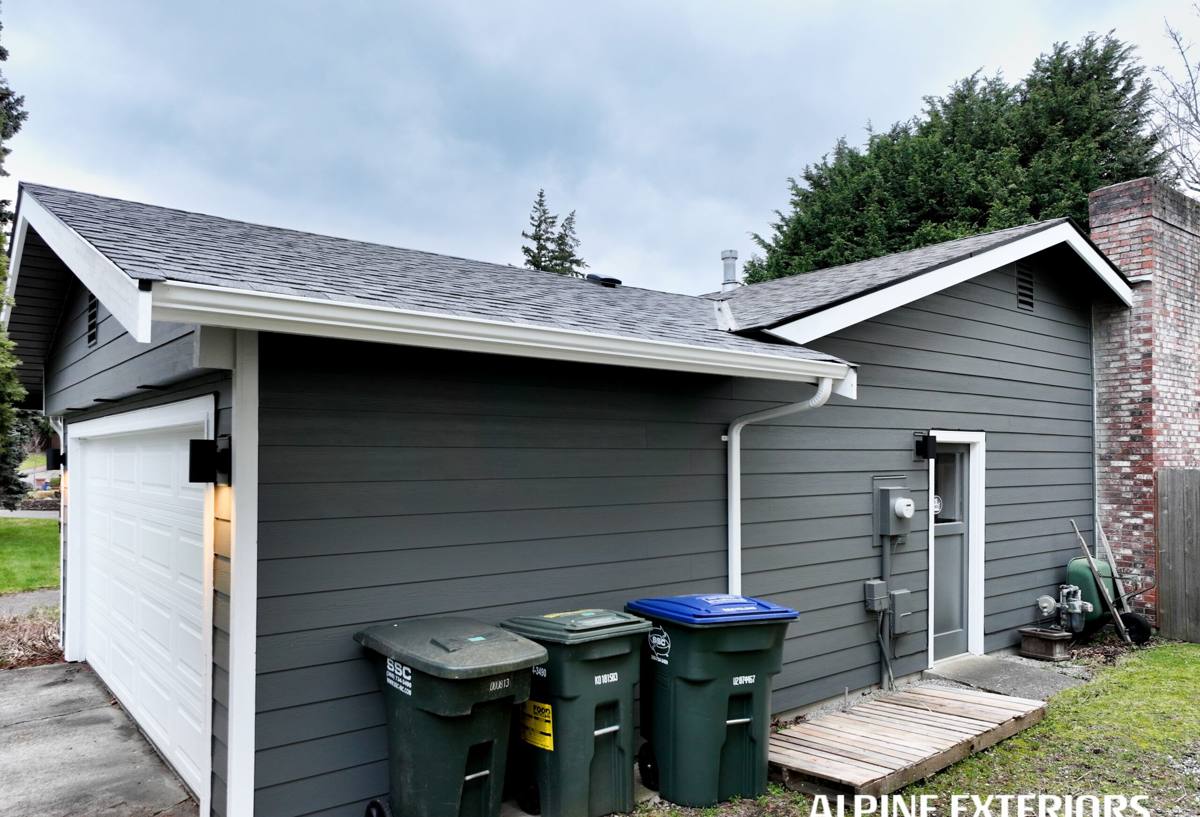
What Lynden's Climate Does to Existing Siding
Wind-Driven Rain Finds the Weak Points
Rain in this part of Whatcom County rarely falls straight down. Wind pushes it sideways into walls, and it finds its way into whatever gaps, cracks, or failed caulk joints already exist in a siding system. On a repair call, that's usually where the real damage started — not at the face of the siding itself, but at a seam, a butt joint, or a trim intersection that stopped shedding water correctly.
A Long Moss and Mildew Season
Shaded walls, tree cover, and near-constant moisture give moss and mildew a season that can run most of the year in Lynden. Staining and organic growth aren't just cosmetic — on porous or damaged siding, they're a sign that moisture is sitting against the surface longer than it should, which accelerates whatever damage is already underway underneath.
Salt Air, Even This Far Inland
Lynden is far enough from the immediate shoreline that salt exposure gets overlooked, but marine air still moves this far inland. Over years it works on fasteners, flashing, and lower-grade trim hardware, and a repair that reuses corroded fasteners or skips proper flashing detail tends to fail again within a few seasons.
Common Siding Problems We See on Lynden Homes
Damage at Corners, Trim, and Butt Joints
These are the seams in any siding system, and they're where water gets in first. A single failed caulk joint or a piece of trim that's pulled away slightly can let moisture behind the cladding for months before it shows up as a visible stain or soft spot.
Impact and Age Damage
Cracked, split, or missing boards from age, impact, or settling are straightforward to spot but not always straightforward to fix correctly — matching an existing profile, color, and reveal takes more care than it looks like from the ground.
Moisture Damage Behind the Siding
The damage that concerns us most isn't always what's visible on the surface. A stained or soft-feeling section of siding can be a sign that water has already reached the sheathing behind it, which turns a simple board swap into a repair that has to address the structure underneath, not just the finish.
Recurring Paint or Finish Failure
Siding that needs repainting more often than it should, or that shows peeling and bubbling in the same spots year after year, usually has a moisture problem driving the finish failure rather than a paint problem on its own.
What a Correct Siding Repair Actually Involves
Diagnosing the Cause, Not Just the Symptom
The most common mistake in siding repair is patching what's visible without figuring out why that section failed in the first place. If the underlying cause — bad flashing, a failed seal, a missing kickout, poor grading against the wall — isn't addressed, the same spot fails again, usually within a wet season or two.
Checking What's Behind the Siding
Any repair involving suspected moisture damage means opening up the affected area to check the condition of the sheathing and house wrap underneath, not just replacing the visible board and moving on. Skipping this step is how a small repair turns into a much bigger problem a couple of years later.
Matching Material, Profile, and Reveal
A patch that doesn't match the surrounding siding's exposure, profile, and finish stands out and can also create a new water-entry point at the transition. Getting this right takes more attention on repair work than on a full re-side, where everything starts from the same batch.
Rebuilding Water Management, Not Just the Surface
Proper flashing, correctly lapped house wrap, and sealed penetrations matter more on a repair than the visible board does. A repair that looks right but skips the water management details behind it is a repair that fails again.
Repair, Patch, or Recommend Replacement?
Not every siding call ends in a repair recommendation, and not every one ends in a push toward full replacement either. We look at how localized the damage is, whether the underlying sheathing is sound, how many prior repairs that section has already had, and what material is actually on the house.
| Factor | Usually Favors Repair | Usually Favors Replacement |
|---|---|---|
| Extent of damage | Isolated to one or two areas | Spread across multiple walls or elevations |
| Sheathing condition | Dry, sound structure behind the damaged section | Soft, stained, or rotted sheathing found on inspection |
| Repair history | First real repair on that section | Same area patched more than once already |
| Existing material | Material and color are still available to match | Discontinued product or a faded finish that won't blend |
| Overall siding age | Siding is otherwise well within its service life | Siding is near or past its expected lifespan house-wide |
We explain what we find on the wall and why, and we'd rather tell a Lynden homeowner honestly that a repair will hold than sell a full re-side that isn't needed yet — or the reverse, when another round of patchwork is really just delaying a bigger bill.
Where James Hardie Fits Into a Repair
Bellingham Roofing Co installs James Hardie fiber cement siding as our standard product, and it's what we use whenever new material goes onto a wall — matching an existing Hardie installation, patching in a section on a home that already has it, or replacing a failed run entirely. If a home has an older siding material that's reached the point of repeated repairs rather than one-off fixes, we'll say so plainly rather than keep patching a product that's working against the homeowner. That's not a sales pitch; it's the same reasoning that led us to standardize on Hardie in the first place — a non-combustible fiber cement core, a factory-applied ColorPlus finish that holds up far longer than field-applied paint, and an HZ5 formulation built for climates with sustained moisture exposure like this one. Those properties matter just as much on a repaired section as they do on a brand-new installation.
Our Siding Repair Process for Lynden Homeowners
Inspection and Diagnosis
We start by looking at the actual damage, checking adjacent areas for related issues, and where warranted, opening up the affected section to check the sheathing and moisture barrier underneath. This is what the estimate is based on, not a guess from the ground.
A Written, Honest Scope
You get a clear explanation of what we found, what's causing it, and what the repair actually involves — including whether we think repair is the right call or whether we'd recommend planning for replacement instead.
The Repair Itself
Work includes removing damaged material, addressing whatever let moisture in to begin with, rebuilding flashing and water management where needed, and installing matching material with the same attention to fastening and sealing we'd use on a new installation.
A Follow-Up Look
Because the real test of a repair is how it holds through a wet season, we stand behind the work and are reachable if something doesn't perform the way it should.
Why a Crew That Already Works in Lynden Matters
A crew that repairs siding across this county through every season sees how salt air, wind-driven rain, and moss actually behave on real houses over years, not just how a product performs on a data sheet. That shows up in practical decisions on a repair call: recognizing which failure patterns are cosmetic and which point to a bigger moisture problem, knowing which flashing details are worth rebuilding properly instead of just resealing, and understanding that an inland valley wall dries differently than a wall closer to open water. It also means being around for a follow-up call if a repair needs a second look, instead of a contractor who did one job in the area and moved on.
What Affects the Cost of a Siding Repair
| Cost Factor | Why It Matters |
|---|---|
| Size and location of the damage | A single accessible board is far less labor than damage spread across multiple walls or high, hard-to-reach areas |
| Hidden moisture damage | Rotted sheathing or framing found during the repair adds scope beyond the visible siding |
| Material matching | Sourcing a discontinued color or profile can add time and sometimes cost compared to an in-stock match |
| Access and elevation | Second-story or steep-grade sections take more setup time than ground-level work |
| Underlying cause | A repair that also requires rebuilding flashing or water management costs more than a straightforward board swap, but it's what keeps the repair from failing again |
Signs It's Time to Call for a Siding Repair Estimate
- A board or panel that's cracked, split, or missing
- Soft or spongy spots when you press on the siding
- Staining or discoloration that returns soon after cleaning
- Paint that's peeling, bubbling, or failing in the same spot repeatedly
- Visible gaps at trim, corners, or butt joints
- Water stains on interior walls near an exterior siding section
- A previous repair that didn't hold through a wet season
Any one of these is worth a professional look before it's left through another Whatcom County winter. Caught early, most of these are a straightforward repair. Left alone, several of them turn into sheathing damage that costs a lot more to fix.
If you're dealing with damaged, stained, or failing siding on a Lynden home, we're glad to take a look and give you a straightforward, honest read on what it actually needs. Reach out using the form below to schedule a free, no-pressure estimate.