 Bellingham Roofing
 Why Sudden Valley Siding Wears Differently Than a Typical Bellingham Lot
Sudden Valley sits along the south end of Lake Whatcom, tucked into wooded, hilly terrain that's noticeably different from an open in-town Bellingham lot. Heavy tree cover means more shade, more standing moisture on north- and west-facing walls, and a longer window each year where siding simply doesn't get a chance to dry out between rain events. Add in the marine air that moves through all of Whatcom County off Bellingham Bay and the Strait, and you've got a climate that's hard on any exterior material — but especially hard on siding that wasn't engineered for sustained moisture exposure.
We've replaced siding on enough homes in this part of the county to know the pattern: it's rarely one catastrophic failure. It's years of moss creeping up from the ground line, paint film breaking down under UV and damp cycles, and butt joints slowly wicking water into the substrate behind them. By the time it's visible from the driveway, the damage is often already a few years old.
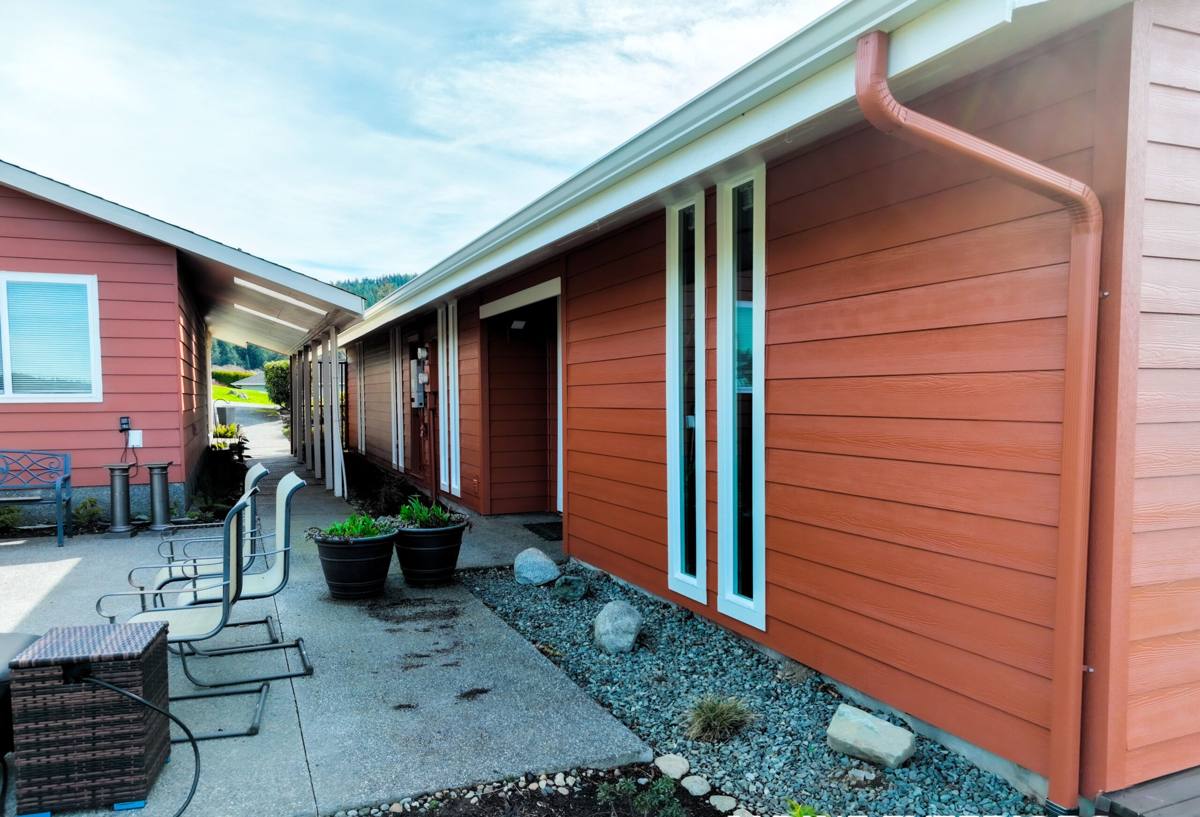
What Failing Siding Looks Like on a Sudden Valley Home
Because of the tree canopy and lake humidity, the failure signs here tend to show up in specific places first:
- Moss or dark green streaking along the lower courses and anywhere a roofline sheds water onto a wall below
- Soft, spongy spots at butt joints and around window and door trim — a sign moisture has already reached the wood or composite behind the siding
- Paint that's chalking, peeling, or has gone flat and dull on shaded, north-facing elevations well before the sunnier sides
- Visible warping or cupping on lap boards, common with older wood or fiberboard products that were never rated for this kind of sustained dampness
- Gaps opening up at seams and corners as the underlying material swells and shrinks with the seasons
Any one of these on its own might just mean a repaint or a few board replacements. Several of them together, especially on a home more than 15-20 years old, usually means the whole siding system has reached the end of its useful life and repairs would just be delaying a full replacement.
Why We Only Install James Hardie Fiber Cement Here
We install James Hardie fiber cement exclusively — not vinyl, not LP SmartSide, not Cemplank, not Allura, not primed spruce or cedar. That's not a marketing position, it's a decision based on what actually holds up in a climate like this one.
Fiber cement is non-combustible and dimensionally stable, meaning it doesn't expand, contract, warp, or rot the way wood-based products can when they're exposed to years of shade and moisture. James Hardie's ColorPlus factory-applied finish is baked on and backed by its own finish warranty, which matters in a shaded, damp environment where field-applied paint tends to fail faster than the label suggests. Hardie also builds its products in climate-specific formulations — engineered differently for regions with hard freeze-thaw cycles versus the milder, wetter coastal climate we have here in Whatcom County — so the board reaching a Sudden Valley job site is actually matched to the conditions it has to survive.
We're not going to tell you every other product is junk. Vinyl is inexpensive and low-maintenance in the right setting; wood has a look a lot of people love; engineered wood products have improved over the years. But we've made a professional call that on shaded, moisture-heavy lots like the ones common around the lake, the long-term maintenance burden and moisture risk of those alternatives isn't worth it compared to what fiber cement delivers, and we'd rather stand behind one product system we trust completely than install several we have reservations about.
What a Correct Siding Replacement Actually Involves
Siding is a system, not just a set of boards. A replacement done right on a Sudden Valley home includes:
- Full tear-off and inspection of the sheathing underneath — this is where hidden rot from years of trapped moisture usually shows up
- Repair or replacement of any damaged sheathing and framing before a single new board goes up
- A correctly installed weather-resistive barrier (house wrap) with proper overlap and taping at seams
- Rain screen or drainage gap detailing where the wall assembly calls for it, so bulk water has somewhere to go instead of sitting against the back of the siding
- Correct flashing at every window, door, and roof-to-wall transition — the majority of siding failures we find trace back to bad or missing flashing, not the siding material itself
- Manufacturer-spec fastening pattern and clearances, including the ground-to-siding clearance that keeps splashback and moss from creeping up the bottom course
- Factory-finished ColorPlus boards installed with minimal field caulking, since over-reliance on caulk is itself a common point of future failure
Skipping any one of these steps is how a siding job looks fine for a year or two and then starts failing early — usually right where the shortcuts were taken.
Access and Site Considerations Specific to Sudden Valley
Wooded, sloped lots and Sudden Valley's privately maintained community roads mean staging and scheduling take a bit more planning than a flat in-town job. We account for that up front — material staging, dumpster or debris hauling routes, and coordinating around community guidelines — so it doesn't turn into a delay once we're mid-project.
Our Process, Start to Finish
- On-site assessment — we walk the exterior, check for moisture intrusion at trim and penetrations, and look at what's actually happening behind the current siding wherever we can access it
- Written scope and estimate — a clear breakdown of what's being replaced, what product and color, and what the sheathing/framing contingency looks like if we find hidden damage
- Tear-off and inspection — old siding comes off, sheathing gets inspected board by board, and any rot gets addressed before we move forward
- Weather barrier and flashing — house wrap, drainage detailing, and flashing go in correctly at every penetration and transition
- Hardie installation — fastened and finished to manufacturer spec, with trim and caulking kept to what's actually necessary
- Final walkthrough — we go over the finished job with you before we consider it done
What Drives Cost on a Job Like This
| Factor | Why It Matters |
|---|---|
| Tear-off vs. new construction | Removing and disposing of old siding adds labor and haul-away cost versus a bare-sheathing install |
| Hidden sheathing/framing damage | Rot found during tear-off has to be repaired before new siding goes on — this is the most common source of a mid-project cost adjustment |
| Home size and wall complexity | More corners, dormers, and trim details mean more cutting, fitting, and labor time |
| Siding profile | Lap, shingle, and panel styles each require different labor and trim approaches |
| Story height and access | Second-story and steep-lot work requires more scaffolding/staging time |
| Color and trim package | Standard ColorPlus colors versus custom trim details affect material cost |
We won't quote a number without seeing the home, but this is the honest list of what actually moves the price up or down — not vague line items.
What to Check Before Hiring Anyone for Siding Work Out Here
- Are they licensed and insured in Washington, and will they show you proof without you having to ask twice?
- Do they inspect and photograph sheathing condition during tear-off, or do they just cover it back up?
- Can they explain their flashing and drainage detailing in plain terms, not just "we caulk everything"?
- Do they have experience with the specific access and scheduling realities of working in a lake-side, wooded community?
- Is the manufacturer warranty registered in your name after the job, with installation done to that manufacturer's published spec?
Living With Hardie Siding After Installation
One of the practical advantages of ColorPlus-finished fiber cement is how little upkeep it asks for compared to repainting cycles on wood or engineered wood siding. That said, no siding is maintenance-free in a climate this wet. We'd still recommend an annual walk-around: check that gutters are directing water away from walls rather than overflowing onto them, keep tree branches and shrubs from holding moisture against the siding, and address any moss or algae on nearby roof or hardscape surfaces before it spreads onto walls. None of that is Hardie-specific — it's just what living under this much tree cover and rainfall requires, whatever the siding.
Get a Straight Answer About Your Home
If your Sudden Valley home is showing moss buildup, soft spots, or paint that just won't hold anymore, it's worth having someone look at it before winter's rain settles back in. We'll walk the exterior with you, tell you plainly what we find, and give you a free, no-pressure estimate — no obligation, no pressure to sign anything on the spot.